8 Tips to Find the Best Time to Post Social Media in 2025
Unlock peak engagement by finding the best time to post social media. Our 2025 guide covers platform-specific windows and data-driven scheduling tips.
You've crafted the perfect post—witty caption, stunning visual, and a compelling call-to-action. You hit 'publish' and… crickets. The culprit likely isn't your content; it's your timing. Posting at the wrong moment means your message gets buried before your audience even has a chance to see it. The key to unlocking viral reach and skyrocketing engagement isn't just what you post, but when you post.
Generic advice to 'post at 9 AM' is outdated. A smarter strategy involves understanding user behavior, leveraging platform-specific data, and aligning your schedule with your unique audience's habits. This guide breaks down eight proven timing strategies, moving beyond the basics to give you actionable insights for each major platform. We'll explore the 'why' behind peak engagement windows and show you how to find the best time to post social media for your specific goals.
To truly stop guessing and start leveraging data, consider reviewing our comprehensive guide on the 7 best times to post on social media in 2025 for broader insights. By implementing these tailored approaches, you can transform your content from unseen to unmissable. Let's dive into the specific windows and strategies that will maximize your impact.
1. The 9 AM Weekday Power Hour
The "9 AM Weekday Power Hour" refers to the peak engagement window between 8 AM and 10 AM on weekdays, specifically Tuesday through Thursday. This timeframe capitalizes on a common daily routine: people checking their phones during their morning commute, while drinking coffee, or just before settling into their workday. Posting during this period ensures your content is one of the first things your audience sees.
This strategy is effective because it targets users when they are mentally fresh and actively seeking information or a quick dose of inspiration to start their day. It's a prime opportunity to capture attention before the daily flood of meetings and tasks begins. Determining the best time to post on social media often starts with understanding these universal behavioral patterns.
Why It Works: Real-World Success
Major brands and platforms have identified this morning window as a high-impact zone. For instance, LinkedIn's own data highlights that B2B engagement is highest between 8 AM and 10 AM on weekdays. Similarly, marketing giant HubSpot found its own content performs best when posted at 9 AM EST, aligning perfectly with the morning routine of its professional audience.
Key Insight: This early-morning slot is less about entertainment and more about providing value. Users are in a "get ready for the day" mindset, making them receptive to educational, motivational, or news-worthy content.
How to Implement This Strategy
To make the most of the 9 AM Power Hour, you need a precise and consistent approach.
- Pinpoint Your Audience's Time Zone: If your followers are spread globally, focus on the primary time zone of your most engaged segment. Use your platform's analytics to identify where the majority of your audience lives.
- Test and Refine: Don't just stick to 9 AM. Experiment by posting at 8:30 AM one week and 9:30 AM the next. Monitor your engagement metrics to discover the exact sweet spot for your specific followers.
- Automate with Scheduling Tools: Manually posting at 9 AM every day isn't always practical. Use a social media scheduling tool to queue your content in advance, ensuring you never miss this valuable window.
- Align Content with Morning Mindset: Share content that is easy to digest. Think quick tips, inspiring quotes, industry news, or a thought-provoking question to kickstart a conversation.
2. The 1-3 PM Lunch Break Window
The "1-3 PM Lunch Break Window" is a critical engagement period that targets users during their midday break from work or school. This timeframe, typically between 12 PM and 3 PM on weekdays, captures a massive audience that is actively scrolling through social media feeds to unwind, catch up on news, or simply disconnect from their professional tasks.
This strategy is highly effective because it aligns with a predictable daily habit. People use their lunch break as a mental reset, making them more receptive to entertaining, lighthearted, or visually engaging content. Understanding the best time to post on social media involves recognizing these natural pauses in a user's day, and the lunch hour is one of the most consistent.
Why It Works: Real-World Success
Many B2C brands and publishers have mastered this midday slot. BuzzFeed, for example, often sees its viral quizzes and listicles peak in engagement around 1 PM on weekdays as people look for a quick distraction. Food-focused brands like Chipotle also leverage this window, seeing massive engagement with posts around 12:30 PM, just as their audience is thinking about lunch.
Key Insight: The lunch break window is ideal for content that is easily and quickly consumed. Users are looking for entertainment and escape, not complex or work-related information. This is the prime time for memes, short videos, and interactive content.
How to Implement This Strategy
Capitalizing on the lunch break requires content that is both timely and appropriate for a mental break.
- Align Content with a Midday Mindset: Post lighter, easily digestible content. This is the perfect time for polls, questions, behind-the-scenes photos, or entertaining short-form videos that don't require deep concentration.
- Test the Exact Lunch Hour: While 1-3 PM is a general guide, your specific audience's lunch patterns may differ. Test posting at 12 PM, 1 PM, and 2 PM in their primary time zone to see which slot generates the most interaction.
- Lean into Relevant Themes: Consider content themes that align with the break, such as food, lifestyle, travel, or humor. This makes your post feel more native to the user's current state of mind.
- Use Interactive Features: Leverage features like Instagram Stories polls or Twitter questions to boost engagement. Users are more likely to tap a quick poll button during a break than to type out a long comment.
3. The 7-9 PM Evening Engagement Zone
The "7-9 PM Evening Engagement Zone" targets users during their prime relaxation hours. This window captures audiences after dinner and daily responsibilities are complete, when they are most likely to be scrolling through social media to unwind, catch up, and be entertained. Posting during this period taps into peak activity levels across most major platforms.
This strategy is effective because it aligns with a user’s relaxed mindset. Unlike the morning rush, evening users have more time for deeper engagement, such as watching long-form videos, reading detailed captions, and interacting with community-focused content. Understanding this behavioral shift is crucial for determining the best time to post on social media for maximum impact.
Why It Works: Real-World Success
Entertainment giants have mastered this evening window. Netflix and Disney+ consistently announce new shows or drop trailers around 8 PM, capitalizing on when their audience is most likely to be thinking about what to watch. Similarly, data shows that Instagram Reels posted around 7 PM can receive significantly higher viewership, and Facebook video content often performs best between 8 PM and 9 PM.
Key Insight: The evening slot is less about information and more about connection and entertainment. Users are seeking escapism, humor, and community, making them highly receptive to visually compelling and emotionally resonant content.
How to Implement This Strategy
To succeed in the evening engagement zone, your content needs to stand out and invite interaction.
- Focus on High-Value Entertainment: This is the prime time for your best content. Use high-quality visuals, compelling videos, and engaging storytelling that encourages likes, comments, and shares.
- Be Present and Engage: Don't just post and ghost. Be active in the comments for the first hour after posting to foster a sense of community and boost your content's visibility in the algorithm.
- Encourage Discussion: Plan content that sparks conversation. Ask questions, run polls, or post about a trending topic to get your audience talking. This is a core tactic for anyone learning how to increase social media engagement.
- Test Platform-Specific Times: While 7-9 PM is a strong general window, test to see if 7:30 PM works better on Instagram while 8:30 PM is superior for your Facebook audience. Use analytics to refine your timing.
4. The Tuesday-Thursday Sweet Spot
The "Tuesday-Thursday Sweet Spot" is the widely recognized principle that mid-week days offer the highest engagement potential. This strategy avoids the "Monday morning catch-up" chaos and the "Friday afternoon check-out" mentality, positioning your content when audiences are settled into their weekly routine and most receptive to new information.
This approach works by targeting users when their focus is high and distractions are relatively low. Mondays are often consumed by planning and meetings, while Fridays are marked by a wind-down for the weekend. Tuesday, Wednesday, and Thursday represent the core of the workweek, where people are actively engaged, productive, and scrolling their feeds for industry insights and valuable content. Understanding this rhythm is crucial for determining the best time to post on social media.
Why It Works: Real-World Success
This mid-week phenomenon is consistently validated by data across different industries. For example, email marketing giant Mailchimp has reported that campaigns sent on Tuesdays and Thursdays often see significantly higher open rates. Similarly, Salesforce data indicates that LinkedIn engagement for B2B content often peaks on Wednesdays, when professionals are deep into their workweek challenges and solutions.
Key Insight: The mid-week window is ideal for content that requires more cognitive engagement. Users are in a professional and productive mindset, making them more likely to read articles, watch webinars, or engage with in-depth educational posts.
How to Implement This Strategy
To leverage the Tuesday-Thursday Sweet Spot, focus on delivering your most important content during this period.
- Save Major Announcements for Mid-Week: Launch a new product, share a major company update, or post your most valuable content on a Tuesday or Wednesday to maximize visibility and impact.
- Use Monday for Teasers: Build anticipation by using Monday to post "coming this week" teasers or reminders about the valuable content you plan to share on Tuesday or Wednesday.
- Focus on Educational Content: Align your posts with the audience's mindset. Share how-to guides, industry analyses, case studies, or thought leadership pieces that provide tangible value during their most productive days.
- Combine with Time-of-Day Strategies: This strategy is most powerful when paired with a time-specific one. Posting at 9 AM on a Tuesday combines the power of the morning routine with the peak engagement of a mid-week day.
5. The Weekend Discovery Hours (Saturday 10 AM - 12 PM)
The "Weekend Discovery Hours" refers to the prime engagement window between 10 AM and 12 PM on Saturdays. This timeframe captures a unique audience mindset: users are relaxed, off the clock, and leisurely scrolling through their feeds. Instead of rushing to work, they are actively looking for inspiration, entertainment, and content to shape their weekend plans.
Posting during this period allows lifestyle, travel, and entertainment brands to connect with an audience that has more time and mental space for deeper engagement. Knowing the best time to post on social media isn't just about weekdays; it involves understanding these crucial weekend moments when users are more receptive to discovery and aspirational content.
Why It Works: Real-World Success
Brands that align with a weekend lifestyle see massive success in this slot. For example, Airbnb’s posts featuring dream destinations often see significantly higher engagement on Saturday mornings as people plan future getaways. Similarly, Food Network's recipe videos peak during this time, inspiring followers' weekend cooking adventures. Fitness brands like Peloton also notice engagement spikes as users look for motivation for their weekend workouts.
Key Insight: This window is less about urgent news and more about inspiration and leisure. Users are in a "discovery" mode, making them highly receptive to visually appealing, aspirational, and longer-form content like videos or detailed guides.
How to Implement This Strategy
To effectively leverage the Weekend Discovery Hours, your content and timing must be perfectly aligned with a leisurely mood.
- Focus on Lifestyle and Aspiration: Share high-quality visuals that inspire weekend activities. This could be anything from a beautiful travel destination to a delicious brunch recipe or a DIY home project.
- Showcase Behind-the-Scenes Content: Weekends are a great time for more personal, authentic content. Share a look at your team, your creative process, or a day in the life to build a stronger community connection.
- Engage with User-Generated Content: Encourage followers to share their weekend experiences using your branded hashtag. Resharing their content during this window creates a powerful sense of community and social proof.
- Test Saturday vs. Sunday: While Saturday is often the peak, some audiences are more active on Sunday mornings. Test both days between 10 AM and 12 PM to see which yields better results for your specific followers.
6. Platform-Specific Optimization Strategy
A Platform-Specific Optimization Strategy moves beyond one-size-fits-all advice, acknowledging that each social media channel has its own unique user base and rhythm. It involves tailoring your posting schedule to the specific behavioral patterns of each platform's audience, as what works on LinkedIn is unlikely to yield the same results on TikTok. This approach maximizes reach and engagement by aligning your content with when users are most active and receptive on a given network.
This method is crucial because it respects the distinct culture and algorithm of each platform. For example, a B2B audience browses LinkedIn during work hours, while a lifestyle and DIY audience might scroll through Pinterest on a weekend evening. Understanding the best time to post on social media requires this granular, platform-by-platform analysis for truly effective results.
This quick reference summarizes the general peak engagement windows for three major platforms.
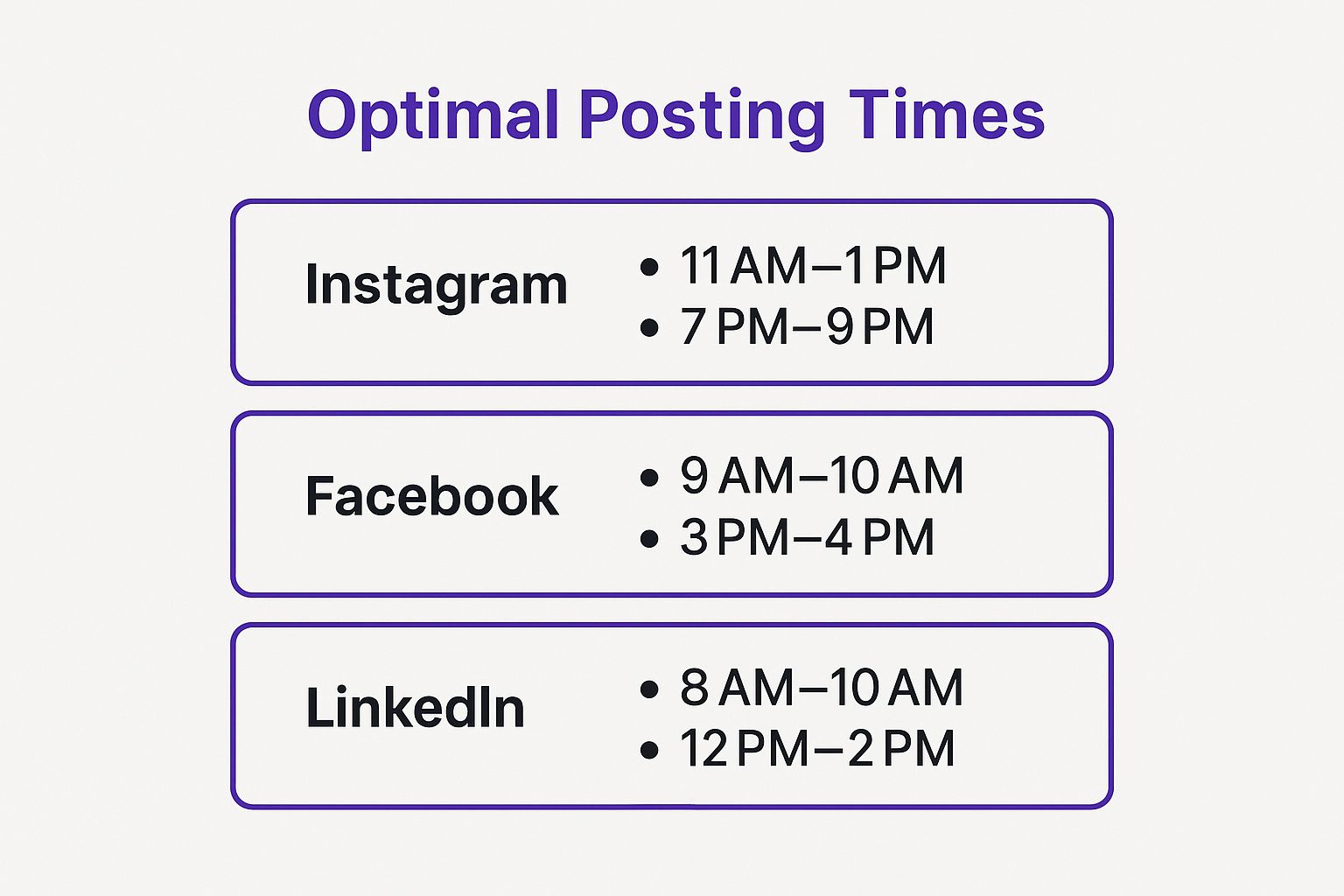
The data clearly shows how user behavior shifts, with professional networks peaking during business hours and more entertainment-focused platforms gaining traction during commuter times and evenings.
Why It Works: Real-World Success
Leading social media management tools like Hootsuite, Buffer, and Sprout Social built their analytics around this very principle. Their data consistently shows that different platforms have wildly different peak times. For example, Later's analysis reveals that early morning (6-10 AM) and late evening (7-9 PM) are golden hours for TikTok, while B2B brands on LinkedIn see the highest interaction at 7:45 AM and 5:45 PM. These companies prove that a platform-centric approach is non-negotiable for success.
Key Insight: Don't syndicate the same post at the same time across all channels. Treat each platform as a unique opportunity and customize your timing and content format to match its audience's expectations.
How to Implement This Strategy
A successful platform-specific strategy requires a data-driven and organized approach.
- Dive into Platform Analytics: Use the native analytics tools on Instagram, Facebook, and LinkedIn to find out exactly when your followers are most active. This is the most reliable source of truth.
- Adapt Content to Timing: Schedule professional, value-driven content for LinkedIn during work hours. Post visually engaging, inspirational, or entertaining content on Instagram during evening scroll times.
- Test and Validate: Commit to testing different posting times on each platform for at least two to four weeks. Document your engagement rates to establish a clear pattern before setting a permanent schedule.
- Use a Multi-Platform Scheduler: Tools like Repostly allow you to efficiently schedule unique posts for different platforms at their respective optimal times from a single dashboard, saving you time and effort. Beyond just timing, a comprehensive approach to social media marketing involves exploring effective social media strategies for various platforms.
7. Audience Timezone Mapping Strategy
The Audience Timezone Mapping Strategy moves beyond generic advice by focusing on your specific followers' locations and active hours. Instead of posting based on broad national averages, this approach involves analyzing your audience's geographic distribution and scheduling content for the peak times in their respective time zones. This ensures your posts go live when your most valuable demographic clusters are actually online and ready to engage.
This targeted method is crucial for global brands or businesses with a dispersed customer base. It acknowledges that the best time to post on social media isn't a single universal slot but a series of coordinated windows tailored to different segments. By meeting your audience where they are, you drastically increase the likelihood of visibility and interaction before the content gets buried in the feed.
Why It Works: Real-World Success
Global brands excel with this strategy. For instance, a global SaaS company like Slack doesn't just post during U.S. business hours; it maps content to the morning routines of its primary user hubs in North America, Europe, and Asia-Pacific. Similarly, Coca-Cola often aligns its social media campaigns with regional consumption patterns, posting when people in a specific country are most likely on a lunch break or unwinding in the evening.
Key Insight: This strategy transforms your social media from a monologue into a series of localized conversations. It shows your audience that you understand their daily rhythm, which fosters a stronger connection and brand loyalty.
How to Implement This Strategy
Successfully mapping your content to various time zones requires data and careful planning.
- Identify Audience Clusters: Use your platform’s built-in analytics (like Instagram Insights or Facebook Audience Insights) to see where your followers are located. Identify the top 2-3 cities or countries that represent the bulk of your audience.
- Create Timezone-Specific Schedules: Don't try to find one time that fits all. Instead, schedule the same or similar posts multiple times to hit the peak engagement hours (e.g., 9 AM) in each key timezone.
- Use Advanced Scheduling Tools: Managing multiple time zones manually is nearly impossible. Using tools that can handle sophisticated scheduling across different regions is essential. If you need tips on this, you can learn more about how to manage multiple social media accounts effectively.
- Test and Iterate: Monitor the performance of your posts in each geographic segment. You may find that your London audience is most active at 8 AM GMT, while your New York followers engage most at 10 AM EST. Adjust your schedule based on this data.
8. The Real-Time Engagement Approach
The Real-Time Engagement Approach flips the script on scheduled posting, arguing that the context of the moment is more important than the time on the clock. This strategy prioritizes immediate, authentic interactions and capitalizing on trending topics as they happen. Instead of waiting for a predetermined slot, you post when conversations are already at their peak.
This method moves away from finding the single best time to post on social media and instead focuses on being part of the cultural zeitgeist. It's about joining relevant conversations, which can lead to massive organic reach and build a strong, relatable brand personality. The goal is to be timely and relevant, making your brand a participant in culture, not just an advertiser.
Why It Works: Real-World Success
This approach has created some of social media's most iconic marketing moments. Oreo’s "You can still dunk in the dark" tweet during the 2013 Super Bowl blackout is a classic example of turning an unexpected event into a viral win. Similarly, Wendy’s has built an entire brand identity around its witty, real-time Twitter roasts and responses to users and other brands.
Key Insight: Real-time engagement is about authenticity and speed. It demonstrates that your brand is listening and is agile enough to join a conversation in a meaningful way, which resonates deeply with modern audiences.
How to Implement This Strategy
Successfully executing a real-time strategy requires preparation and a clear process.
- Set Up Social Listening: Use tools like Brand24 or Sprout Social to monitor keywords, hashtags, and trending topics relevant to your industry. This allows you to spot opportunities as they emerge.
- Prepare Flexible Templates: Create a bank of pre-approved visual and copy templates. This enables your team to quickly adapt content for a breaking trend without starting from scratch.
- Establish a Rapid Approval Process: Real-time moments disappear quickly. Have a streamlined approval workflow in place so you can get content live within minutes, not hours.
- Focus on Genuine Interaction: Don't just push promotional content. Your primary goal should be to add value, humor, or a unique perspective to the ongoing conversation. Ask questions, respond to comments, and engage like a person, not a bot.
Best Time to Post: 8-Point Strategy Comparison
| Strategy | 🔄 Implementation Complexity | 💡 Resource Requirements | 📊 Expected Outcomes | 💡 Ideal Use Cases | ⭐ Key Advantages |
|---|---|---|---|---|---|
| The 9 AM Weekday Power Hour | Medium - consistent scheduling & timezone adjustments | Moderate - scheduling tools recommended | High morning engagement, better B2B CTR | B2B, working professionals, commuters | High alertness audience, cross-platform reach |
| The 1-3 PM Lunch Break Window | Low - fixed midday posting | Low - simpler content, less production | Good engagement, higher video completions | General consumers, office workers, mobile-first | Natural break, higher dwell time |
| The 7-9 PM Evening Engagement | Medium-High - quality visual/video content | High - video production, active engagement needed | Highest daily engagement & sharing rates | Entertainment, lifestyle, community building | Peak social activity, strong sharing & comments |
| The Tuesday-Thursday Sweet Spot | Low - stable midweek posting | Low - routine scheduling | Predictable, steady engagement | B2B, professional audiences, regular users | Consistent rates, lower competition midweek |
| Weekend Discovery Hours (Sat 10 AM -12 PM) | Low-Medium - weekend timing | Moderate - lifestyle/aspirational content | Moderate engagement, higher content discovery | Lifestyle, millennials, weekend active users | Relaxed mindset, less business competition |
| Platform-Specific Optimization | High - complex multi-platform scheduling | High - analytics, content customization | Maximized platform-specific reach and engagement | Multi-platform marketers, data-driven strategies | Algorithm alignment, efficient content use |
| Audience Timezone Mapping | High - analytics driven, geographic segmentation | High - robust analytics tools & ongoing monitoring | Highly relevant engagement, better ROI | Global brands, location-specific businesses | Personalized timing, competitive advantage |
| The Real-Time Engagement Approach | Very High - ongoing monitoring & rapid response | Very High - social listening, flexible content | Viral moments, authentic community growth | Trend-savvy brands, entertainment, consumer brands | Capitalizes on trends, high organic reach |
Automate Your Perfect Timing and Get Your Time Back
Cracking the code on the best time to post on social media can feel like the difference between shouting into a void and sparking a viral conversation. Throughout this guide, we've explored the universal windows of opportunity, from the 9 AM weekday power hour to the weekend discovery hours, and delved into platform-specific nuances that give you a competitive edge. We've moved beyond generic advice to show how mapping your audience's timezones and embracing real-time engagement can transform your results.
But let's be realistic. Manually juggling optimal posting times for Instagram, TikTok, LinkedIn, and Facebook is a fast track to burnout. True social media mastery isn't just about knowing the right time to post; it's about building a sustainable system that executes this strategy flawlessly, day in and day out. This is where strategic automation becomes your most valuable asset.
From Data-Driven Insights to Effortless Execution
The core lesson is this: while general guidelines provide a fantastic starting point, your own data is the ultimate source of truth. The most powerful strategy is one that evolves with your audience.
Here are the key takeaways to turn into your action plan:
- Start with the Framework: Use the popular windows like the Tuesday-Thursday sweet spot and the 1-3 PM lunch break as your initial testing ground. They are popular for a reason and provide a solid baseline.
- Analyze Your Own Analytics: Dive into your native platform analytics. Identify which posts generated the most engagement and note the day and time they were published. Look for recurring patterns that are unique to your followers.
- Segment and Conquer: Don't treat your audience as a monolith. If you have significant follower segments in different time zones, create a posting schedule that caters to each group's peak activity hours.
The Power of Smart Automation
Once you've identified your unique peak engagement windows, the next step is to reclaim your time. Instead of setting alarms and manually posting content, you can build a content calendar that works for you. To truly streamline your scheduling and ensure consistent optimal posting, consider investing in dedicated social media automation software. These tools allow you to schedule weeks or even months of content in advance, ensuring you never miss a golden opportunity.
Ultimately, understanding the best time to post on social media is about working smarter, not harder. It’s about leveraging data to make informed decisions and then using technology to execute that strategy with precision. By doing so, you free yourself from the tyranny of the clock and unlock the mental space to focus on what truly matters: creating valuable content that resonates with your audience and builds a thriving community.
Ready to stop guessing and start scheduling with data-backed precision? Repostly’s unified analytics dashboard helps you pinpoint your unique best times to post across all platforms. Schedule your content for those peak windows in minutes and let our automation do the heavy lifting. Sign up for Repostly today and get your time back!
Keep reading
10 Fresh Instagram Story Idea Tactics for 2025
Stuck for content? Discover our top Instagram story idea list, with actionable tips to boost engagement and grow your audience in 2025.
A Practical Social Media Planner for German Markets
Build a results-driven social media planner for Germany. This guide offers actionable strategies for content, scheduling, and analysis in the German market.

Crafting Your Social Media Content Plan
Stop guessing and start strategizing. This guide provides an actionable social media content plan to audit, plan, and execute content that gets results.
Post once. Show up everywhere.
Start your 7-day free trial and publish your next video to every platform in minutes.Pick a plan and publish your next video to every platform in minutes.
Start your free trialSee plansCancel anytime