A Practical Social Media Planner for German Markets
Build a results-driven social media planner for Germany. This guide offers actionable strategies for content, scheduling, and analysis in the German market.

Think of a social media planner as less of a to-do list and more of a strategic blueprint. It's what separates random acts of posting from a cohesive, goal-driven social media strategy. This plan dictates what you'll share, when it goes live, and on which platforms, giving you a clear path to consistent growth and real engagement.
Laying the Groundwork for Your Planner

Before a single post gets scheduled, your planner needs a solid strategic foundation. It's tempting to jump straight into creating fun content, but that's like trying to build a house without pouring the concrete first—it's just not going to hold up. This foundational stage ensures every post you create has a clear purpose and pushes you closer to your bigger business goals.
First things first: your social media activity has to connect to tangible business outcomes. What are you actually trying to achieve? Are you looking to build brand awareness, drive more traffic to your website, or get more direct sales? Your answer here will shape everything that follows.
For instance, a brand laser-focused on generating website traffic will naturally prioritise posts with strong calls-to-action and direct links. On the other hand, if brand awareness is the name of the game, you'll want to focus on highly shareable content like slick infographics or snappy videos.
Start With an Honest Social Media Audit
To figure out where you're going, you need to know exactly where you are right now. A social media audit gives you a clear snapshot of your current performance, showing you what’s hitting the mark with your audience and what’s falling completely flat. This isn't about being critical; it’s about collecting the data you need to make smarter moves.
A great place to start is by digging into your key metrics on each platform using Repostly’s unified analytics dashboard. Take a good look at:
- Top-Performing Posts: Pinpoint the content that got the most likes, shares, and comments. Can you see any common themes or formats?
- Audience Demographics: Who are you reaching? Does this profile match your ideal customer?
- Engagement Rates: Work out the average engagement rate for your posts. This gives you a solid baseline to measure future success against.
This audit will almost certainly uncover some valuable nuggets of information. You might find out that your audience in Germany responds far better to video content on Facebook than they do to static images on Instagram—a crucial insight for planning your content calendar.
The biggest mistake I see people make is skipping the audit. Without this initial data, your entire planner is built on guesswork, not evidence. Taking the time to analyse your past performance is hands-down the most effective thing you can do to improve your future strategy.
Define Your German Target Audience
It's vital to understand the unique landscape of the German market. While internet usage is widespread, social media adoption is actually lower than in many other European countries. Research shows that while 93% of German adults are online, only around 51% are active on social media platforms. This gap means you need a highly targeted approach, not a one-size-fits-all strategy.
A core part of building a strong social media plan is getting crystal clear on who your ideal customer is. For some hands-on advice on this, check out this guide on how to identify your target audience. You'll want to create detailed buyer personas that go way beyond just age and location.
Think about their online habits, which platforms they prefer, and what their main pain points are. Are they professionals scrolling through LinkedIn for industry news, or are they younger consumers looking for entertainment on TikTok? Having this level of clarity ensures your content speaks directly to the people who are most likely to become customers.
See What the Competition Is Up To
Finally, it's time to take a peek at what your competitors are doing. A competitor analysis isn't about copying their every move; it's about spotting opportunities and finding gaps in the market. What are they doing really well? And more importantly, where are they dropping the ball?
You can use Repostly to track their most successful content and spot patterns in their engagement. Maybe you'll notice they’re completely overlooking a key content pillar or ignoring a platform that's gaining traction. This analysis gives you that final layer of strategic insight, making sure your social media planner is not only well-organised but also smart and competitive.
Picking Your Platforms and Defining Your Content Pillars
Alright, you've done your homework on your audience and competitors. Now for the fun part: deciding where you'll show up and what you'll talk about. This is where your planner starts to feel less like a calendar and more like a strategic roadmap.
It's tempting to want to be everywhere at once, but that's a surefire way to spread yourself too thin. The goal is to focus your energy on the platforms where your ideal German customers are already spending their time. This targeted approach is always more effective.
And the opportunity in Germany is massive. As of early 2025, there were about 65.5 million social media users across the country—that's roughly 77.6% of the entire population. Even a platform like Facebook, which some might consider "older," still has around 44.2 million German users. You can dig into more of these numbers in the latest report on Germany's digital landscape.
Where to Play: Selecting Platforms for the German Market
Choosing your social channels shouldn't be a guess. It has to be a deliberate decision based on the audience research you’ve already completed. Where are your buyer personas actually scrolling? A B2B software company in Munich will almost certainly get more traction on LinkedIn and XING, whereas a fashion brand targeting students in Berlin needs to be all over Instagram and TikTok.
Here are a few things to chew on for each platform you're considering:
- Who’s there? Does the platform's main German user base match your target customer profile?
- What works? Are you set up to create the type of content that thrives there? If you’re brilliant at short-form video, TikTok is calling your name. If you're better at thoughtful, written pieces, then LinkedIn articles are your best bet.
- What's the goal? Is the platform built to help you hit your targets? For driving online sales, the visual, shoppable experience on Instagram and Pinterest is hard to beat.
A piece of advice I always give: It's far better to be a big fish in a small pond. Master one or two platforms where your audience lives rather than being a ghost on five different ones. Your time and budget are precious, so put them where you'll see a real return.
To make this a bit more tangible, let's break down some of the major players for the German market.
Platform Selection Framework for the German Market
This table is a simple but effective way to compare your options at a glance. It helps you move past assumptions and make a strategic choice based on who you're trying to reach and what you want to achieve.
| Platform | Primary German User Base | Best Content Formats | Business Suitability |
|---|---|---|---|
| Broad, all age groups, strong in 30-50 demographic | Videos, Links, Community Groups, Events | Excellent for community building and local business engagement. | |
| Younger demographic (18-34), visually-driven | High-quality Photos, Reels, Stories | Ideal for B2C brands in fashion, food, travel, and lifestyle. | |
| LinkedIn/XING | Professionals, B2B decision-makers | Articles, Industry News, Company Updates, Professional Insights | Essential for B2B marketing, recruitment, and professional networking. |
| TikTok | Primarily Gen Z and younger millennials | Short-form, entertaining, and trend-based videos | Great for brands wanting to show a more creative, informal personality. |
Using a framework like this ensures your social media plan is built on a solid foundation, focusing your efforts on channels that give you the best shot at success.
Finding Your Voice: Establishing Core Content Pillars
Once you know where you'll be posting, you need to decide what you'll be posting. This is where content pillars come in. Think of these as the 3-5 core topics your brand will own. They are the foundation of your content strategy, giving it structure and purpose.
Without pillars, your social media feed can quickly become a chaotic mix of random ideas. Pillars create a consistent narrative that helps your audience understand who you are and what you stand for, which is how you build real trust.
Let's imagine you run a sustainable-living shop in Berlin. Your content pillars might look something like this:
- Eco-Product Spotlights: Showcasing your items and their green credentials.
- Zero-Waste Living Tips: Giving practical, everyday advice.
- Meet Our Local Makers: Telling the stories of the people behind your products.
- Community Action: Highlighting local environmental events or partnerships you're involved in.
These pillars become your guide for everything you create. When it's time to fill out your social media planner in a tool like Repostly, you're not starting from a blank slate. You're just brainstorming ideas that fit neatly under each category. This simple structure makes your workflow so much smoother and ensures your audience always knows what kind of value they can expect from you.
Structuring Your Content Calendar and Workflow
Alright, this is where the rubber meets the road. All that strategic thinking now becomes a real, actionable plan for your day-to-day social media. Your content calendar is the heart of your social media planner, turning those brilliant ideas into a steady flow of great content. It’s your command centre, giving you a clear view of what’s coming up and when.
The point isn't just to fill up empty squares on a calendar. It's about crafting a balanced mix of content that actually serves your audience while also hitting your business goals. A solid calendar eliminates that last-minute panic of, "What on earth are we posting today?" and ensures you maintain the kind of steady presence that builds real momentum.
Establishing Your Content Mix and Posting Frequency
One of the biggest mistakes I see brands make is treating their social media like one long, drawn-out advertisement. If you want to build an engaged community, you’ve got to offer more than just sales pitches. A balanced approach means you’re giving value, building relationships, and then, yes, gently guiding people toward a purchase.
A solid, battle-tested content mix often looks something like this:
- Educational Content (40%): Think "how-to" guides, quick tips, or industry insights that teach your audience something genuinely useful. This is how you establish yourself as the expert.
- Community-Focused Content (30%): This is all about interaction. Share user-generated content (with permission, of course!), ask questions, or run polls to get people talking.
- Promotional Content (20%): Time to talk about your products, services, or special offers. Keep these posts focused, impactful, and don't overdo it.
- Behind-the-Scenes Content (10%): People love a peek behind the curtain! Show them your team, your creative process, or your company culture. It’s a fantastic way to build trust and humanise your brand.
This simple breakdown provides a fantastic blueprint. As you start filling out your planner, you can categorise each post to make sure you're not leaning too heavily in one direction. For a head start, you can grab our social media content planning template to get the ball rolling.
Creating a Streamlined Workflow in Repostly
An organised workflow is what makes your content calendar truly sing. Without a clear process for creation, review, and scheduling, even the most perfect plan can crumble under pressure. This is exactly where a tool like Repostly shines, helping your team ditch messy spreadsheets for a unified, efficient system.
Think of your workflow as an assembly line for your content. It clearly defines who does what and when, from drafting the initial caption to giving the final nod of approval. This clarity is a game-changer for preventing bottlenecks and keeping everyone on the same page.
A typical content journey might look like this:
- Ideation: Your team brainstorms post ideas that fit neatly into your content pillars.
- Creation: A writer crafts the copy, and a designer works their magic on the visuals.
- Internal Review: The draft gets submitted for feedback right inside the Repostly platform.
- Final Approval: If a client or manager needs to sign off, the post can be sent for approval with a single click.
- Scheduling: Once approved, it’s scheduled to go live at the perfect time.
This infographic helps visualise how those high-level strategic steps—like choosing your platforms and defining your content pillars—directly feed into this daily workflow.
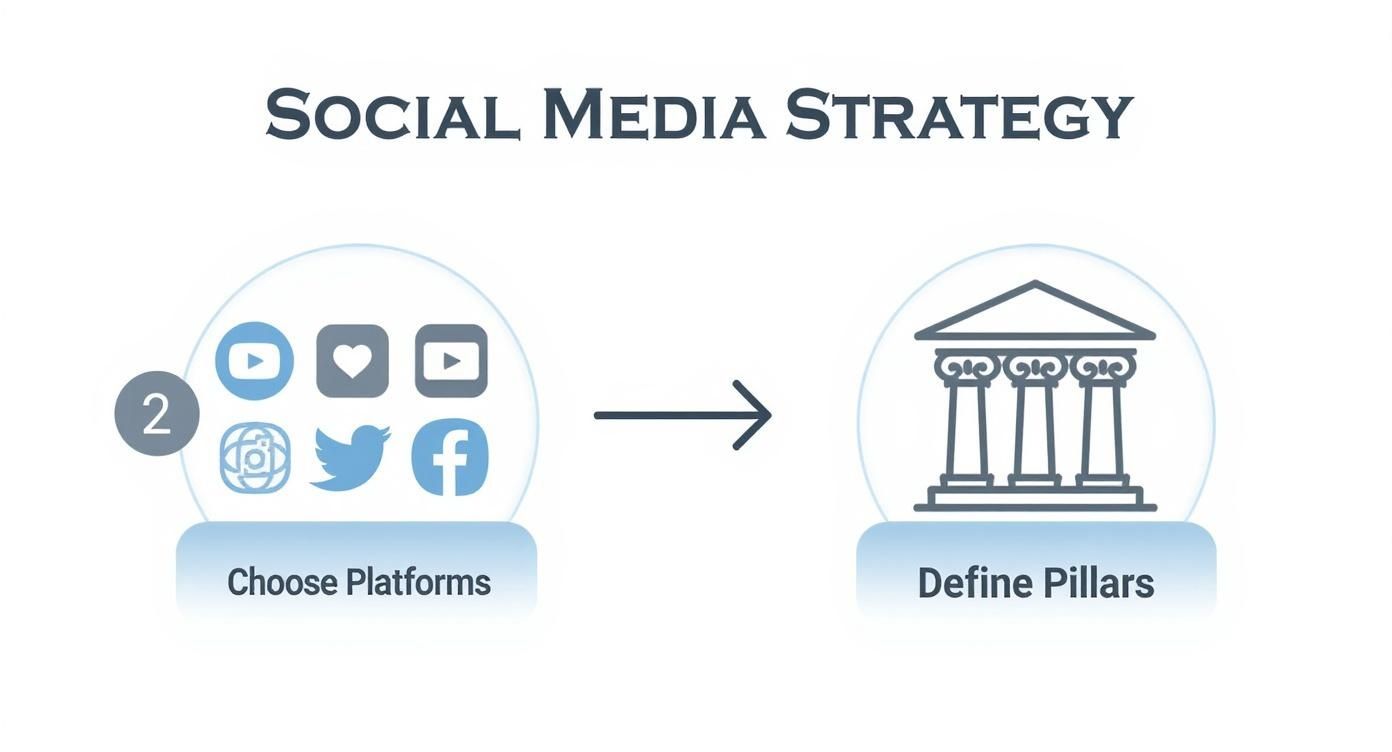
It’s a great reminder that every post entering your workflow should have a clear, strategic purpose right from the very start.
Nailing Your Posting Cadence
So, how often should you actually post? There’s no magic number, but I can tell you this: consistency beats frequency every single time. Posting three high-quality, engaging pieces a week is infinitely better than posting ten mediocre ones that nobody interacts with.
Your best guide here will be your own data. Start with a baseline schedule and then dive into your Repostly analytics to see what’s working.
Pro Tip: Use Repostly’s analytics to pinpoint exactly when your audience is most active online. Scheduling your content for these peak times is one of the easiest ways to boost your initial reach and engagement without any extra effort.
If you’re just starting out, here are some solid guidelines:
- Instagram: Aim for 3-5 feed posts per week, and try to supplement with daily Stories.
- Facebook: 3-5 times per week works well here, too. Video content and community-building posts tend to perform best.
- LinkedIn/XING: Stick to 2-4 posts per week, keeping the focus on professional insights and company news.
- TikTok: The algorithm loves fresh content, so aim for 4-7 times per week if you have the resources.
Remember, these are just starting points. The real magic happens when you start analysing your own data and tweaking your social media planner. Your audience is telling you what they want to see—you just have to listen.
Bringing Your Social Media Plan to Life

A perfectly mapped-out planner is a great start, but it's the daily hustle that really makes a strategy work. This is where your creative ideas and audience knowledge turn into content that actually stops the scroll and gets people talking. It’s time to breathe some life into that calendar.
Now, the focus shifts from planning to doing. We're talking about writing captions that really connect, creating visuals that are impossible to ignore, and getting the hang of community management. After all, social media is a two-way street, not a billboard.
Crafting Captions That Connect
Think of your caption as your chance to give your visuals some personality, context, and a clear next step. A great caption does more than just describe the picture; it gives your audience another reason to care.
To make your captions hit harder, try these approaches:
- Start with a Hook: Kick things off with a question or a bold statement. You have to grab their attention right away.
- Tell a Story: People remember stories, not just product specs. Share the "why" behind what you do or a quick behind-the-scenes moment.
- Add a Clear Call-to-Action (CTA): What do you want them to do? Whether it’s “shop now,” “learn more,” or “drop your thoughts below,” make it crystal clear.
For instance, instead of just posting, "New sustainable coffee cups in stock," you could try something with a bit more flavour: "Your morning coffee just got an eco-friendly upgrade. ☕️ Ever wonder how much waste single-use cups create? Tap the link in our bio to see the difference you can make." This simple switch turns a basic announcement into a conversation.
Designing Visuals That Stop the Scroll
In a sea of content, your visuals are your first (and sometimes only) chance to make an impact. High-quality, on-brand images and videos are absolutely essential.
Think about how people in Germany use social media—they browse content, share posts, and follow influencers. Your visuals need to work for all these behaviours. Knowing that Facebook and Instagram are popular helps you tailor content for those crowds. And since many in Germany still use desktops for social media, make sure your visuals look just as good on a big screen.
To speed things up, you can use specialised tools to create platform-specific content. For example, a good AI TikTok video generator can help you quickly produce the kind of short, snappy clips that perform well there. The key is to always tie your visuals back to the content pillars you defined earlier. This creates a feed that looks cohesive and feels professional.
Mastering Community Management
This might just be the most important piece of the puzzle. Hitting 'publish' is only half the battle; the real magic happens in the DMs and comments section. Community management is all about building genuine relationships with the people who follow you.
That means doing more than just dropping a generic "Thanks!" in the comments. It’s about:
- Responding Thoughtfully: Actually read what the person said and add something meaningful to the conversation.
- Engaging Proactively: Don't just sit back and wait. Like and comment on your followers' content and join relevant conversations happening elsewhere.
- Handling Feedback Gracefully: All feedback, good or bad, is a gift. Thank people for their thoughts and address any concerns with transparency and professionalism.
Building a community isn't about collecting followers; it's about making genuine connections. Every comment and message is an opportunity to strengthen your relationship with a customer or potential customer. Don't waste it.
A well-looked-after community becomes one of your biggest assets. Your followers turn into advocates who trust you, engage with what you post, and are much more likely to stick around as loyal customers. While you’re busy filling your planner, remember that great software can handle the actual posting for you. Our guide on the https://repostly.app/blog/best-social-media-scheduling-tools-68a586e344be737efa9f3c3f can help you pick the right one, giving you more time for this vital engagement work. Your planner tells you what and when to post, but your daily interactions give people a reason to care.
Measuring Performance and Optimising Your Strategy
https://www.youtube.com/embed/Z1KJ-16Rfs0
Getting your social media planner up and running is a huge win, but the work doesn't stop there. The real magic happens when you start digging into what's working, what's falling flat, and—most importantly—why. This is the point where your planner transforms from a simple schedule into a powerful, living tool that adapts to your audience.
Without data, you’re just posting into the void. Think of analytics as your guide, showing you precisely how to adjust your content pillars, nail down the perfect posting times, and drive results that actually matter to your business. This constant loop of measure, analyse, and tweak is what separates the pros from the amateurs.
Identifying Your Core Metrics
Before you can start improving, you need to know what you're actually measuring. It's easy to get buried under a mountain of data, so the key is to focus on the numbers that tie directly back to the business goals you set in the beginning. These are your Key Performance Indicators (KPIs).
For instance, if your main goal was to boost brand awareness, you'll be laser-focused on metrics like Reach (how many unique people see your posts) and Impressions (the total number of times your content was viewed). But if you were aiming to drive more website traffic, then your world will revolve around Click-Through Rate (CTR) and Website Referrals. For a more detailed look, our guide on selecting the right KPIs for social media can help you zero in on what's most impactful for your specific goals.
Don't fall for the trap of vanity metrics like follower count. Sure, it’s nice to see that number go up, but a high engagement rate from a smaller, dedicated community is almost always more valuable than a massive following that ignores your content.
Using Repostly to Uncover Insights
This is where a tool like Repostly becomes your best friend. It pulls all of your data into a single, clean dashboard, so you're not constantly switching between the native analytics of Facebook, Instagram, and LinkedIn. This unified view makes it incredibly easy to spot trends and see how different platforms are performing side-by-side.
Imagine you’re a B2B company based in Germany. A quick glance at your Repostly dashboard might reveal that your in-depth articles on LinkedIn are killing it, driving both high engagement and valuable traffic to your website. Meanwhile, your slick visuals on Instagram get plenty of likes but almost no clicks. That’s a game-changing insight. It tells you to double down on your thought leadership content for LinkedIn and rethink your Instagram strategy, perhaps by adding stronger calls-to-action or interactive Stories.
A Practical Cycle of Optimisation
Optimising your strategy isn't a one-and-done task; it's a rhythm you get into. Make it a habit to block out time each month to review your performance. This review-and-adjust cycle should become a non-negotiable part of your social media workflow.
Here’s a simple, repeatable framework you can use:
- Review: Pull up your report in Repostly for the last 30 days. Pinpoint your best-performing posts based on your main KPIs. What do they have in common?
- Analyse: Now, play detective. Why did those posts do so well? Was it the video format? The candid tone in the caption? The morning post time? Form a quick hypothesis, like, "Our German audience loves short video tutorials posted before 10 a.m. on weekdays."
- Adjust: Based on that hypothesis, make some concrete changes to your upcoming planner. If video tutorials are a hit, schedule more of them. If a content pillar is consistently underperforming, maybe it’s time to swap it for something your audience is clearly more interested in.
- Test & Repeat: Put your new plan into action for the next month. Then, do it all over again. This iterative approach is how you ensure your strategy never gets stale and continues to improve over time.
To get started, it helps to know which metrics give you the most actionable information. Here’s a quick breakdown of the essentials and what they can tell you about your strategy.
Key Social Media Metrics to Track
The table below breaks down the essential metrics, what they actually mean, and why they’re so critical for fine-tuning your social media planner.
| Metric | What It Measures | Why It Matters | Tool to Track (e.g., Repostly) |
|---|---|---|---|
| Engagement Rate | The percentage of your audience that interacts (likes, comments, shares, saves) with your content. | This shows if your content is truly connecting. A low rate is a clear sign of a mismatch. | Repostly's unified analytics dashboard. |
| Reach | The total number of unique people who saw your content. | This is your brand awareness barometer. If it’s not growing, you need to work on discoverability. | Platform-specific reports within Repostly. |
| Website Clicks | The number of people who clicked a link in your post to visit your website. | This directly measures your social media's ability to drive traffic to your most important asset. | Repostly’s link tracking features. |
| Follower Growth | The rate at which your follower count is increasing over time. | A steady upward trend indicates that your content is successfully attracting new people to your brand. | Repostly's audience growth charts. |
By consistently monitoring these numbers and using what you learn to inform your social media planner, you’ll move beyond just posting content. You'll start building a smart, data-driven machine that delivers real, tangible results for your business. This is how a simple plan evolves into a powerful engine for growth.
Common Questions About Social Media Planning
Diving into a more structured approach to social media always kicks up a few questions. It’s one thing to build a great planner, but it’s another thing entirely to keep it running smoothly and make sure it’s actually delivering results. Let’s tackle some of the most common things people ask when they start getting serious about planning.
Getting these details right is what turns your planner from a simple document into a living, breathing tool that helps you navigate the fast-paced world of social media.
How Often Should I Post on Social Media in Germany?
I get this question all the time, and the truth is, there's no single magic number. The most important thing to remember is that consistency always beats sheer frequency. A flurry of ten posts one week followed by radio silence the next just doesn't work. It’s much better to find a steady, reliable rhythm your audience can count on.
If you’re just starting out and targeting a German audience, here’s a decent baseline:
- 3-5 high-quality posts per week for platforms like Instagram and Facebook.
- 2-3 thoughtful posts per week on the more professional networks like LinkedIn or XING.
But the real, honest answer is hiding in your analytics. This is where your planner becomes a powerful experiment. Test out different schedules and then jump into your Repostly dashboard to see what’s working. Your own data—when your audience is most active and what they engage with—will always be a better guide than any generic advice. Remember, the goal is to share something valuable, not just to hit a quota.
What Are the Most Important Parts of a Social Media Planner?
A truly useful planner is more than just a date and a caption. To make it the cornerstone of your operations, it needs a few key components to keep everyone on the same page and aligned with your strategy.
Think of your planner as your team's single source of truth. It should have enough detail that anyone can look at it and instantly understand the what, why, when, and where of every post. This clears up so much confusion and makes your whole workflow smoother.
At a minimum, every entry in your planner should have:
- Post Date and Time: The exact moment it’s set to go live.
- Designated Platform(s): Is this for Instagram, LinkedIn, or both?
- The Full Caption: The complete text, including any @mentions or links.
- Visual Placeholder: A clear link or description of the image or video needed.
- Relevant Hashtags and Tags: All the tags you need for better reach and context.
- Status Tracker: A simple way to see where things stand (e.g., 'Draft,' 'Needs Review,' 'Scheduled').
Want to take it to the next level? Add a column linking each post back to a specific content pillar. This is a great way to make sure everything you create has a clear purpose and ties directly back to your bigger marketing goals.
How Far in Advance Should I Plan My Social Media?
This is all about finding the right balance. If you plan too far ahead, you risk becoming rigid and unable to react to what’s happening right now. But if you don't plan far enough in advance, you’re just inviting chaos and last-minute panic.
From my experience, the sweet spot for most teams is planning their content two to four weeks in advance.
This gives you enough breathing room to create genuinely good content, get it through any necessary approvals, and schedule everything without the last-minute stress. It keeps you organised but leaves you nimble enough to adapt.
And that's the key: always leave some empty space in your planner. You absolutely need the agility to jump on a trending topic, share some breaking company news, or join a relevant conversation. A plan is supposed to be your guide, not a straitjacket.
Ready to build a social media planner that saves you time and drives real results? Repostly provides the scheduling, workflow, and analytics tools you need to streamline your entire process. Start your free trial today and see the difference.
Keep reading

10 Fresh Instagram Story Idea Tactics for 2025
Stuck for content? Discover our top Instagram story idea list, with actionable tips to boost engagement and grow your audience in 2025.

Crafting Your Social Media Content Plan
Stop guessing and start strategizing. This guide provides an actionable social media content plan to audit, plan, and execute content that gets results.

Content Creation on Social Media: 10 Quick Strategies
Elevate your content creation on social media with 10 actionable strategies. Learn to engage your audience and grow reach with expert tips for 2025.
Post once. Show up everywhere.
Start your 7-day free trial and publish your next video to every platform in minutes.Pick a plan and publish your next video to every platform in minutes.
Start your free trialSee plansCancel anytime