Crafting Your Social Media Content Plan
Stop guessing and start strategizing. This guide provides an actionable social media content plan to audit, plan, and execute content that gets results.

Before you can build a killer social media content plan, you have to get brutally honest about where you are right now. This isn't just about counting likes; it's about digging in to understand what actually connects with your audience and setting a clear path forward.
Auditing Your Social Media Before You Plan
Jumping straight into creating content without an audit is like trying to navigate a new city without a map. Sure, you'll be moving, but you'll have no idea if you're heading in the right direction. A proper social media audit is your map—it shows you what’s worked, what’s bombed, and where the real opportunities are hiding.
Think of it as the groundwork. This deep dive into your existing channels gives you the hard data you need to inform every other decision you'll make.
Analyse Your Performance Data
First things first, pull your performance metrics from each platform for the last 6-12 months. It's easy to get distracted by vanity metrics like follower counts, but you need to focus on the numbers that signal a real connection.
- Engagement Rate: Look at which posts got the most comments, shares, and saves. This is your goldmine for figuring out what genuinely resonates with people.
- Reach and Impressions: What content travelled the furthest? This tells you what has the potential to break out beyond your core followers.
- Click-Through Rate (CTR): Which posts actually got people to leave the platform and visit your website or a landing page? That’s a direct line to business goals.
Your data tells a story. A high number of shares on an in-depth educational carousel, for instance, is a far more powerful signal than a high number of likes on a generic stock photo. This is a huge part of effective social media monitoring, which helps you keep a pulse on the conversations happening around your brand.
This audit process really boils down to three core activities: analysing your performance, getting to know your audience on a deeper level, and seeing how you stack up against the competition.
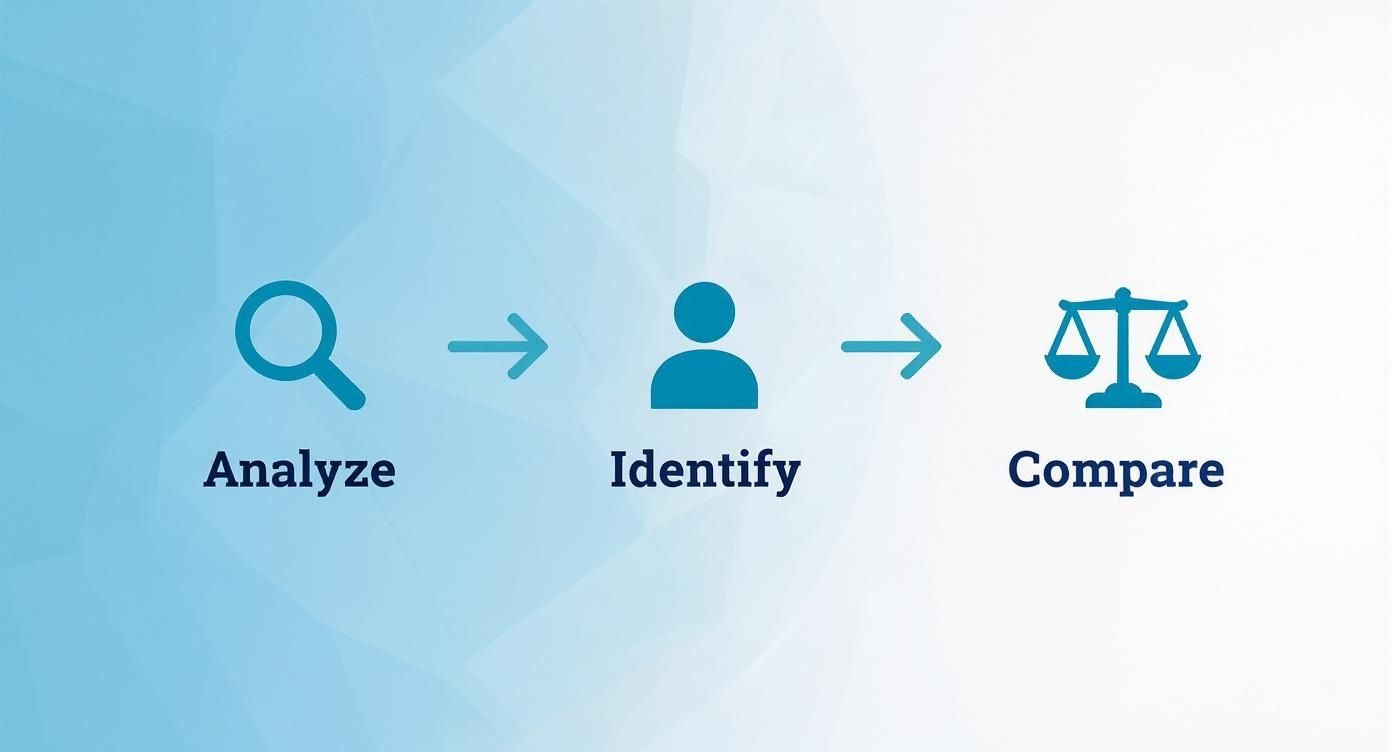
As you can see, it’s a logical flow. Each step naturally builds on the insights from the one before it, giving you a comprehensive picture.
Identify Audience and Competitor Gaps
Once you have your performance data sorted, it’s time to look outward. Who are your most engaged followers? Take a closer look at their demographics and common interests to sharpen your target audience profile.
It’s also vital to understand the wider context. In Germany, for example, about 93% of adults are online, but only around 51% are active on platforms like Facebook or Instagram. This statistic is eye-opening—it shows there's a huge portion of the online population that isn't on these channels, meaning any strategy there has to be incredibly well-targeted to capture the attention of a more discerning audience.
Finally, do a quick and dirty competitor analysis.
A competitor audit isn't about copying what others are doing. It’s about spotting what they aren't doing. It’s about finding the content gaps you can fill and discovering opportunities to bring a unique voice or perspective to your niche.
Check out their best-performing content, see what questions their audience is asking in the comments, and get a feel for their overall brand tone. This step is absolutely crucial for ensuring your new social media content plan is designed to stand out, not just blend into the noise.
Setting Social Media Goals That Matter

Trying to build a social media presence without clear goals is a bit like driving without a destination. You're definitely burning fuel, but you aren't actually getting anywhere meaningful. Vague ambitions like "get more followers" or "go viral" aren't goals; they're wishes. To create a strategy that delivers genuine business value, you need to define targets that are specific, measurable, and tied directly to your company's bigger picture.
Every single piece of content you post should have a purpose. Are you aiming to drive traffic to a new blog post? Are you trying to get sign-ups for an upcoming webinar? Or is the focus on building a more tight-knit, engaged community around your brand? Answering these questions first is crucial. It ensures your efforts are focused and your results are tangible.
From Vague Ideas to SMART Objectives
The best way I’ve found to make goals concrete is by running them through the SMART framework. This isn't just corporate jargon; it's a practical filter that ensures your objectives are solid enough to guide your entire social media plan.
Here’s how it breaks down:
- Specific: Nail down exactly what you want to achieve. Instead of "increase engagement," a much better goal is "increase the average number of comments on our Instagram Reels."
- Measurable: How will you actually track your progress? You need concrete numbers. For example, "achieve a 5% click-through rate from LinkedIn posts to our website."
- Achievable: Be ambitious, but stay realistic. If you're currently generating 10 leads a month, aiming for 1,000 next month is just setting yourself up for failure. A 20% increase, on the other hand, is a challenging yet attainable target.
- Relevant: Does this goal support your wider business objectives? If the company’s main priority is boosting sales, your social media goal should be about lead generation, not just raising brand awareness.
- Time-bound: Give yourself a deadline. A goal like, "increase website traffic from social media by 15% by the end of Q3" creates a sense of urgency and a clear timeline for evaluation.
This structure transforms a fuzzy idea into an actionable plan. If you want to dive deeper, exploring different goal setting frameworks can help translate your vision into a practical, step-by-step process.
Translating Business Needs into Social KPIs
Once you have your goals, you need to translate them into tangible Key Performance Indicators (KPIs) for social media. This is how you prove the value of your work and demonstrate a real return on investment (ROI). Think about what success actually looks like for your business, and then work backwards to find the right metrics.
I see it all the time: people chase vanity metrics that look impressive on a report but do nothing for the bottom line. Ten highly qualified leads from a targeted campaign are infinitely more valuable than 10,000 likes from a disengaged audience.
Let's say a core business goal is to establish your brand as an authority in its niche. Your social media KPIs might then include:
- Share of Voice: How often is your brand mentioned online compared to your competitors?
- Audience Engagement: Are industry experts and influencers commenting on and sharing your content?
- Sentiment Analysis: What’s the general tone of the conversation around your brand? Is it positive?
By linking every activity back to a specific, measurable goal, your social media plan stops being just a list of things to post and becomes a powerful engine for business growth.
Finding Your Core Content Pillars and Platforms
Once you've got your goals locked in, it's time to get focused. Spreading yourself too thin—trying to be on every platform and talk about everything under the sun—is a surefire recipe for burnout and getting nowhere fast. A truly effective social media content plan is all about making smart choices about what you're going to talk about and where you’re going to talk about it.
This is where content pillars come in. These are the 3-5 core themes that your brand will consistently own. Think of them as the main subjects you want to become known for. They should be topics that showcase your expertise, connect directly to your business goals, and, most importantly, actually help your audience.
How to Define Your Content Pillars
The sweet spot for your content pillars lies right where your brand's knowledge meets your audience's needs. A great way to start is by brainstorming topics that naturally branch out from your products or services. Take a sustainable fashion brand, for example. They wouldn't just post pictures of their clothes day after day.
Instead, their pillars could look something like this:
- Ethical Manufacturing: Taking people behind the scenes to see how their clothes are really made.
- Sustainable Living Tips: Offering broader advice that resonates with their eco-conscious followers.
- Fabric Education: Doing deep dives into the benefits of organic cotton or recycled fibres.
- Conscious Styling: Showing people how to wear and re-wear their pieces in practical, stylish ways.
This strategy gives you a nearly endless supply of content ideas, so you're never scrambling at the last minute. It positions you as an expert resource, not just another brand trying to sell something.
Choosing the Right Social Platforms
Knowing your pillars is half the battle; the other half is deciding where to plant them. Don't just sign up for the biggest platforms out of habit. You need to be where your target audience genuinely spends their time. Your channel audit should give you some clues, but it's also worth looking at wider demographic data.
For instance, if your audience is in Germany, you can't ignore Facebook. As of September 2025, the platform has around 44.2 million users there, and the largest demographic is the 25-34 age group. For any brand targeting that segment, not being on Facebook is a massive missed opportunity. You can find more up-to-date German social media user statistics on napoleoncat.com.
Your energy is finite. Pouring resources into a platform where your audience isn't active is a waste. It's far better to dominate one or two relevant channels than to have a weak presence on five.
Platform and Content Pillar Alignment Example
To bring this to life, let’s look at how a B2B SaaS company might adapt its content pillars for different platforms. Each channel has its own culture and content format, so a one-size-fits-all approach just won't cut it.
| Content Pillar | Best for Facebook | Best for Instagram | Best for LinkedIn |
|---|---|---|---|
| Industry Insights & Trends | Share engaging infographics, short video summaries, and link to blog posts for discussion. | Use Reels to highlight a key stat or trend. Create visually appealing carousels. | Post detailed analyses, long-form articles, and spark professional debates. |
| Customer Success Stories | Post video testimonials and tag the customer's business page to foster community. | Create a visually compelling Reel or Story series with customer quotes and results. | Write a detailed case study as an article, focusing on business metrics and ROI. |
| Productivity Tips & Tricks | Create simple, shareable "how-to" graphics or quick video tutorials. | Use a carousel post to walk through a 5-step productivity hack. | Share a thought leadership piece on team efficiency or a professional "pro-tip." |
| Behind-the-Scenes & Culture | Showcase team events, anniversaries, and casual office life to humanise the brand. | Use Stories for day-in-the-life takeovers and post high-quality team photos on the grid. | Highlight employee achievements, new hires, and company milestones. |
As you can see, the core theme stays the same, but the execution is tailored to fit what works best on each platform. A B2B tech company will naturally gravitate towards LinkedIn for deep professional insights, while a visually-driven brand selling handcrafted jewellery will find its home on Instagram or Pinterest.
Always match your platform to your audience's online behaviour and the kind of content you want to create. This focus makes your social media plan more manageable and much, much more effective.
Building a Practical Content Calendar
With your goals mapped out and your content pillars defined, it's time to get tactical. This is where your strategy moves off the whiteboard and becomes a real-world, actionable schedule. A well-organised content calendar is truly the difference between a proactive, strategic social presence and a chaotic, reactive one. It's what ends the last-minute scramble for something—anything—to post.
A good calendar is more than just filling empty slots on a spreadsheet. It’s about thoughtfully creating a balanced content mix that consistently delivers value to your audience. This deliberate approach is how you build a loyal community and maintain a steady presence without burning out your team.
Organising Your Content Mix
One of the most common traps I see brands fall into is hammering one type of content over and over, usually promotional posts. This is the fastest way to trigger audience fatigue. A great social media feed keeps things fresh and engaging by balancing different formats and messages.
To start, think about including a mix of these:
- Educational Content: This is your bread and butter for establishing authority. Think how-to guides, quick tips, or industry deep-dives that genuinely solve your audience's problems.
- Promotional Posts: You still need to drive business, of course. Use these slots for new product announcements, special offers, or upcoming events.
- Behind-the-Scenes Moments: Give people a peek behind the curtain! Showcasing your company culture, your team, or your creative process helps to humanise your brand and build connection.
- User-Generated Content (UGC): Sharing posts from happy customers is pure gold. It’s powerful social proof and a fantastic way to make your community feel seen and valued.
Sprinkling in this variety keeps your audience genuinely interested and meets their different needs as they get to know your brand.
The point of a content calendar isn't to lock you into a rigid, unchangeable plan. It's to create a reliable framework. Think of it as a flexible blueprint that gives you structure but still leaves plenty of room for spontaneous, timely content when opportunities pop up.
Choosing Your Tools and Frequency
You really don't need fancy, expensive software to get started. A simple spreadsheet is often more than enough to organise your posts, platforms, dates, and copy. If you're a more visual person, it can be helpful to check out some great social media content calendar examples to get a feel for what might work for you.
As your operations scale up, however, dedicated tools become a lifesaver. For bigger teams or agencies juggling multiple accounts, the right project management software for creative agencies can make a world of difference in streamlining approvals and workflows.
Now, how often should you post? Honestly, it's more art than science. A good starting point is a manageable schedule—say, 3-5 times a week on your main platform. From there, watch your analytics like a hawk. Let your audience's engagement be your guide. If they're loving it, you might be able to scale up. If engagement starts to dip, you could be overdoing it.
For a market like Germany, where social media use often leans towards personal connections, a content plan that feels localised and relatable can significantly boost interaction. Tailoring your calendar to nod to regional events or cultural nuances shows you're actually paying attention. You can dig into more insights on social media activities in Germany on Statista. Ultimately, a well-built calendar is what turns your strategy into a consistent, engaging, and measurable part of your marketing engine.
Creating Content That Actually Connects

Okay, you’ve got the calendar mapped out. Now for the fun part: breathing life into those empty slots. This is where you move from strategy to creativity, crafting the actual words and visuals that make someone stop scrolling and pay attention.
The real goal here isn’t just to post; it’s to connect. We want to deliver genuine value, spark a bit of conversation, and build relationships that feel real, not like a sales pitch. It all starts with a consistent brand voice, making sure every caption, video, and reply sounds like it’s coming from the same place.
Crafting Scroll-Stopping Copy and Visuals
Your copy is your direct line to your audience, so make it count. Keep it clear, keep it concise, and please, ditch the corporate jargon. Write like you’re talking to a friend.
One of the easiest ways to get people engaged? Just ask a question. It’s a simple trick, but it instantly turns a one-way broadcast into a two-way street.
Of course, it’s the visuals that grab them first. Whether you’re using professional photos, custom graphics, or quick videos, they need to feel like you. And you don’t need a massive budget for this. I've often seen a candid, behind-the-scenes video shot on a phone outperform a slick production because it feels honest and relatable.
Your audience follows you for a reason, and it’s rarely just for your product. They connect with your unique voice, your perspective, and the value you provide. Stick with what makes you you and create content that authentically markets your brand.
The Power of Content Curation
Creating amazing original content is the goal, but let's be realistic—you don't have to create every single thing from scratch. This is where content curation comes in. It’s the simple act of finding and sharing genuinely useful content from other credible sources.
Done right, this move positions your brand as a trusted resource in your industry, not just another seller.
Start looking for things like:
- Insightful articles from industry blogs that your followers would actually find helpful.
- Compelling data or statistics from a recent report that make people think.
- Inspiring posts from thought leaders or even non-competing brands in your space.
When you share great content from others, you’re still providing immense value, just without the heavy lifting. It diversifies your feed, builds goodwill, and proves you’re invested in your community’s success, not just your own bottom line. It's a non-negotiable part of any sustainable social media plan.
How to Measure and Optimise Your Plan

A social media content plan isn't a "set it and forget it" document. Think of it as a living strategy that needs to breathe and adapt. The final—and most crucial—part of this whole process is getting into the habit of measuring your performance and using those insights to get better. This feedback loop is what separates accounts that grow consistently from those that eventually hit a wall.
Tracking the right metrics is all about tying your daily posts back to those SMART goals you set earlier. Without that connection, you're just staring at numbers in a vacuum. By regularly checking in on your performance, you can confidently double down on what’s working and have a good reason to ditch what isn't.
Choosing KPIs That Truly Matter
It’s incredibly easy to drown in a sea of analytics. The secret is to zero in on Key Performance Indicators (KPIs) that actually reflect your goals, rather than getting distracted by vanity metrics like your raw follower count.
For instance, if one of your big goals is to build brand awareness, the numbers you should care about most are:
- Reach: How many unique people saw your content.
- Impressions: The total number of times your content was shown on screen.
- Share of Voice: How much of the conversation around your industry involves your brand versus your competitors.
But if you’re focused on driving traffic to your website and getting leads, you should be obsessing over different metrics:
- Click-Through Rate (CTR): The percentage of people who saw your post and actually clicked the link.
- Conversions: The number of people who took a specific action, like signing up for your newsletter, after clicking through.
Learning how to measure your social media ROI is fundamental. It’s how you prove your work has real value and contributes directly to the business's bottom line.
Establishing a Regular Review Cadence
Data is completely useless if you never look at it. Block out time in your calendar for a proper performance review. A monthly check-in is a great place to start, followed by a deeper dive every quarter. This doesn't have to mean creating massive, complicated reports; it’s about asking simple but powerful questions.
During your review, pull up your top-performing posts and hunt for patterns. What topics or formats consistently get the best engagement? You might discover your audience loves quick, educational Reels but scrolls right past your static image posts. Or maybe posts featuring customer stories get double the shares of your product announcements.
The goal of a review isn't just to see what happened; it's to understand why it happened. This understanding is what allows you to make smarter, more informed decisions for your next content calendar.
Use these regular check-ins to spot trends as they emerge and pinpoint what needs tweaking. This constant cycle of measuring, learning, and optimising is the engine that will drive the long-term success of your social media content plan, turning good results into great ones.
Keep reading

10 Fresh Instagram Story Idea Tactics for 2025
Stuck for content? Discover our top Instagram story idea list, with actionable tips to boost engagement and grow your audience in 2025.

A Practical Social Media Planner for German Markets
Build a results-driven social media planner for Germany. This guide offers actionable strategies for content, scheduling, and analysis in the German market.

Content Creation on Social Media: 10 Quick Strategies
Elevate your content creation on social media with 10 actionable strategies. Learn to engage your audience and grow reach with expert tips for 2025.
Post once. Show up everywhere.
Start your 7-day free trial and publish your next video to every platform in minutes.Pick a plan and publish your next video to every platform in minutes.
Start your free trialSee plansCancel anytime