How to Improve Social Media Engagement: Top Tips & Strategies
If you want to get more engagement on social media, you have to stop thinking like a broadcaster and start acting like a host at a great party. It's all about creating value-driven content that gets people talking, actively building a community, and using your data to make smarter moves next time. Get these three things right, and you'll turn passive scrollers into a genuinely loyal audience.
Why Social Media Engagement Actually Matters
Let's get one thing straight: engagement isn't just a vanity metric. It's the engine that drives your visibility on almost every platform today.
Algorithms have gotten a lot smarter. They no longer reward just likes or views; they're looking for real conversations. Comments, shares, and saves are the signals that tell the algorithm your content is worth showing to more people.
Without that active buzz, even the most brilliant content can feel like shouting into the void. High engagement is proof that you're connecting, and it creates a snowball effect, pushing your posts into new feeds and in front of potential followers.
The Foundation for Authentic Growth
Think of engagement as the outcome of a solid strategy, not the strategy itself. Real, sustainable growth comes from a simple feedback loop built on a few core ideas:
- Create Real Value: Your content needs a job. Is it here to teach, to entertain, or to inspire? Whatever it is, it has to be something your audience actually wants and can't just get anywhere.
- Nurture Your Community: Don't just post and ghost. Jump into the comments, ask questions, and share content from your followers. Make people feel like they're part of something, not just a number on your follower count.
- Let Data Be Your Guide: Your analytics are your best friend. They tell you what's hitting the mark, who you're talking to, and when they're listening. This is how you stop guessing and start making strategic decisions.
The secret to boosting social media engagement is realizing it’s a two-way street. Your audience gives you their time and attention. Your job is to give them a reason to keep coming back by building a real relationship.
This shift is more important than ever when you look at how people behave online. A staggering 65.7% of the world's population is on social media, spending over two hours a day hopping between platforms.
Even more telling? 58% of consumers now find new businesses through social media—that’s more than traditional advertising. You can dig deeper into these numbers with these social media marketing statistics on Sprinklr.com. This tells us that your social profiles aren't just marketing channels anymore; they're primary discovery tools where genuine connection builds the trust that leads to sales.
With that foundation in place, let's get into the practical steps you can take to make it happen.
Before we dive into the specific tactics, let's quickly summarize the core principles we've just covered. Think of this table as your cheat sheet for building a powerful and engaging social media presence.
Core Pillars of Social Media Engagement
| Pillar | Key Action | Why It Works |
|---|---|---|
| Value-Driven Content | Create posts that educate, entertain, or inspire your specific audience. | Gives people a reason to follow you and pay attention, moving beyond simple product promotion. |
| Community Nurturing | Actively respond to comments, ask questions, and feature user content. | Makes followers feel seen and valued, turning passive viewers into active participants. |
| Data-Informed Strategy | Regularly review analytics to see what content performs best and why. | Allows you to double down on what works and stop wasting time on what doesn't. |
Keep these three pillars in mind as we explore the actionable strategies in the next sections. They are the bedrock of everything that follows.
Develop a Content Strategy That Sparks Conversation

If you really want to get people talking on social media, you have to stop shouting ads into the void. It’s time to start creating content that actually invites people to join a conversation. Your goal shouldn't be just to get views; it’s to be the brand people remember, share, and talk about.
It all starts with understanding why people are scrolling in the first place. You might think it's just to see what their friends are up to, but the data paints a much broader picture.
Globally, only about 50.8% of users are on social media primarily to connect with friends and family. A huge chunk of people are looking for entertainment, news, and new things to discover. This is a massive opportunity, and it shows why a strategy built only on self-promotion is destined to fall flat.
Build a Balanced Content Mix
Think of your content calendar like a well-balanced meal, not just a single, repetitive dish. A healthy mix keeps your audience engaged and gives them different reasons to interact with you day after day.
Here's a simple breakdown I recommend to clients:
- Educate: Share how-to guides, handy tips, or posts that bust common myths in your industry. Solve a real problem for them.
- Entertain: Post funny memes, share a behind-the-scenes look at your office, or tell a relatable story. Show the human side of your brand.
- Inspire: Highlight customer success stories, share a motivational quote, or post about values that resonate with your audience.
- Promote: This is where you talk about new products, special deals, or upcoming events. Keep this slice of the pie small.
By rotating through these content types, you're consistently providing value. You stop asking for attention and start earning it with every single post.
Make Your Content Interactive
Let's be honest: passive content gets passive results. If you want to kickstart a real conversation, you have to build interaction directly into your posts. Don't just show them something—ask them to do something.
For example, a coffee shop could post a simple photo of a new blend. Or, they could post a poll: "New blend dropping soon! Are you team A) Bold & Dark or B) Smooth & Light? Vote below!" See the difference? That simple tweak turns a boring announcement into a fun dialogue.
A post isn't finished when you hit "publish." It's finished when your community has had a chance to react, respond, and add their own voice to the conversation.
User-generated content (UGC) campaigns are another fantastic way to do this. Ask your followers to share photos of themselves using your product with a unique hashtag. When you feature their content on your feed, it’s a powerful form of recognition that makes them the hero of your brand's story. It’s a win-win: you get authentic content, and they get a moment in the spotlight.
Understanding how to foster these interactions is a game-changer. Exploring different ways to boost overall customer engagement can give you even more ideas to build a loyal community. And if you’re aiming for that one big hit, you can learn more about specific techniques here: https://repostly.app/blog/how-to-create-viral-content-689d9100650d8992d6cf6fb9.
Ultimately, a strategy that prioritizes conversation is what turns followers into a community, and a community into your most passionate advocates.
Weave AI and Tech Into Your Strategy

Let's be honest, moving away from guesswork is the key to building a powerful engagement strategy. Technology, especially AI, isn’t about replacing the human touch; it's about making it smarter and more effective. With the right tools, you can finally understand what your audience truly wants and create content that clicks—way faster than you could on your own.
Think of these tools as your new strategic partners. They do the heavy lifting with data and content ideas, which frees you up to do what really matters: build genuine relationships. You get to work smarter, not harder, making sharp, data-backed decisions that consistently level up your engagement.
Tune In With Social Listening Tools
Imagine being a fly on the wall for every online conversation about your brand, your industry, and your competitors. That’s exactly what social listening tools give you. They go way beyond just tracking mentions; they dig into the sentiment behind the words, spot trends as they’re bubbling up, and highlight your audience's biggest pain points.
Let's say you're a skincare brand. You might use a listening tool and discover a huge spike in conversations about a new, niche ingredient. That's pure gold. You can immediately jump on it by creating a video explaining the benefits or running a poll to see who's already using it. Your content becomes timely, relevant, and impossible to ignore.
This approach flips your content calendar on its head. It stops being a rigid schedule and becomes a living, breathing plan that taps directly into what your audience is excited about right now.
Let Generative AI Be Your Brainstorming Buddy
We’ve all been there: staring at a blank screen, desperately trying to think of what to post next. This is where generative AI can be a total game-changer. It doesn't replace your creativity; it acts as a brainstorming partner that never, ever runs out of ideas.
You can use AI to:
- Spark post ideas around a keyword or a trending topic.
- Draft killer captions in any tone you need, from quirky and fun to serious and professional.
- Create stunning visuals or suggest ways to make your current images pop.
Technology should serve your strategy, not define it. The real goal is to use AI and analytics to amplify your authentic voice and make your human connections even stronger.
And this isn't just theory—it actually works. Research shows that a whopping 90% of businesses using generative AI save a ton of time, and 73% report real, tangible increases in their engagement rates.
To take it a step further, think about how different AI-powered tools can fit into your workflow. You can explore a variety of AI applications that help with everything from content generation to analytics. By automating the tedious stuff and getting smarter insights, you free up more time to actually talk to your community. That's how technology becomes your ultimate secret weapon.
Build a Thriving Community Through Active Interaction

Putting great content out there is only half the job. Honestly, it's the easier half. The real work—and where the magic happens—is what you do after you hit "publish." Social media is meant to be a conversation, and the brands that win are the ones that actually talk back.
Think about it: when someone stops scrolling long enough to leave a comment, they're giving you an opening. It's an invitation to connect. All you have to do is accept. A quick, genuine response shows there's a real person on the other side of the screen, and that single act can turn a casual follower into a true fan.
Go Beyond Basic Replies
Replying to comments is table stakes. It’s the absolute minimum. If you really want to build a community that feels alive, you have to get more involved. Look for ways to shine a spotlight on your audience and make them feel like they're part of your brand's journey.
Here are a few ways I’ve seen this work wonders:
- Feature User Comments: Did someone leave a particularly smart or hilarious comment? Screenshot it and pop it in your Stories. Not only does it make that person feel seen, but it also encourages everyone else to step up their comment game.
- Run Community-Exclusive Contests: Instead of a generic "follow and tag" giveaway, try something more creative. Ask people to share a photo using your product. You'll get amazing user-generated content (UGC) and build a much deeper connection.
- Create Dedicated Groups: Platforms like Facebook Groups or even a Discord server can be goldmines. They give your biggest supporters a private space to connect with you and each other, creating an incredible sense of belonging.
Don’t just post and ghost. Engaging with your audience makes them feel valued. When you reply to comments, ask follow-up questions, and like user comments, you are actively building relationships that create lasting loyalty.
Handling Negative Feedback with Grace
Let's be real—not every comment is going to be a glowing review. And that's perfectly fine. How you deal with criticism in public speaks volumes about your brand. My advice? Don't just delete negative comments (unless they're spammy or offensive, of course). That usually just makes things worse.
Instead, jump on it quickly and professionally. Acknowledge their point, say you're sorry if it's warranted, and offer to move the conversation to DMs to sort it out. Everyone else watching sees that you're responsive and that you genuinely care, which can turn a potentially bad situation into a win for your brand's reputation.
Building a community doesn’t happen overnight. It takes consistent effort and a genuine desire to connect. There are tons of powerful audience engagement strategies you can try, but it all comes down to being present. These small, proactive steps create a positive cycle that builds trust and gets you seen.
Turn Analytics Into Your Engagement Roadmap
Data can feel like a tidal wave, but it's the closest thing you have to a crystal ball for your content strategy. If you want real engagement, you have to stop guessing what your audience wants and start listening to what the numbers are telling you. That means looking right past the vanity metrics, like follower count, and digging into the data that actually matters.
Real engagement is all about action. When people share, save, or comment on your posts, they're sending a powerful signal. These metrics, along with reach, show that your content connected so well that someone had to do something about it. That's exactly what tells the platform algorithms your content is valuable and worth pushing to a wider audience.
Finding Gold in Your Native Analytics
You don't need to shell out for fancy, expensive tools right away. Every major platform—from Instagram Insights to TikTok Analytics—has a robust, built-in dashboard packed with useful information. These tools are literally designed to give you a clear snapshot of who your audience is and what they love.
So, where do you start? Dive into your insights and try to answer a few key questions:
- Who is really in your audience? Check out the demographics. Is your content reaching the age, gender, and location you were aiming for? Sometimes the answer is surprising.
- When are they actually online? Most platforms pinpoint the exact days and hours your followers are most active. Posting during these peak windows is low-hanging fruit for getting more eyeballs on your content right away.
- What content is hitting the mark? Sort your posts by engagement, reach, and shares to find the winners. Are carousels crushing single images? Do your followers go wild for behind-the-scenes videos? Look for the patterns.
This simple chart is a great example of how different content formats can pull in completely different levels of engagement.
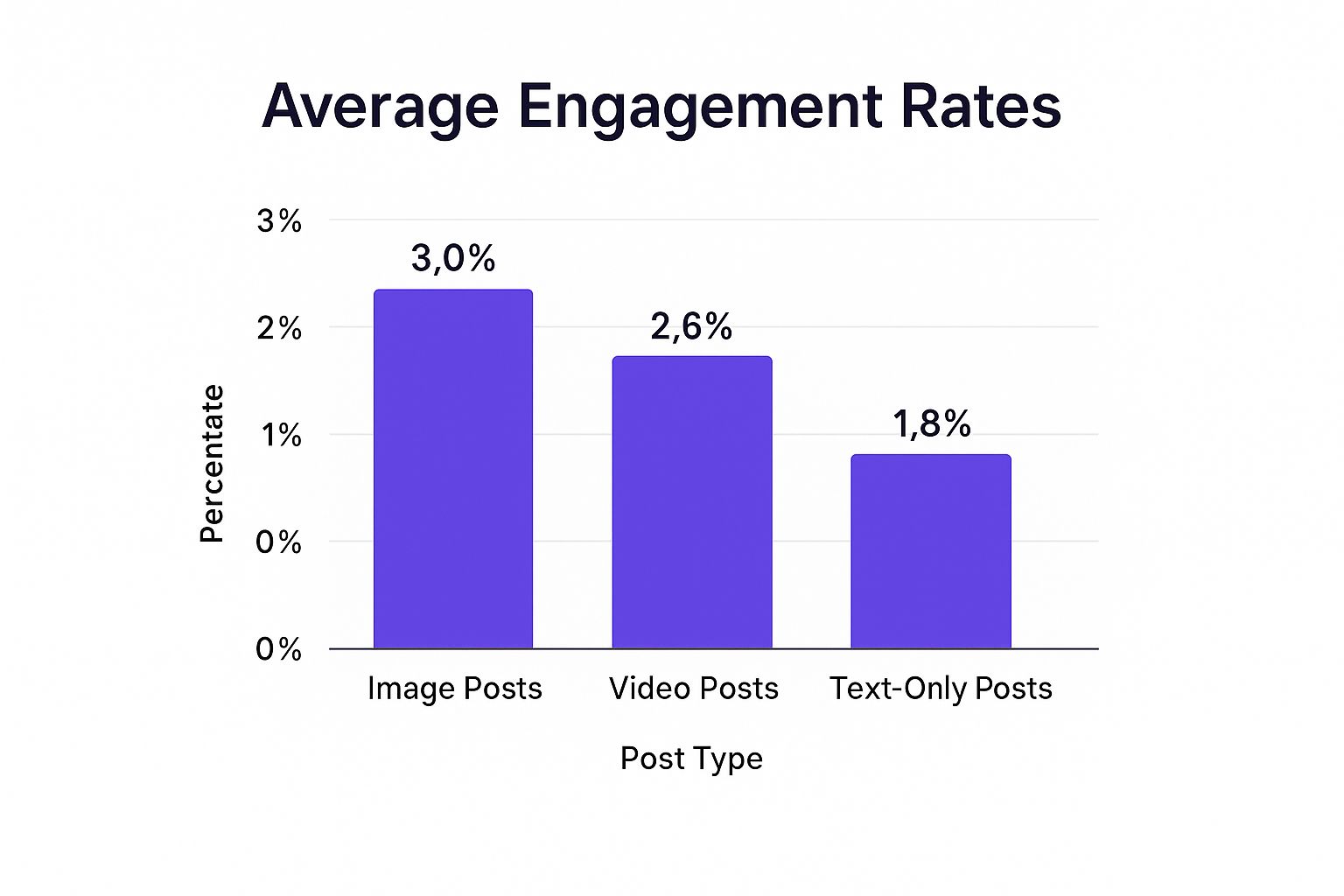
It’s pretty clear from this data that video often sparks the most interaction, making it a go-to format if you're trying to get a conversation started.
Your analytics aren't a report card; they're a roadmap. Think of every data point as a clue telling you what to create next to better serve your audience and drive genuine connection.
Key Engagement Metrics and What They Mean
To truly understand your performance, you need to know what you're looking at. This table breaks down some of the most important metrics you'll find in your analytics dashboards.
| Metric | How to Calculate It | What It Tells You |
|---|---|---|
| Engagement Rate | (Total Likes + Comments + Shares + Saves) / Total Followers x 100 | The percentage of your followers who actively interact with your content. It's a great measure of overall content quality and audience health. |
| Reach | The total number of unique users who saw your post. | Your content's overall visibility. High reach means your post is spreading beyond your immediate followers. |
| Shares | The number of times users shared your post to their own stories, feeds, or direct messages. | This is a huge vote of confidence. It means your content was so valuable or entertaining that someone wanted to be associated with it. |
| Saves | The number of times users bookmarked or saved your post for later. | This indicates your content is evergreen or highly useful. People save things they want to come back to, like recipes, tips, or tutorials. |
| Comments | The total number of comments on a post. | A direct line to your audience. Comments show your content sparked a conversation and is a key indicator of community building. |
Looking at these numbers together gives you a much richer story than just watching your follower count go up. It helps you see why certain posts work and how you can replicate that success.
Beyond your own profile, you need to understand where you fit in the bigger picture. A great way to do this is to learn how to calculate your share of voice, which helps you see how much of the conversation in your niche you actually own compared to your competitors.
For an even deeper look at making your numbers work for you, check out our guide on https://repostly.app/blog/data-analytics-in-social-media-68aed59844be737efa9f3cc5. The goal isn’t to copy what others are doing, but to find the gaps where your brand can be the one to provide something unique and valuable.
Your Top Social Media Engagement Questions, Answered
Feeling like you're just throwing content out into the void? You're not alone. Social media engagement can feel like a mystery, with rules that seem to change every other week. Let's clear up some of the most common questions I hear from marketers and creators.
How Often Should I Post to Maximize Engagement?
Forget the idea of a magic number. Anyone promising a "one-size-fits-all" posting schedule is selling snake oil. The truth is, it's all about consistency and quality, not just blasting your followers with content.
Think about it: posting seven mediocre updates a week will do more harm than good. You’ll just end up training your audience to ignore you. It's far better to post three genuinely valuable pieces of content that get people talking.
As a starting point, aim for 3-5 high-quality posts per week on platforms like Instagram and Facebook. For something faster-moving like X (formerly Twitter), you might need to dial that up a bit. The real goal isn’t just to show up; it's to show up with something worth your audience's time.
It's far better to be consistently good than to be frequently average. Your audience rewards quality with their attention, and attention is the currency of social media.
Your own analytics are your best friend here. Dive into your data to see when your specific audience is online and active. Test different schedules and watch what happens. Don't just track when you post—track when engagement actually spikes. That's your roadmap.
What's the Best Way to Handle Negative Comments?
First things first: don't panic. A negative comment isn't a personal attack. It's actually a golden opportunity to show off your fantastic customer service to everyone watching. The core rule here is simple: address it publicly, professionally, and quickly.
Whatever you do, don't delete the comment unless it's clear spam, abusive, or contains hate speech. Deleting genuine criticism makes it look like you have something to hide, and that almost always blows up in your face.
Instead, try this simple, three-step approach:
- Acknowledge: Jump in with a public reply that acknowledges their concern. Let them know they've been heard.
- Apologize: If your company made a mistake, own it. A sincere "we're sorry" goes a long way.
- Resolve Offline: Offer to move the conversation to a private channel like DMs or email to sort out the specifics. Something like, "We're so sorry to hear this. Please send us a DM with your order number, and we'll get this sorted for you right away."
This strategy shows your entire audience that you’re responsive, accountable, and genuinely care.
My Engagement Suddenly Tanked. What Do I Do?
Seeing your engagement fall off a cliff is nerve-wracking, but it's usually a fixable problem. Before you hit the panic button, run through a quick diagnostic.
First, do a quick Google search. Have there been any major algorithm changes on the platform? Sometimes, a drop has absolutely nothing to do with your content and everything to do with a platform-wide update.
Next, take a hard look at your recent posts. Did you recently switch up your content style, topic, or format? It’s possible your audience just isn't jiving with the new direction. Also, check your reach—a drop in engagement is often tied directly to a drop in how many people are seeing your posts in the first place.
To bounce back, get back to basics and focus on re-igniting your community.
- Run a poll or ask a direct question.
- Go live for an impromptu Q&A session.
- Share a super-valuable, "savable" piece of content, like a cheat sheet or a tutorial.
Proactively engaging with other accounts in your niche is also a great way to get your visibility back up.
Should I Be on Every Social Platform, or Focus on Just One?
This is one of the biggest mistakes I see people make: spreading themselves too thin. Trying to be everywhere at once is a surefire way to kill your engagement.
It is so much more effective to build a thriving, engaged community on one platform than to have a weak, ghost-town presence on five.
Each network has its own culture, its own language, and its own audience. Do your homework to figure out where your ideal customers actually spend their time online, and then go all-in there. Once you've built a strong foundation and have a system that works, you can start thinking about strategically expanding to another platform.
Ready to save time and boost your engagement across all your platforms? Repostly lets you schedule, automate, and analyze your social media content from one simple dashboard. See how over 10,000 creators are saving 5+ hours a week and increasing their reach. Start your free trial today at https://repostly.app.