Small Business Social Media: Boost Your Brand Today
Learn how small business social media can help you grow your brand, connect with customers, and increase sales. Get started now!
Think of using social media for your small business like setting up a shop on the busiest street in the world. It’s your chance to connect directly with customers, build real relationships, and grow your brand without needing a giant marketing budget. It's not just a nice-to-have anymore; it's a must-do.
Why Social Media Is Your Digital Storefront
Picture the main street in your town or a lively city square. It's where people meet, chat, and check out new places. Social media is today's version of that town square. For a small business, being active on these platforms means you’re not just watching from the sidelines—you're part of the community where your customers already spend their time.
Your website might be your official headquarters, but your social media profiles are the friendly faces out front, welcoming people in. They give a sneak peek of who you are and what you're about, starting a conversation long before a sale ever happens. This is how you build real brand awareness—not by yelling into the void, but by sharing things people actually find useful and interesting.
Leveling the Playing Field for Growth
Big companies can throw a ton of money at traditional ads, but on social media, things are different. Here, creativity and a genuine voice can easily outperform a big budget. This really levels the playing field, giving your small business a shot to stand out. You get to talk directly with your audience, get instant feedback, and build a loyal following of people who feel connected to your journey.
And it’s about more than just getting seen. A smart social media plan can help you:
- Build a real community: Create a place where customers can talk to you and each other, turning casual followers into your biggest fans.
- Get more website traffic: Share links to your products, blog posts, and services to lead interested people right where you want them to go.
- Find quality leads: Use targeted posts and ads to reach people who are actually looking for what you sell, making your sales process a whole lot easier.
You Can’t Argue With the Numbers
The data makes it crystal clear just how important these platforms are. By 2025, social media has become a core marketing tool, with over 96% of small business owners using it in their strategies. This is no surprise when you consider there are over 5.07 billion active users worldwide, spending an average of 143 minutes a day scrolling. You can read more about the latest social media for business statistics on cropink.com.
It’s simple: your customers are on social media. Every single day. The real question isn’t if you should be there, but how you can show up in a meaningful way that builds trust and brings in business.
At the end of the day, using social media for your small business isn't just about posting pretty pictures. It's about making real connections, one follower at a time. It's the modern-day word-of-mouth that helps you grow for the long haul by becoming a part of your customers' daily lives.
Choosing the Right Platforms for Your Business
When you're starting out, it's tempting to jump on every social media platform at once. It feels productive, right? But this is one of the most common mistakes I see small businesses make. It’s like trying to have a meaningful conversation in a dozen different rooms at the same time—you end up spread way too thin, your message gets diluted, and you burn out fast.
A much smarter small business social media strategy is to focus your energy where it will actually make a difference.
Think of it like fishing. You wouldn't cast a line into a mountain stream hoping to catch a marlin. You have to go where the fish you want are already swimming. Each social media platform is its own unique ecosystem, with its own audience, culture, and preferred style of content.
Align Your Business with the Right Audience
The very first step is getting crystal clear on who you're trying to reach. Are you selling handcrafted jewelry to millennials? Offering financial consulting to corporate executives? Or sharing home renovation tips with DIY enthusiasts? The answer is your roadmap, pointing you directly to the right platforms.
A visual brand, like a local bakery or a fashion boutique, is going to feel right at home on Instagram, where beautiful images and videos are king. On the flip side, a B2B software company will get far more traction on a professional hub like LinkedIn.
Your goal isn't to be everywhere; it's to be somewhere meaningful. Choosing one to three core platforms lets you create high-quality, focused content that truly connects with a specific audience, which always beats a scattered, generic approach.
This isn't just a gut feeling; the data backs it up. For instance, 91% of B2C small businesses lean on Facebook because of its massive and diverse user base. Meanwhile, 86% of B2B marketers focus their efforts on LinkedIn to connect with other professionals in their industry.
A Snapshot of Platform Popularity
This chart gives you a quick look at where most small businesses are spending their time. It's a great way to see the current trends at a glance.
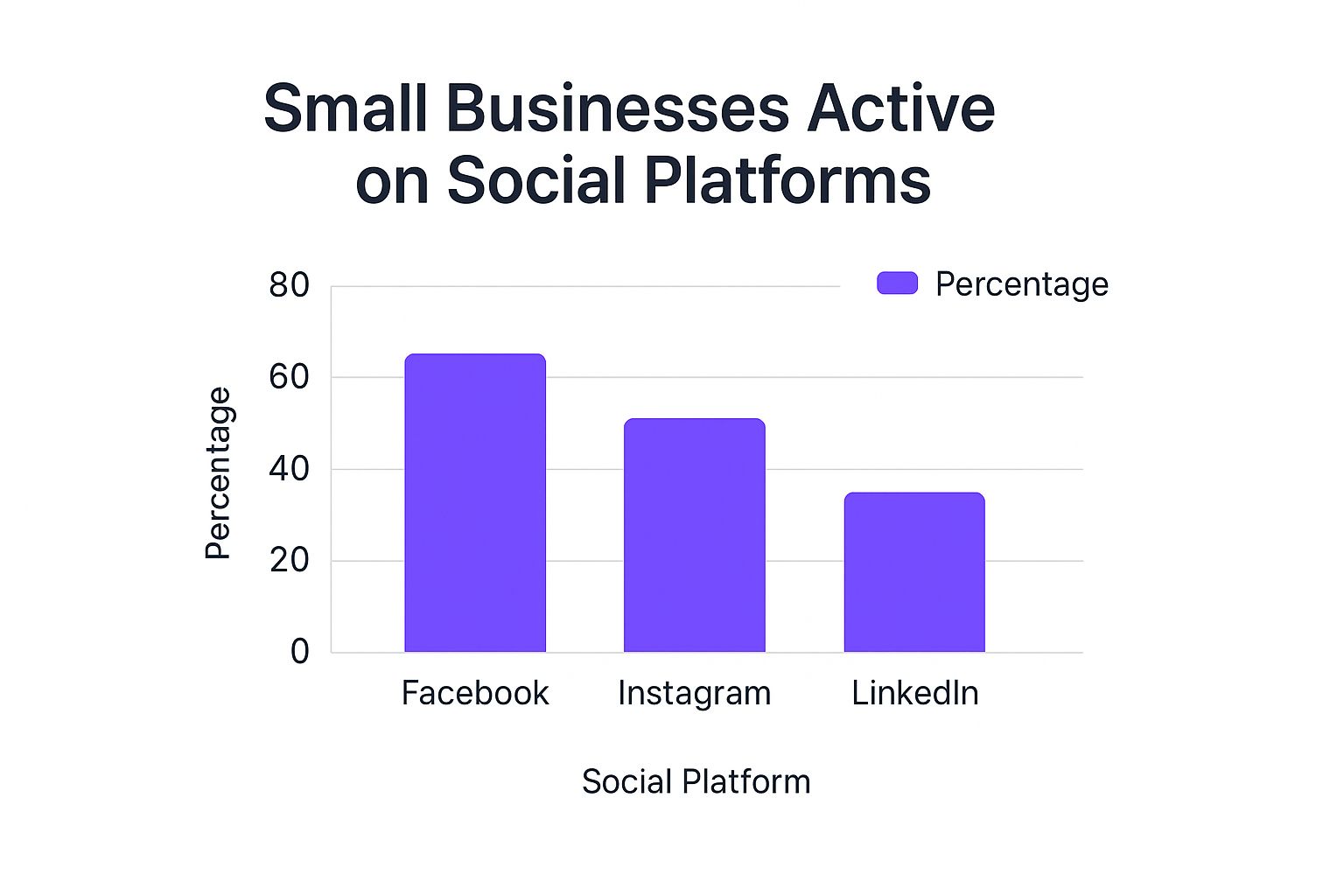
As you can see, Facebook is still the top choice for many, but a huge number of businesses are also tapping into the visual power of Instagram and the professional clout of LinkedIn to grow.
Which Social Media Platform Is Best For Your Small Business
To make the right call, you need to understand what each platform brings to the table. Let's break down the major players to help you find the perfect fit. If you want to go even deeper, our complete guide to social media marketing for small business has you covered.
Here’s a simple comparison to get you started.
| Platform | Primary Audience | Best For Content Type | Ideal Business Type |
|---|---|---|---|
| Broad demographic, primarily Gen X and Millennials (ages 25-55+) | Community building, ads, news updates, and diverse content formats. | Almost any business, especially local services, retailers, and community-focused brands. | |
| Younger demographic, primarily Millennials and Gen Z (ages 18-34) | High-quality visuals, short-form video (Reels), Stories, and influencer collaborations. | E-commerce, fashion, beauty, food, travel, and any visually driven brand. | |
| Professionals, B2B decision-makers, and job seekers (ages 25-49) | Industry insights, company news, professional networking, and long-form articles. | B2B services, consulting, tech companies, and professional service providers. | |
| TikTok | Primarily Gen Z and younger Millennials (ages 16-24) | Short, entertaining, and trend-based videos with a focus on authenticity. | Brands targeting a younger audience, especially in lifestyle, entertainment, and e-commerce. |
| X (Twitter) | Broad audience interested in real-time news and conversations | Quick updates, news-jacking, customer service, and public conversations. | Media, tech, SaaS, and brands with a strong public voice or need for immediate customer interaction. |
| Predominantly female audience interested in discovery and inspiration | High-quality images (infographics, tutorials), product discovery, and visual guides. | DIY, home decor, wedding planning, food blogs, and retail products. |
By really thinking through this breakdown, you can confidently pick the platforms where your ideal customers are already hanging out. This focused approach will save you time, protect your marketing budget, and ultimately drive much better results for your business.
Developing a Content Strategy That Connects

Okay, you’ve picked your platforms. Now comes the million-dollar question: "What on earth do I actually post?" Staring at a blank content calendar can be daunting, but it doesn't have to be. A good content strategy is your roadmap, guiding you to create posts that truly resonate with your audience without burning you out.
Think of your small business social media feed like you're hosting a great dinner party. You wouldn't serve your guests the same dish over and over, right? You’d mix it up with appetizers, a main course, and dessert to keep everyone happy and engaged. Your social media content should work the same way by offering a variety of valuable, entertaining, and promotional posts.
Building Your Content Pillars
One of the best ways to simplify content creation is to use the content pillar framework. It sounds fancy, but it's really simple. Content pillars are just three to five core topics or themes that your brand will consistently talk about. These pillars should tie directly back to your business and the things your audience genuinely cares about. They become your go-to "buckets" for ideas, making sure everything you post feels connected and on-brand.
Let's say you run a local coffee shop. Your content pillars could look something like this:
- Coffee Education: Simple posts explaining different brewing methods, where your beans come from, or what certain flavor notes mean.
- Behind the Scenes: Showcasing your amazing baristas, the roasting process, or just the day-to-day vibe of the shop.
- Community Events: Highlighting the local artist whose work is on your walls, promoting an open mic night, or shouting out a nearby business you've partnered with.
- Menu Spotlights: Delicious shots of your new seasonal latte, a close-up of a fresh-baked pastry, or announcing a new special offer.
Once you have these pillars, you'll never be stuck for ideas again. Every post idea can be neatly filed under one of your core themes, helping you build a cohesive and compelling brand story.
The goal is to stop thinking post-by-post and start thinking theme-by-theme. This framework lets you batch-create content and generate a steady stream of ideas that truly resonate with your followers.
Choosing the Right Content Formats
With your pillars in place, it’s time to think about how you'll present those ideas. Different content formats are better suited for different platforms and goals. Mixing it up is key to keeping your feed from feeling stale.
Here are a few popular formats to play with:
Short-Form Video (Reels, TikToks, Shorts): These are absolute gold for grabbing attention fast. Think behind-the-scenes clips, quick how-to's, or just hopping on a fun audio trend. They’re fantastic for boosting your reach and showing off your brand's personality.
Carousels and Image Slideshows: Perfect for breaking down bigger ideas into bite-sized, swipeable chunks. Use them for step-by-step guides, lists of tips, or to tell a visual story. Carousels get a lot of saves, which is a great signal to the platform's algorithm.
High-Quality Photos: The classic for a reason. Crisp, beautiful images are essential for showing off your products, introducing your team, or sharing photos from happy customers (with their permission, of course!).
Text Posts and Stories: Never underestimate the power of good old-fashioned words. Use text-based posts on platforms like X or LinkedIn to share industry insights and spark conversations. On Instagram, use Stories for interactive polls, Q&As, and quizzes to get your audience talking back to you.
No matter the format, authenticity is what really counts. For example, Instagram stands out as a highly engaging platform, where 69% of users say they find the best content from brands. And get this: content shot on a regular phone often outperforms slick, professional ads by 63%, which just goes to show that people crave connection, not perfection. You can discover more insights about small business trends on bizplanr.ai.
At the end of the day, a winning content strategy is all about providing value first. Solve your audience's problems, answer their questions, make them laugh, or inspire them. Do that consistently, and you'll build the trust that turns casual followers into loyal customers.
Turning Followers Into a Loyal Community
A great content plan is a huge first step, but social media is a conversation, not a megaphone. Just blasting out your message is like a shopkeeper shouting sale prices from behind a closed door. To really get social media working for your small business, you have to open that door, invite people inside, and actually talk to them. This is how you stop collecting followers and start building a real community.
Think of it like being the owner of a small-town shop. You know your regulars by name, you ask about their day, and you remember what they like. That personal touch builds a kind of trust and loyalty that a slick ad just can't buy. Online, we call this engagement, and it’s the digital version of that same handshake.
The Art of the Two-Way Conversation
Engagement isn't just another number to track; it's the pulse of your online community. When someone takes a minute out of their day to comment, send a message, or share your post, they're essentially raising their hand and saying, "Hey, I'm here!" Ignoring that is a huge missed opportunity.
Responding with care is your secret weapon. Sure, a quick "thanks!" is fine, but a reply that actually references what they said shows you're paying attention. If someone asks a question, answer it right there in the comments for everyone to see. It’s a simple gesture that proves there's a real person behind the brand who genuinely cares.
A follower count is just a number. A community is a powerful asset. By actively engaging, you invest in building relationships that fuel long-term growth and create genuine brand loyalty.
If you're looking for fresh ideas to get the conversation flowing, check out these proven social media engagement strategies that can help you spark more meaningful interactions.
Putting Your Audience in the Spotlight
Want to know one of the best ways to build a community? Make your audience the star. I'm talking about user-generated content (UGC)—all those photos, videos, and reviews your customers create that feature your brand. When you share UGC (always ask for permission first!), you hit a home run.
- You get real, authentic content: UGC is basically a visual testimonial. It shows new customers that real people are already using and loving your products.
- You make your customers feel amazing: Getting a shout-out from a brand you love is a big deal! It makes people feel seen and encourages them to keep sharing.
- You build a stronger bond: It creates this awesome feedback loop where your customers feel like they’re part of your story, not just people buying your stuff.
A great way to get started is by creating a unique hashtag for your brand. Put it in your bio, mention it in your posts, and maybe even run a contest for the best photo or video submission.
Fostering Belonging with Interactive Content
Today’s social media platforms are packed with tools designed to get people talking. Using them isn't just for fun; it's a way to invite your audience to play an active role in your brand. It makes them feel like they're part of an exclusive club.
Try weaving these features into your regular content plan:
- Polls and Quizzes: Use Instagram Stories or X polls to ask for opinions. It can be anything from "Which new product design do you like best?" to a fun, silly question just to break the ice.
- Q&A Sessions: Host an "Ask Me Anything" (AMA) on a live video or with a Story sticker. This is an incredible way to share what you know and show people the human side of your business.
- Exclusive Groups: Think about creating a private Facebook Group or an Instagram "Close Friends" list for your top fans. This gives them a special space to connect and fosters a powerful sense of belonging.
When you consistently create these little moments for conversation, you stop being just another account people scroll past. You start building a thriving digital neighborhood with your brand right at the center.
5. Work Smarter, Not Harder: Using Tools to Manage Your Social Media

Let's be honest: as a small business owner, you're already wearing a dozen different hats. Juggling content creation, posting schedules, and customer engagement can feel like a full-time job in itself. The secret isn't to work harder; it's to work smarter by letting technology be your marketing assistant.
Smart tools take care of the repetitive, time-sucking tasks. This frees you up to focus on what really matters in small business social media—your strategy and building genuine connections with your audience.
The Magic of Scheduling
Imagine this: you set aside a few hours on Monday morning and knock out all of your social media posts for the entire week. That’s the power of content batching, and scheduling tools make it a reality. Instead of scrambling to post something new every single day, you can get it all done in one go.
Tools like Buffer, Later, and Hootsuite are built for this very purpose. They let you:
- Plan your content: Lay out your posts on a visual calendar to make sure you have a good mix of content.
- Post on autopilot: Schedule everything to go live at the best times for each platform, even if you’re away from your desk.
- Stay consistent: Keep a steady stream of content flowing to your audience without the daily grind.
This simple shift changes your workflow from reactive to proactive. It gives you back precious time to actually talk to the people commenting on your posts. For a closer look, check out our guide to the best social media automation tools and find the perfect one for your business.
Your New Creative Partner: AI
Artificial intelligence isn't some far-off concept anymore; it's a practical tool that can seriously boost your content creation. Think of AI as a brainstorming buddy that never gets tired or runs out of ideas. It can help you smash through writer's block and sharpen your message in minutes.
AI doesn't replace your brand's voice; it just helps you find it faster. It handles the heavy lifting so you can add the human touch that makes your business special.
AI-powered tools can help with everything from writing first drafts of captions to giving you fresh angles on a topic. There's a reason so many are jumping on board: a whopping 90% of businesses using AI report saving a ton of time, and 73% see better engagement.
Bring It All Together
Beyond just scheduling, a new wave of tools helps you manage your entire social media presence from one place. This unified dashboard approach ends the chaos of bouncing between different apps and browser tabs, saving you both time and sanity.
To truly streamline your process, look into social media marketing tools built specifically for small businesses. These platforms often roll scheduling, analytics, and content management into one clean package. For some great recommendations, check out this list of the Top Social Media Marketing Tools for Small Businesses.
By picking the right tech, you can put your social media growth on a kind of autopilot, keeping your brand active and engaged while you get back to running your business.
5. Measure What Matters
https://www.youtube.com/embed/ol0v779BlAA
Putting content out there is a great start, but it's only half the job. To really win at small business social media, you have to know what's landing with your audience and what's falling flat.
Diving into social media analytics can feel like trying to drink from a firehose. There are charts, graphs, and a ton of confusing terms. But here's the secret: you just need to ignore most of it and focus on the numbers that actually move the needle for your business.
Think of it like the dashboard in your car. You don't need to be a mechanic to know that the gas gauge and the speedometer are what really count. It's the same with social media—a few key metrics will tell you if you're heading in the right direction.
Look Past the "Vanity Metrics"
It’s always a rush to see a post get a ton of likes. But vanity metrics, like the number of likes or followers you have, don't paint the full picture. Sure, they feel good, but they don’t automatically lead to business growth.
A post with 500 likes that brings zero visitors to your website is far less valuable than a post with 50 likes that scores you five new customers.
The big question isn't, "How many people liked this?" Instead, ask yourself, "What did people do after they saw this?" Shifting your focus this way is what turns a busy social media account into a profitable one.
The Metrics You Should Actually Be Tracking
The good news is that every social media platform has its own free analytics tool, like Meta Business Suite for Facebook and Instagram or the built-in analytics on LinkedIn. These are your new best friends.
When you're starting out, just focus on these core numbers:
- Reach: This is the total number of unique people who saw your content. It’s a great way to see how far your message is spreading beyond your current followers.
- Engagement Rate: This tells you how much your audience is actually interacting with your posts through likes, comments, shares, and saves. It’s a powerful sign that your content is hitting the mark. To really get a handle on this, you'll want to track the essential social media engagement metrics.
- Click-Through Rate (CTR): This is the percentage of people who clicked a link in your post. If your goal is to get people to your website or a specific landing page, this metric is absolutely vital.
- Conversions: This is the holy grail. It tracks how many people took the action you wanted them to take—making a purchase, signing up for a newsletter, or filling out a form—after coming from your social media.
Tracking these numbers helps you understand what resonates with your audience so you can do more of what works.
Key Social Media Metrics And What They Mean
To make it even clearer, here's a quick breakdown of what to watch and why it's important for your small business.
| Metric | What It Measures | Why It's Important For Your Small Business |
|---|---|---|
| Reach | The unique number of people who saw your content. | Shows your brand awareness and potential audience size. |
| Engagement | Clicks, comments, shares, and reactions to your posts. | Indicates how well your content resonates with your audience. |
| CTR | The percentage of people who clicked on a link in your post. | Measures how effective your call-to-action is at driving traffic. |
| Conversions | The number of people who completed a desired action (e.g., a sale). | Directly links social media activity to business goals like leads or revenue. |
This table is just the beginning. For a deeper dive into setting up your own reports, our guide on key social media metrics and reporting can help you build a simple dashboard that makes sense.
Proving Your Social Media ROI
Finally, let's talk about Return on Investment (ROI). This simple calculation proves that the time and money you're putting into social media are actually worth it. While you can get fancy with it, all you really need is a basic formula:
(Profit from Social Media - Cost of Social Media) / Cost of Social Media x 100 = ROI %
For instance, if you spent $100 on a social media ad campaign and it brought in $500 in sales, your ROI is a whopping 400%.
Tracking this helps you make smarter decisions with your budget and confidently shows that your marketing efforts are paying off. When you focus on these meaningful numbers, you can steer your social media strategy toward real, sustainable growth for your business.
Answering Your Biggest Social Media Questions

Jumping into social media for your business can feel like you’ve been handed a pop quiz. New questions pop up just when you think you've got it all figured out.
Let's clear up some of the most common hurdles with simple, direct answers. Think of this as your go-to cheat sheet for making smart social media moves.
How Often Should My Business Post on Social Media?
There’s no magic number here, but the real key is consistency over frequency. It’s far better to share high-quality content a few times a week than to post daily just for the sake of it.
For platforms like Facebook and Instagram, aiming for 3-5 solid posts per week is a fantastic starting point. This creates a reliable rhythm your audience can get used to. Planning your content in a calendar and using a scheduling tool will help you keep up the pace without burning out.
Always keep an eye on your analytics. If you ramp up your posting and see engagement drop, that’s your audience telling you to focus more on quality, not quantity.
The best posting schedule is the one you can stick to without sacrificing quality. Don’t chase an arbitrary number. Start slow, be consistent, and let your audience’s feedback guide you.
How Much Should a Small Business Spend on Social Media Ads?
Good news: you don't need a huge ad budget to make an impact. Many small businesses see great results by starting small—think $5 to $10 a day—to test the waters with different ad types and audiences. This approach lets you learn what works without a major financial commitment.
A great trick is to "boost" your best-performing organic posts. If a post is already a hit with your followers, a little paid push can help it reach a much wider audience that's likely to love it, too. Once you know what's driving real results, like clicks or sales, you can confidently increase your spend.
Brands clearly see the value here, with global social media ad spending projected to reach around US$276.72 billion in 2025. You can dig into more small business statistics from bizplanr.ai. For you, it’s all about starting smart and scaling up based on what's proven to work.
What's the Easiest Way to Create Visuals Without a Designer?
You don't need a design degree to create stunning visuals anymore. Modern tools have made it incredibly easy for anyone to make professional-looking content.
- Lean on Template-Based Tools: Platforms like Canva are a total game-changer. They give you thousands of pre-made, customizable templates for everything from Instagram posts to short videos. Just drop in your logo, tweak the colors, and you’ll have polished content in minutes.
- Use Your Smartphone: Seriously, don't underestimate the camera in your pocket. Authentic, behind-the-scenes photos and videos often connect better with audiences because they feel real. Show off your workspace, introduce your team, or give a sneak peek of a new product—people love that genuine feel.
Ready to stop juggling multiple platforms and start saving time? With Repostly, you can schedule and automate your posts across all your social accounts from one simple dashboard. Get back over five hours a week and watch your reach grow. Start your free 7-day trial today at https://repostly.app and see the difference for yourself.
Keep reading

10 Fresh Instagram Story Idea Tactics for 2025
Stuck for content? Discover our top Instagram story idea list, with actionable tips to boost engagement and grow your audience in 2025.
A Practical Social Media Planner for German Markets
Build a results-driven social media planner for Germany. This guide offers actionable strategies for content, scheduling, and analysis in the German market.

Crafting Your Social Media Content Plan
Stop guessing and start strategizing. This guide provides an actionable social media content plan to audit, plan, and execute content that gets results.
Post once. Show up everywhere.
Start your 7-day free trial and publish your next video to every platform in minutes.Pick a plan and publish your next video to every platform in minutes.
Start your free trialSee plansCancel anytime