How to Measure Social Media ROI for Your Business
A practical guide on how to measure social media ROI. Learn to set goals, track the right metrics, and calculate the true value of your marketing efforts.

To truly measure your social media ROI, you need a simple but powerful formula: (Profit − Investment) ÷ Investment × 100. This calculation requires you to define clear business goals, track metrics that go far beyond simple likes, and, crucially, assign a real monetary value to actions like lead generation or direct sales.
Why You Need to Measure Social Media ROI Now

Relying on vanity metrics like follower counts and likes is a relic of the past. It's no longer enough to justify your social media budget. In today's competitive market, every pound spent has to demonstrate a clear contribution to the bottom line. Measuring your return on investment (ROI) is the only real way to prove the value of your social media efforts and make data-driven decisions that fuel genuine growth.
This isn't just about appeasing the finance department; it's a strategic imperative. When you have a firm grasp of your social media ROI, you can allocate resources with confidence, double down on what’s working, and cut out the wasteful spending. This process fundamentally shifts the perception of social media from a cost centre to a proven revenue driver.
Before we dive deeper, let's break down the core components you'll need to get a handle on. This table gives you a quick reference for the essential elements involved in any ROI calculation.
Core Components of Social Media ROI Calculation
| Component | Description | Example |
|---|---|---|
| Profit | The net income generated from your social media activities after all costs are deducted. This is the "return" part of the equation. | Revenue from sales driven by a social campaign. |
| Investment | The total cost associated with your social media efforts. This includes tools, ad spend, labour, and content creation. | £1,000 in Facebook ad spend + £500 for a content creator's time. |
| Metrics | The specific data points you track to measure success. These must be tied to your business objectives. | Conversion rate, cost per lead, customer lifetime value. |
| Attribution | The method used to connect a specific social media action (like a click or view) to a desired business outcome (like a sale). | Using UTM parameters in links to track sales from a specific Instagram post. |
Understanding these elements provides a solid framework for everything that follows. It's the foundation for building a measurement strategy that actually means something to your business.
Moving Beyond Surface-Level Metrics
For years, marketers were happy to report on growing engagement. But let's be honest, a "like" doesn't directly pay the bills. The real challenge—and the biggest opportunity—is to connect that online buzz to tangible business outcomes.
That means shifting your focus to metrics that truly matter:
- Conversions: How many people actually completed a desired action? This could be making a purchase, signing up for your newsletter, or downloading a guide.
- Lead Generation: How many high-quality leads did your latest LinkedIn or Facebook campaign bring in?
- Customer Lifetime Value (CLV): Are the customers you acquire through social media more valuable over the long term compared to those from other channels?
Economic pressures have also made ROI tracking absolutely essential. For example, the current economic and budgetary climate heavily influences how German marketers assess social media performance. With Germany’s digital ad market projected to grow, businesses are laser-focused on optimising their marketing budgets for maximum efficiency.
A Nielsen survey revealed that 60% of European marketers, including many in Germany, have trimmed their advertising expenditures due to regional economic uncertainties. Despite these cuts, they continue to prioritise social media because it offers more measurable returns than traditional advertising. You can learn more about these trends from insights on the German digital marketing landscape.
The ultimate goal is to draw a straight line from a tweet, post, or video directly to a sale or a qualified lead. This is how you demonstrate undeniable value and secure ongoing investment in your social strategy.
Knowing your ROI allows you to speak the same language as the C-suite, justifying your budget with hard numbers instead of fuzzy metrics. It empowers you to refine your strategy, prove your team's worth, and ultimately make smarter, more profitable decisions.
Setting Goals That Actually Drive Business Value
Let's be honest: tracking metrics without a clear purpose is a waste of time. It's like driving without a destination—you're moving, sure, but you're not getting anywhere that matters. Before you can even begin to measure social media ROI, you have to define what success actually looks like for your business.
This means setting sharp, specific objectives that draw a straight line from your social media activity to tangible business outcomes. Simply aiming for "more engagement" isn't a goal; it's a wish. A powerful objective is specific, measurable, achievable, relevant, and time-bound (the classic SMART framework), but crucially, it must connect directly to revenue, customer acquisition, or brand equity.
From Vague Hopes to Concrete Objectives
It's time to move beyond generic targets. The right objective for an e-commerce brand is going to be completely different from that of a B2B tech firm. Your goals need to be customised to your business model and what you're trying to achieve right now.
Here’s how that looks in the real world:
For an E-commerce Brand: The name of the game is usually direct sales. A solid objective would be: "Increase website sales originating from Instagram product tags by 15% in the next quarter." It’s specific, measurable, and tied directly to the bottom line.
For a B2B Tech Firm: Here, the focus shifts to lead generation. A much stronger goal is: "Generate 50 marketing-qualified leads (MQLs) from our LinkedIn content campaign on AI integration within the next 60 days." This prioritises the quality of leads, not just the quantity.
For a Local Service Business (e.g., a plumber): The goal is often a mix of local awareness and immediate leads. For them, a great objective might be: "Increase inbound phone calls from Facebook ads targeting our service area by 25% over the next month."
Each of these goals gives you a clear benchmark for success. They give your social media efforts a real purpose and make the ROI calculation that follows much more straightforward, because you know exactly what you're measuring against.
The most critical step in this process is connecting each goal to a monetary value. Without a pound sign attached, your ROI calculation will always be incomplete.
Assigning Monetary Value to Your Goals
This is where many marketers stumble, but it's simpler than you might think. The key is to figure out what a specific action or conversion is actually worth to your business. This is how you turn abstract goals into the hard figures needed for the ROI formula.
Let’s break down how to calculate this value.
Calculating the Value of a Lead
For a B2B company, not every lead turns into a customer. To find the value of a single lead, you just need to work backwards from the final sale.
- Start with your average customer lifetime value (CLV): Let’s say your average client is worth £5,000 over their lifetime.
- Find your lead-to-customer conversion rate: If you know from experience that 1 in 10 leads from LinkedIn becomes a paying customer, your conversion rate is 10%.
- Calculate the value per lead: Now, just multiply the CLV by the conversion rate. In this example, that's £5,000 x 0.10 = £500.
Just like that, you know that every qualified lead generated from your LinkedIn campaign is worth £500 to the business. That number becomes the "Return" for each conversion in your ROI calculation.
Valuing E-commerce Conversions
This is much more direct for e-commerce stores. The easiest way is to use your Average Order Value (AOV). If a customer who clicks through from a Facebook ad typically spends £75, then each conversion from that ad is worth £75.
If you want to get more advanced, you can track the CLV of customers acquired through different social channels. You might find that customers from Instagram have a higher long-term value than those from TikTok, which is incredibly valuable information for your strategy.
Even "soft" goals like brand awareness can be assigned a value. For example, you could measure the value of increased website traffic by calculating what that traffic would have cost if you'd paid for it through PPC ads. By attaching a real monetary value to every goal, you transform your social media reports from a list of vanity metrics into a powerful analysis of genuine business impact.
Choosing the Right Metrics for Each Platform
Alright, you've set your goals. Now comes the part where so many marketers trip up: picking the right metrics to measure success. It’s easy to get lost in a sea of data or, worse, to chase vanity numbers that look impressive but don’t actually move the needle for your business.
The secret is to stop thinking about social media as a single entity. What matters on LinkedIn is often background noise on Instagram. Each network has its own audience, its own culture, and its own algorithm. Your measurement strategy has to reflect that. A sky-high engagement rate on Instagram is gold for a fashion brand, but for a B2B software company, it means very little compared to the number of clicks on a whitepaper link from LinkedIn.
Aligning Metrics with Platform Strengths
To get a true picture of your social media ROI, you have to connect your metrics to both your business goal and the platform's natural strengths. Trying to push hard sales on a network built for professional networking can feel like swimming upstream. Similarly, you wouldn't expect to get high-quality B2B leads from a short-form video app.
Let's get practical and see how this plays out on the major platforms.
Facebook for E-commerce: If you're selling products, you need to track actions, not just eyeballs. Your go-to KPIs should be Conversion Rate (how many clicks turned into a sale?), Cost Per Acquisition (CPA), and Return on Ad Spend (ROAS). These metrics tell you the real story of profitability.
LinkedIn for B2B Lead Quality: When your aim is to fill your sales pipeline, the game changes. Here, you should be laser-focused on metrics like Click-Through Rate (CTR) to your landing pages, the number of Marketing Qualified Leads (MQLs) you generate, and the Cost Per Lead (CPL). Post engagement is nice, but it's secondary to a potential customer actually taking a meaningful step.
Instagram for Brand Engagement: For businesses building a community and boosting awareness, engagement metrics really do matter. Keep a close eye on your Engagement Rate (likes, comments, shares, and saves), Story Views and Completion Rate, and your Follower Growth Rate. For platforms like these, understanding the nuances of Facebook and Instagram marketing strategies for engagement is crucial.
Here's the golden rule: If a metric doesn't help you understand whether you're getting closer to your specific, monetised business goal, it's a distraction. Focus on the few KPIs that truly matter.
Setting Up Reliable Data Tracking
Choosing your metrics is one thing; collecting clean, reliable data is another. You need to get comfortable with each platform's native analytics tools right from the start.
Get familiar with these essentials:
- Meta Business Suite: This is your control centre for Facebook and Instagram. Use it to track ad performance, audience demographics, and the conversion events you’ve set up with the Meta Pixel.
- LinkedIn Analytics: Found on your Company Page, this tool gives you deep insights into your followers, post performance, and the professional makeup of your audience.
- YouTube Studio: For video, this is the best in the business. It goes way beyond view counts, showing you critical data like Audience Retention, Traffic Sources, and CTR on your thumbnails.
To get a unified view without constantly switching tabs, a good social media management tool is a game-changer. Our guide on choosing the right metrics and reporting tools can help simplify this. Tools like Repostly pull all your data into a single dashboard, which is a massive time-saver.
It's also worth knowing the local context. For instance, in Germany, Facebook ads can reach over 39.4% of adults, and with 67.8 million Germans on social media, there's a huge opportunity to measure engagement and ROI effectively.
Comparing Metrics Across Goals and Platforms
Let’s pull this all together. A single business goal can demand wildly different metrics depending on the platform you're using. This is where you need to be strategic. The table below shows how you can adapt your measurement approach for different scenarios.
Platform Metrics Aligned with Business Goals
| Business Goal | Facebook/Instagram Metrics | LinkedIn Metrics | YouTube Metrics |
|---|---|---|---|
| Increase Sales | Conversion Rate, ROAS, Average Order Value (AOV) | Not ideal; focus on lead value instead. | Clicks to Product Pages, Conversions from In-Stream Ads |
| Generate Leads | Lead Form Completion Rate, Cost Per Lead (CPL) | MQLs Generated, CTR on Content Downloads, CPL | Subscribers from Gated Content, Clicks to Lead Magnets in Description |
| Build Awareness | Reach, Impressions, Video View-Through Rate, Share of Voice | Impressions, Follower Growth Rate, Company Page Views | Video Views, Audience Retention, Brand Mentions in Comments |
By tailoring your KPIs this way, you shift from a scattergun approach to a focused, strategic method of measurement. This kind of precision is exactly what you need to accurately calculate—and ultimately improve—your social media ROI.
The Practical Side of Calculating Your ROI
Right, let's get into the numbers. The formula for social media ROI is pretty simple on the surface: (Profit - Investment) / Investment x 100. But its real power comes from digging into what truly goes into each of those variables. Get this right, and your social media reports transform from a simple list of activities into a compelling statement of business value.
Let’s pull apart each piece of the puzzle, starting with the one that’s easiest to get wrong: your total investment. It’s so much more than just your ad budget.
Adding Up Your Total Social Media Investment
To get a genuinely accurate ROI, you have to account for every single pound you pour into your social media efforts. If you leave costs out, you’ll just end up with an artificially high return, which gives you a completely misleading picture of how things are really going.
Make sure your investment calculation always covers these key areas:
- Ad Spend: This is the obvious one. It’s the total cash you’ve spent on ads across platforms like Facebook, Instagram, LinkedIn, or TikTok for a specific campaign.
- Content Creation Costs: Did you bring in a freelance photographer or pay for a video shoot? Maybe you bought some stock images or clips? Those expenses are a direct part of your investment.
- Tools and Software: Don’t forget about the subscription fees for your social media management platform (like Repostly), analytics tools, or even design software like Canva.
- Labour Costs: This is the big one that many businesses miss. You need to calculate the cost of your team's time. Just multiply their hourly wage by the number of hours they spent on the campaign—from strategy and content creation to community management and reporting.
Once you’ve got that grand total for your investment, the next job is to figure out the value that investment actually generated.
Putting a Monetary Value on Your Returns
As we talked about earlier, "profit" doesn't always mean a direct sale. Your return is the total monetary value you generated from your social media work, all tied back to the specific goals you set in the first place. It's about turning actions into pounds and pence.
Let's look at a few common scenarios:
- An E-commerce Sale: This is the most straightforward. Let's say your Instagram campaign cost £1,000 to run and it brought in 50 sales with an average order value of £80. Your total return is simple maths: 50 x £80 = £4,000.
- A B2B Lead: Imagine your LinkedIn campaign generated 20 qualified leads. If you know from past data that each lead is worth about £500 to your business, your total return is 20 x £500 = £10,000.
- A Spike in Qualified Traffic: What if your main goal was driving traffic to a new service page? You can value this by working out what that same traffic would have cost you via pay-per-click ads. If your campaign drove 2,000 clicks and your average cost-per-click (CPC) on Google Ads is £2.50, then the value of that traffic is 2,000 x £2.50 = £5,000.
This process—assigning a real monetary value to outcomes—is absolutely crucial for measuring social media ROI properly. It makes sure you're comparing apples to apples when you finally run the numbers.
The key is to be realistic. The value you assign must be backed by your own data. Whether you're using average order value, customer lifetime value, or lead value, stick to your own business metrics for the most accurate calculation.
Putting It All Together: A Real-World Example
Let's see how this plays out in practice for a retail brand running an Instagram campaign for a new product line.
Goal: Drive sales for the new collection.
Campaign Duration: One month.
Investment Calculation:
- Ad Spend: £1,500
- Influencer Collaboration: £1,000
- Team's Time (20 hours at £25/hour): £500
- Total Investment: £1,500 + £1,000 + £500 = £3,000
Return Calculation:
- Direct sales tracked via UTM codes: 80 sales
- Average Order Value: £75
- Total Return: 80 x £75 = £6,000
Now, we just pop these figures into our ROI formula:
(£6,000 - £3,000) / £3,000 x 100 = 100%
A 100% ROI is brilliant. It means for every pound the brand invested, they got that pound back plus an extra pound in profit. This kind of clear, powerful metric is exactly what you need when you're talking about budgets and future strategy.
This visual breaks down the simple flow from identifying your costs and revenue to getting that final ROI percentage.
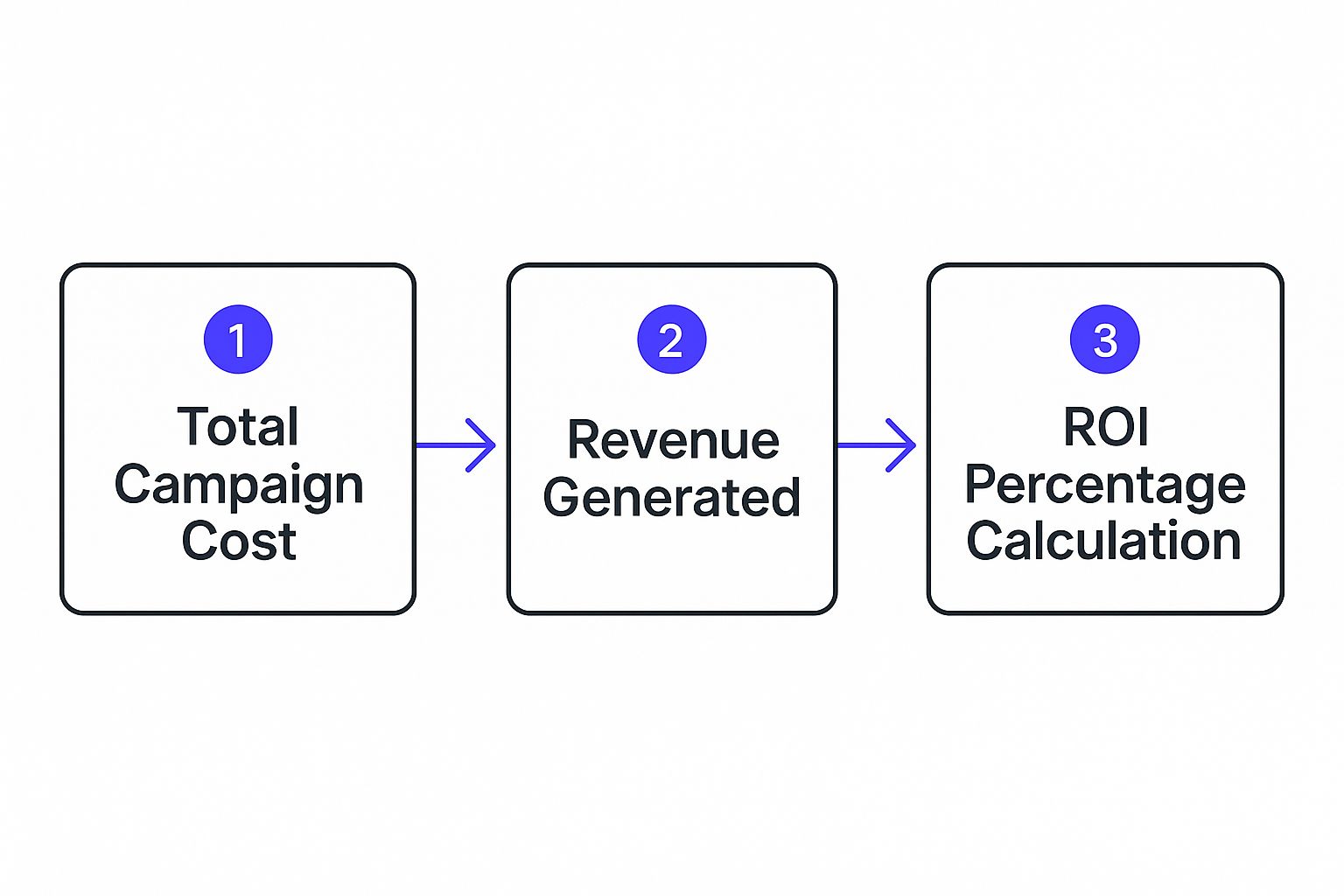
Seeing it laid out like this really shows that calculating ROI is a logical process, not some complicated dark art. If you want to speed things up, you can check out our guide on using a social media ROI calculator to handle the maths for you.
Tools and Tech to Simplify ROI Tracking
Let’s be honest: trying to calculate your social media ROI with a spreadsheet is a recipe for a headache. You’re bouncing between platforms, manually copy-pasting data, and hoping you haven’t made a mistake. It’s slow, tedious, and frankly, prone to error. The right tech stack doesn't just make this easier; it automates the heavy lifting and gives you a clear, consolidated view of what’s actually working.
You don't need a huge budget to get this right. The journey starts with the tools you already have—the native analytics dashboards built into Facebook, Instagram, LinkedIn, and the rest. These are your ground-level source for platform-specific insights. But the real magic happens when you bring all that scattered data together into one place.
Centralising Your Social Media Data
The fundamental problem with tracking ROI is that your data is all over the shop. Engagement metrics are on Instagram, lead gen data lives on LinkedIn, and the final conversion details are tucked away in your website analytics. This is precisely the problem a good social media management tool is built to solve.
Platforms like Repostly are designed for this exact purpose. They hook into all your social accounts and pull the most important performance indicators into a single, unified dashboard. This doesn't just save you from hours of mind-numbing data entry; it makes spotting trends and comparing channel performance incredibly straightforward. No more logging into five different apps—you get the full picture at a glance.
Here’s a glimpse of what that clarity looks like, bringing all your cross-platform efforts into focus.
This kind of visual reporting immediately tells you where engagement is highest, helping you make smarter, faster decisions. If you want to explore more options, this breakdown of the best social media analytics tools is a great place to find the perfect fit for your specific needs.
Connecting Social Activity to Website Conversions
Most of your social media activity is designed to drive people to your website, so bridging that gap is critical for measuring ROI. This is where Google Analytics 4 (GA4) becomes an indispensable part of your toolkit. By using UTM parameters—little bits of code added to your URLs—you can tell GA4 exactly which social post sent a visitor your way.
When you share a link, your UTM tags should specify the:
- Source: (e.g.,
facebook,linkedin) - Medium: (e.g.,
social,cpc) - Campaign: (e.g.,
spring_sale,q2_webinar)
This setup reveals precisely which posts, campaigns, or platforms are driving traffic, sign-ups, and sales on your site. From there, you can assign a monetary value to these conversions right inside GA4, which gives you the "Profit" part of your ROI calculation.
Tracing the Full Customer Journey
For many businesses, especially in B2B, the journey from lead to customer can take months. A click on a LinkedIn post today might not turn into revenue until the next quarter. This is where a Customer Relationship Management (CRM) system like Salesforce or HubSpot is invaluable.
By integrating your CRM with your website and social tools, you can follow a lead from their very first interaction with a social post all the way to the final sale. This gives you an incredibly clear picture of which channels are producing your most valuable customers, not just the most leads.
This complete view is the gold standard for ROI tracking. It proves the long-term value of your social media activities by connecting them directly to closed deals and actual revenue.
To make sure your paid social efforts are as efficient as possible, it's also worth looking into services like a free ad account audit. This can help you spot any wasted spend and ensure your investment is working as hard as it can. By combining platform analytics, web analytics, and your CRM, you create a powerful, interconnected system that makes measuring your true social media ROI an accurate and repeatable process.
Got Questions About Social Media ROI? We've Got Answers.
Even the most seasoned marketers run into tricky situations when it comes to measuring social media ROI. Let's tackle some of the most common questions that come up and get you the clear, practical answers you need.
How Do I Track ROI for Goals That Aren't About Sales?
This is a classic. What happens when your goal isn't a direct purchase, but something like building brand awareness or improving customer sentiment? The trick is to assign a "proxy value"—a realistic monetary figure—to these non-financial wins.
Just ask yourself: what would we have paid to get this result another way?
- Brand Awareness: Think about your organic reach and impressions. What would it have cost to buy that same visibility with paid ads? If you generated 500,000 impressions from a campaign and your typical CPM (cost per thousand impressions) is £10, that awareness is worth £5,000.
- Customer Service: How many support tickets are you closing on social media instead of through your call centre? If every call centre interaction costs your business £8 and your team handles 100 queries on Twitter each month, you've saved a very real £800.
By translating these "softer" goals into hard numbers, you can plug them right into your ROI formula. This gives you a much truer picture of how social media is contributing to the bottom line.
What’s a Good Social Media ROI, Anyway?
The honest answer? It really depends. There's no magic number that works for everyone. The benchmark for a "good" ROI can vary wildly depending on your industry, business model, and campaign goals.
A B2B software company might be over the moon with a 200% ROI from a six-month lead generation campaign. In contrast, an e-commerce brand running a weekend flash sale might be shooting for 1,000% or more.
Instead of getting hung up on industry averages, focus on setting and beating your own internal benchmarks. The real goal is to consistently improve your ROI over time. If you hit a 150% return last quarter and 200% this quarter, that’s a win.
That said, if you need a general rule of thumb, a return of 5:1 (a 400% ROI) is widely considered strong. Anything hitting 10:1 (a 900% ROI) is exceptional. And if you're below 1:1 (0% ROI), you're losing money.
How Often Should I Be Calculating My ROI?
This is all about finding the right rhythm. Calculating ROI too frequently can be misleading, as good strategies often need time to bear fruit. You don't want to make rash decisions based on a single slow day.
Here’s a more practical approach:
- For short-term campaigns (like a product launch or event promotion), calculate the ROI right after the campaign ends. This gives you a clean, complete dataset to analyse its overall success.
- For ongoing "always-on" marketing (like your day-to-day content), a monthly or quarterly review works best. This timing is perfect for spotting meaningful trends without getting lost in the daily noise.
This structured approach helps you make smart, strategic adjustments instead of just reacting to every little dip and spike.
Which Social Media Platform Gives the Best ROI?
This is the million-dollar question, but it doesn't have a one-size-fits-all answer. The "best" platform is simply wherever your target audience is most active and engaged.
- For B2B companies, LinkedIn is often the clear winner for lead generation. Its professional audience and powerful targeting tools are hard to beat.
- For e-commerce and consumer brands, visual platforms like Facebook and Instagram usually deliver fantastic returns, thanks to their sophisticated ad-targeting and built-in shopping features.
- For brands targeting younger demographics, TikTok can offer an incredible ROI for awareness and engagement, provided your content hits the right note with its fast-paced, trend-driven culture.
The only way to know for sure what works for you is to test and measure. Start with a small, controlled budget on a few different platforms. Track the results carefully, and then confidently invest more in the channels that are actually delivering for your business.
Ready to stop guessing and start measuring? Repostly brings all your performance data into one simple dashboard, making it easier than ever to track what matters and prove your social media ROI. Start simplifying your social media management today.
Keep reading

10 Fresh Instagram Story Idea Tactics for 2025
Stuck for content? Discover our top Instagram story idea list, with actionable tips to boost engagement and grow your audience in 2025.

A Practical Social Media Planner for German Markets
Build a results-driven social media planner for Germany. This guide offers actionable strategies for content, scheduling, and analysis in the German market.

Crafting Your Social Media Content Plan
Stop guessing and start strategizing. This guide provides an actionable social media content plan to audit, plan, and execute content that gets results.
Post once. Show up everywhere.
Start your 7-day free trial and publish your next video to every platform in minutes.Pick a plan and publish your next video to every platform in minutes.
Start your free trialSee plansCancel anytime