A Guide to the Social Media ROI Calculator
Unlock the value of your campaigns with our guide to using a social media ROI calculator. Learn to track key metrics and prove your marketing impact.

Understanding A Social Media ROI Calculator
A social media ROI calculator turns the scatter of likes, shares and clicks into straightforward numbers. When you punch in your total investment—including ad spend, tools and labor—and match it against revenue or lead value, it delivers a clear percentage.
That simple figure shines a spotlight on profit, showing stakeholders the real impact of your efforts.
Why Calculating Social Media ROI Matters
Justifying social media budgets without hard data can feel like spinning your wheels. Stakeholders want more than engagement figures—they want evidence of real business outcomes. That’s why understanding what Social Media ROI truly entails is the bedrock of any measurement plan.

Ignoring ROI comes at a cost. You risk funneling dollars into underperforming channels, guessing at campaign success and constantly defending your team’s worth.
From Metrics To Money
A social media ROI calculator bridges social metrics and financial reality. Start by setting clear objectives—whether that’s lead generation or direct sales—then let the numbers speak for themselves.
By focusing on ROI, you shift the conversation from "How many likes did we get?" to "How much revenue did that campaign generate?" This change is fundamental to gaining executive buy-in and securing future budgets.
Making Smarter Decisions
Routine ROI tracking sharpens your strategy:
- Allocate Budget Effectively: Pinpoint the highest-return channels and direct resources there.
- Optimize Your Strategy: Identify which content and campaigns truly move the needle.
- Demonstrate Your Value: Build reports that tie every social action to the bottom line.
By consistently measuring ROI, you transform your social media program from a cost center into a reliable revenue driver. To learn how to harness your performance data effectively, check out our guide on data analytics in social media.
Gathering the Right Data for Your Calculator
Your social media ROI calculator is a powerful tool, but it's completely dependent on the quality of the data you put into it. Garbage in, garbage out, as they say. To get a real, honest picture of your performance, you need to think like an accountant and create a clear balance sheet for your social media activities.
Let’s start by tallying up everything you’re spending.
Pinpointing Your Investments
This goes way beyond just your ad budget. To get an accurate ROI, you have to account for every single resource you've dedicated to social media. It's easy to overlook smaller costs, but they add up and can seriously skew your numbers, giving you a false sense of success.
Here's what you need to track:
- Direct Ad Spend: This one’s the most straightforward. Just pull the total amount you’ve spent on ads from platforms like Meta Business Suite or LinkedIn Campaign Manager.
- Content Creation Costs: Did you pay a freelancer for that video shoot or hire a designer for your graphics? Those invoices are part of your investment.
- Social Media Tools: Don't forget to include the monthly or annual fees for your scheduler, analytics tools, or social listening software. Yes, your Repostly subscription counts!
- Team Hours: This is the one most people miss, but it's crucial. Figure out how many hours your team spends on social media tasks each month, multiply that by their hourly wage, and you’ll have a real dollar value for their time.
Identifying Your Returns
Once you have your total costs, it's time for the fun part: tracking the value you’re getting back. This is all about connecting your social media efforts to actual business results. A good social media ROI calculator needs these return figures just as much as it needs the investment data. For a different take on this, see how costs are factored into these ROI calculations on Business Initiative.
The key is to move beyond vanity metrics. A viral post is great, but its real value comes from the measurable actions it inspires, whether that’s a direct purchase or a qualified lead entering your sales funnel.
Look for these concrete returns in your analytics dashboards and CRM:
- Direct Revenue: Use UTM parameters in your links or your platform's e-commerce analytics to trace sales directly back to your social media posts and ads.
- Lead Value: You need to assign a dollar value to every lead. For example, if you know that one out of every ten leads becomes a customer worth $1,000, then you can say each lead is worth $100.
- Other Conversions: Don't forget other valuable actions! Assign a monetary value to things like newsletter sign-ups, ebook downloads, or demo requests.
To make sure you don't miss anything, it helps to have a checklist.
Your Social Media ROI Data Checklist
Before you start plugging numbers into a calculator, use this table to organize your data. It’s a simple way to ensure you have all the necessary financial and performance metrics for an accurate calculation.
| Metric Category | Specific Data Point | Where to Find It (Example) |
|---|---|---|
| Investments | Monthly Ad Spend | Meta Ads Manager, LinkedIn Campaign Manager |
| Content Creation Fees | Invoices from freelancers/agencies | |
| Software Subscriptions | Repostly billing, other SaaS invoices | |
| Team Labor Costs | (Hours Worked) x (Hourly Rate) | |
| Returns | Revenue from Social | Google Analytics (UTM tracking), Shopify |
| Value of New Leads | (Lead-to-Customer Rate) x (Avg. Customer Value) | |
| Value of Other Conversions | Estimated value per newsletter signup, etc. |
With this data neatly organized, you've done the hardest part. You’re ready to see what your real social media ROI looks like.
For a deeper dive into what to measure, check out our guide on the most important content marketing metrics to track.
The Simple Math Behind Social Media ROI
Figuring out your social media ROI doesn't require a degree in advanced mathematics. It all comes down to a straightforward formula that cuts through the noise and tells you what's actually working.
At its heart, the classic return on investment formula is: (Profit – Investment) / Investment × 100.
The result is a simple percentage. If it's positive, you're making money. If it's negative, it’s a clear sign that you need to rethink your approach.

What Goes Into the Formula?
To get an accurate number, you need to be honest about what you're putting in and what you're getting out.
- Profit: This isn't just about "likes" or "shares." This is the cold, hard cash your social media efforts brought in. Think direct sales from a campaign, the value of qualified leads, or any other conversions you can tie back to a social channel.
- Investment: This is the total cost of your social media operations. Be thorough here. It includes obvious costs like ad spend, but also things like software subscriptions (like your Repostly plan!), payments to creators or freelancers, and even the cost of your team's time spent on the campaign.
Think of it this way: your Investment is every penny you spent, and your Profit is every penny you earned back directly from that spending. The formula just measures how well you did.
Let's Walk Through an Example
Theory is great, but let's see how this works in the real world. Imagine a small e-commerce brand, "Cozy Candles," that just wrapped up a product launch campaign on Instagram.
First, we need to tally up their costs:
- Instagram Ad Spend: $500
- Influencer Collaboration: $300
- Graphic Design (Freelancer): $150
- Team Time (4 hours at $50/hr): $200
Adding it all up, their total investment is $1,150.
Now for the good part. By using tracking links in their posts and ads, they can see that the campaign directly generated $4,200 in sales.
Let's plug those numbers into our formula:
( $4,200 [Profit] – $1,150 [Investment] ) / $1,150 [Investment] × 100
The result? A 265% ROI.
What does that actually mean? For every single dollar Cozy Candles spent on their Instagram campaign, they got that dollar back plus an extra $2.65 in profit. Suddenly, their social media "effort" becomes a quantifiable business win.
By following this process, you can move from guessing to knowing. Consistently applying this simple calculation is the key to proving the financial value of your social media strategy.
How to Use a Social Media ROI Calculator
Alright, you've done the hard work of gathering your investment and return numbers. Now for the fun part: plugging them into a social media ROI calculator to see what the data really says. This is where raw numbers transform into a clear roadmap for your strategy, whether you're using a simple spreadsheet or a dedicated analytics tool.
Let's walk through a common scenario. Imagine a B2B company just wrapped up a month-long campaign to promote a new whitepaper. Their main goal? Generating high-quality leads. They decided to test two platforms: LinkedIn and Twitter.
Plugging in Your Campaign Numbers
To get a true picture, you need to calculate the ROI for each platform separately. This is the only way to see which channel is pulling its weight and where you should put your money next time.
Here's a breakdown of the B2B company's campaign spending and results:
- LinkedIn Investment: $2,500 total. This covered everything—ad spend, the cost of creating the content, and a slice of the marketing team's time.
- LinkedIn Return: A solid $7,500. They tracked 75 qualified leads, and from past data, they know each lead is worth about $100.
- Twitter Investment: $1,500. They kept the budget smaller here since it was more of an experiment.
- Twitter Return: $2,250. This came from 22 leads (at $100 each) and a couple of direct sign-ups.
Once you have your core financial data organized, the calculation process itself is pretty straightforward.
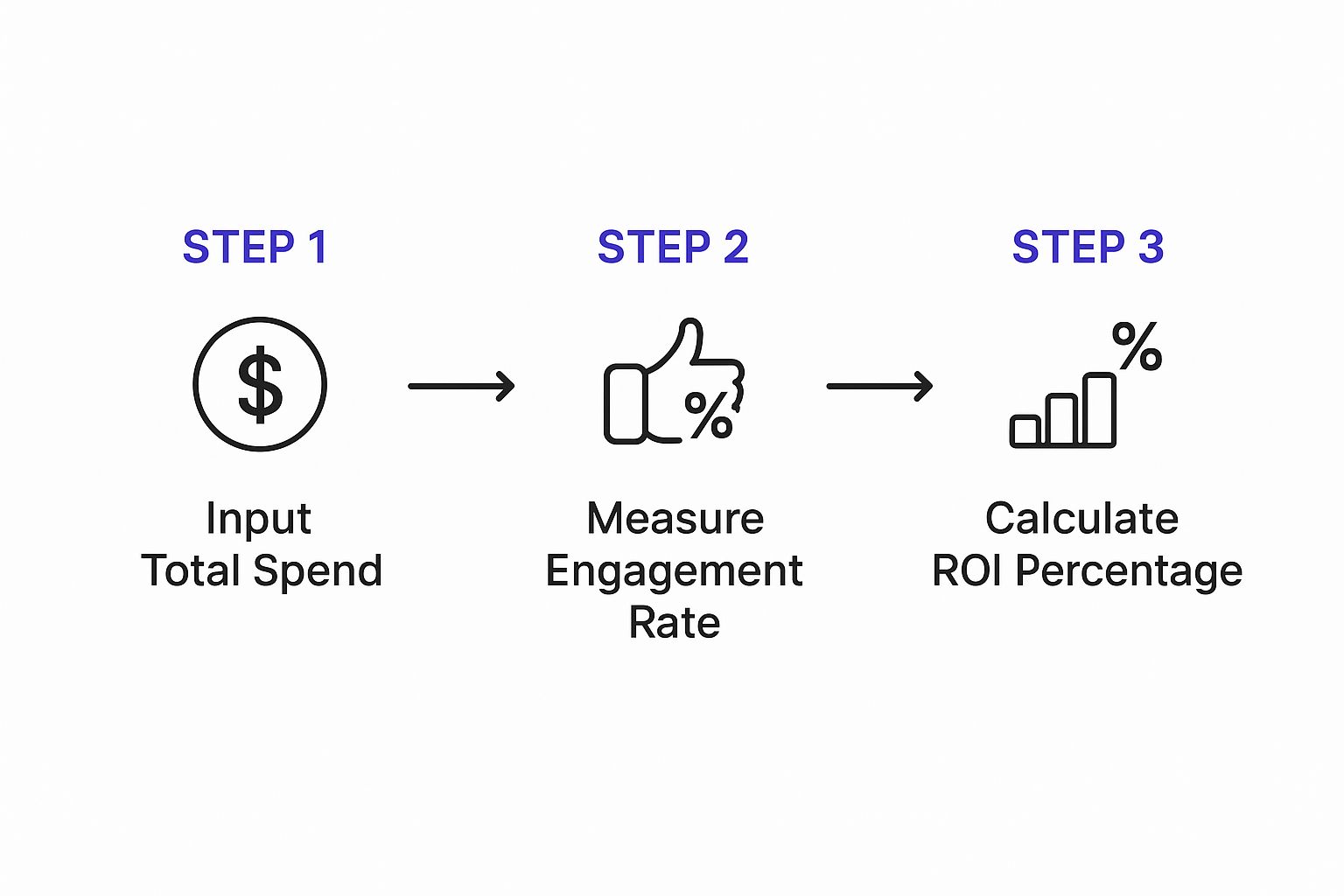
Making Sense of the Results
After entering those figures into the calculator, the ROI percentages pop out. This is where the story gets interesting, as the numbers reveal the campaign's true hero.
The results for our B2B company were eye-opening:
- LinkedIn ROI: 200% (a 3:1 return)
- Twitter ROI: 50% (a 1.5:1 return)
The conclusion is immediate and powerful. For every dollar spent on LinkedIn, the company generated $3 in value. In contrast, every dollar spent on Twitter only brought back $1.50.
To visualize this, let's put the data side-by-side.
Campaign Performance LinkedIn vs Twitter
This table provides a head-to-head comparison of our hypothetical B2B campaign, showing how each platform performed against the same goals.
| Metric | Conclusion | ||
|---|---|---|---|
| Total Investment | $2,500 | $1,500 | LinkedIn received a significantly larger budget. |
| Total Return | $7,500 | $2,250 | LinkedIn generated over 3x the return in absolute dollars. |
| Leads Generated | 75 | 22 | The campaign resonated far better with the LinkedIn audience. |
| Return on Investment (ROI) | 200% | 50% | LinkedIn delivered 4x the ROI of Twitter. |
The data gives a clear directive for the next quarter. While a 1.5:1 return isn't a complete failure, the smart move is to shift more of the budget to LinkedIn. Generally, a successful campaign should aim for at least a 2:1 return, as detailed in this analysis of what makes a good social media ROI by Hootsuite.
This is the real power of an ROI calculator. It stops you from guessing and empowers you to make sharp, data-backed decisions that actually grow the business.
Common Mistakes to Avoid When Calculating ROI
A social media ROI calculator is a fantastic tool, but it's only as good as the numbers you feed it. A few common slip-ups can easily skew your results, giving you a foggy picture of your actual performance. To get a truly accurate calculation, you have to be brutally honest about every dollar spent and every ounce of effort put in.
One of the easiest traps to fall into is undercounting your investments. Sure, ad spend is simple to track, but what about the 10 hours your social media manager poured into that campaign last week? That's not free. Forgetting to factor in real costs like software subscriptions, content creator fees, and your team's salaries will always make your ROI look better than it actually is.

Tunnel Vision on Last-Click Attribution
Another classic mistake is giving 100% of the credit for a sale to the very last thing a customer clicked. Think about it. A customer sees your ad on Instagram, reads a blog post a week later, and finally makes a purchase through a link in your newsletter. Was it just the email that did the work? Of course not. Social media planted the seed.
Focusing only on the final interaction ignores the entire customer journey. True ROI calculation acknowledges that social media often assists conversions, warming up leads long before they decide to purchase.
On that same note, don't ignore the returns that don't have a price tag. Things like a jump in brand awareness, better customer sentiment, or a bigger share of voice in your industry are huge wins. They might be harder to put a dollar value on, but they're absolutely part of the "return" you're getting and they fuel long-term growth. If you need help figuring out what to track, our guide on key social media metrics and reporting is a great place to start.
By sidestepping these common errors, you can trust that your social media ROI calculator is showing you the real, total impact of your hard work. That’s how you get numbers you can confidently stand behind.
Got Questions About Social Media ROI? We Have Answers.
Even with a solid formula, putting social media ROI into practice can get a little messy. It's one thing to know the theory, but quite another to apply it to your actual campaigns. Let's dig into a couple of the most common questions that pop up when marketers start using an ROI calculator.
How Do I Track ROI for Goals That Aren't Direct Sales?
This is probably the biggest question I hear. What happens when you're running a lead generation campaign, not an e-commerce promotion? The trick is to work backward and assign a dollar value to each lead.
Take a look at your sales data. If you know that one out of every 10 leads eventually becomes a customer who spends $500, then you can confidently say each lead is worth $50 to your business. Now you have a hard number to plug into your ROI formula.
Brand awareness is even tougher, but it’s not impossible. You can connect the dots by tracking metrics like reach and engagement alongside a corresponding increase in branded Google searches or direct traffic to your website during the same timeframe. The secret is deciding what a successful result is worth to you before the campaign ever begins.
How Often Should I Be Calculating ROI?
For your day-to-day social media efforts, running the numbers on a monthly or quarterly basis is the sweet spot. This gives you enough data to see real trends and make smart adjustments without drowning in spreadsheets every single week.
However, for specific campaigns—like a new product launch or a Black Friday sale—you absolutely must calculate the final ROI once it's over. This is your report card. It tells you exactly what worked (and what didn't), giving you a playbook for future promotions.
So, what’s a good ROI to aim for? While it really depends on your industry, a 5:1 ratio (meaning $5 earned for every $1 spent) is a great benchmark. But honestly, the most important benchmark is your own previous performance. Always aim to beat your last number.
Ready to stop guessing and start proving the value of your work? Repostly’s unified analytics make it incredibly simple to track the metrics that actually matter. See for yourself how much time and energy you can save.
Keep reading

10 Fresh Instagram Story Idea Tactics for 2025
Stuck for content? Discover our top Instagram story idea list, with actionable tips to boost engagement and grow your audience in 2025.

A Practical Social Media Planner for German Markets
Build a results-driven social media planner for Germany. This guide offers actionable strategies for content, scheduling, and analysis in the German market.

Crafting Your Social Media Content Plan
Stop guessing and start strategizing. This guide provides an actionable social media content plan to audit, plan, and execute content that gets results.
Post once. Show up everywhere.
Start your 7-day free trial and publish your next video to every platform in minutes.Pick a plan and publish your next video to every platform in minutes.
Start your free trialSee plansCancel anytime