Top Marketing Automation Best Practices to Boost Your Strategy
Learn essential marketing automation best practices to improve your campaigns, increase engagement, and drive better results. Click to discover more!
In today's fast-paced digital landscape, 'working harder' isn't enough. The real competitive edge comes from working smarter. Marketing automation has moved beyond simple email schedulers to become the central nervous system of modern marketing strategies. It’s the engine that powers personalized customer journeys, nurtures leads at scale, and provides the data-driven insights needed for exponential growth.
However, simply owning the tools doesn't guarantee success. The difference between a stagnant automation platform and a high-performing growth machine lies in the strategy behind it. Without a clear framework, even the most powerful software can lead to generic campaigns, disconnected customer experiences, and wasted resources. This is where a focus on proven marketing automation best practices becomes critical for any business, from individual creators to enterprise teams.
This guide cuts through the noise to deliver a comprehensive roundup of actionable strategies that are proven to work. We're skipping the generic advice to focus on what truly moves the needle. You will learn how to:
- Map complex customer journeys and automate lifecycle stages.
- Segment audiences with precision for hyper-relevant messaging.
- Align marketing and sales for a seamless lead handoff process.
- Test, optimize, and measure every campaign to prove ROI.
We'll explore these core concepts and more, giving you a clear roadmap to transform your automation efforts from a background process into a revenue-generating powerhouse. Let's dive into the practices that will help you scale efficiently and build lasting customer relationships.
1. Customer Journey Mapping and Lifecycle Automation
Effective marketing automation isn't about sending mass emails; it's about delivering the right message to the right person at the right time. This is where customer journey mapping becomes one of the most crucial marketing automation best practices. This strategy involves visually outlining every touchpoint a customer has with your brand, from initial awareness to becoming a loyal advocate. By understanding this path, you can design automated workflows that respond directly to user behavior and lifecycle stage.
Instead of guessing what a prospect needs, you create a system that listens and reacts. For example, when a user downloads an educational eBook (an awareness stage action), an automated workflow can nurture them with related case studies and product comparisons. This proactive, personalized approach guides prospects smoothly through the sales funnel without manual intervention.
How to Implement Lifecycle Automation
- Start with Key Stages: Define the primary phases of your customer lifecycle: Awareness, Consideration, Conversion, Loyalty, and Advocacy. Map the key actions and questions customers have at each stage.
- Identify Triggers and Actions: For each stage, determine the specific triggers (e.g., visited a pricing page, abandoned a cart) that will initiate an automated workflow. Then, define the corresponding actions (e.g., send a pricing comparison email, offer a limited-time discount).
- Build and Test Workflows: Begin with a simple workflow, such as an onboarding sequence for new subscribers. Use your marketing automation platform to build the logic. For instance, Amazon excels at post-purchase automation by sending shipping updates, review requests, and personalized recommendations, all triggered by a single purchase event.
- Include Human Handoffs: Know when automation should stop and a human should step in. Set up triggers that notify your sales team when a lead becomes "sales-qualified," ensuring a seamless transition from automated nurturing to a personal conversation.
The following graphic illustrates the straightforward process of turning journey maps into tangible results.
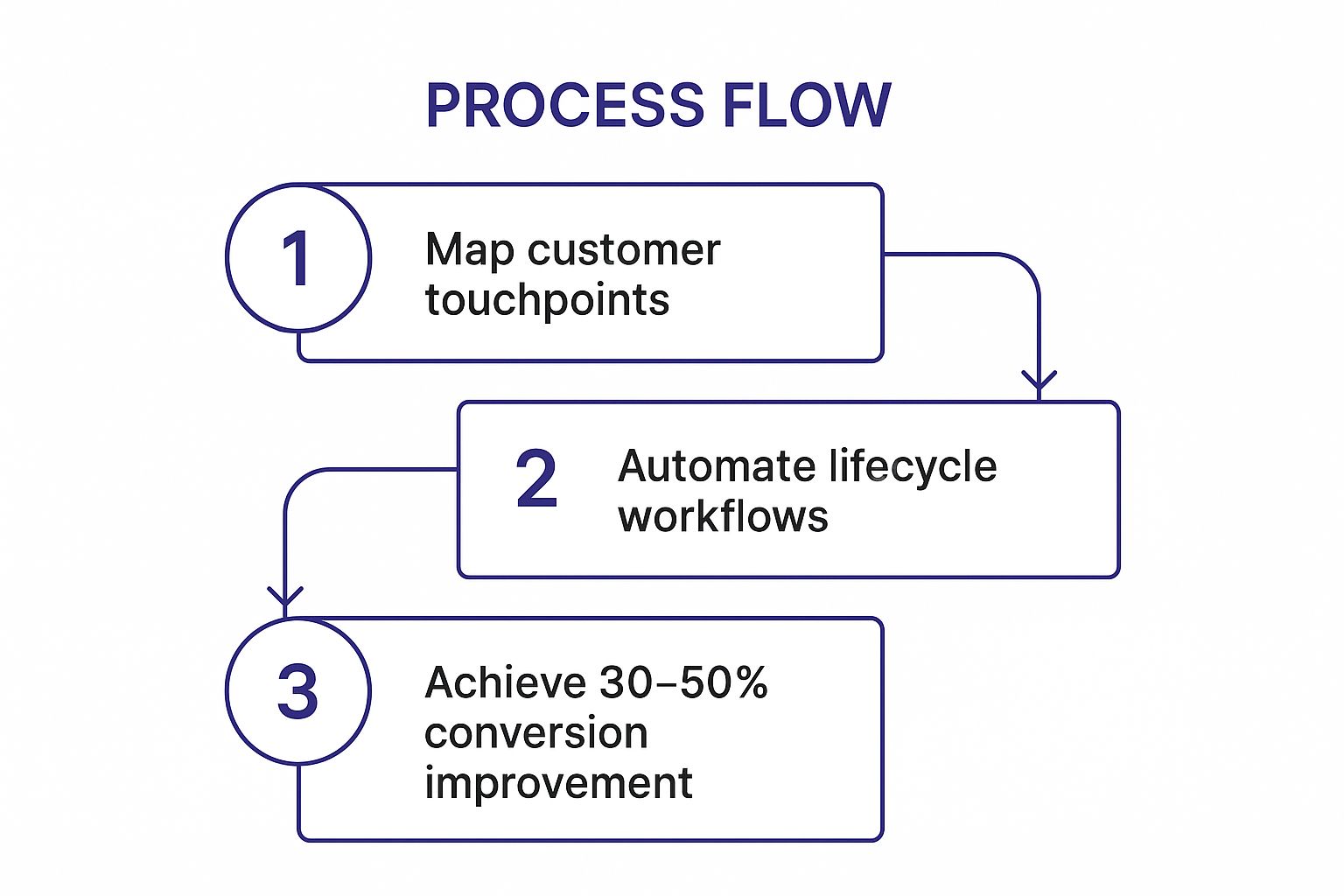
This process highlights how a strategic approach to mapping and automating the customer journey directly translates into significant performance gains. By aligning your automation with the customer’s actual experience, you create a more relevant and effective marketing engine that can dramatically improve conversions.
2. Advanced Segmentation and Personalization
Truly effective marketing automation moves beyond one-size-fits-all messaging and embraces deep personalization. This is where advanced segmentation becomes one of the most powerful marketing automation best practices. This strategy involves dividing your audience into highly specific groups based on demographics, behavior, purchase history, and engagement patterns to deliver hyper-relevant content that resonates on an individual level.
Instead of just segmenting by location, you can create dynamic groups based on user actions, such as "users who viewed a specific product category three times this week but didn't purchase." This allows you to deploy automated workflows with precisely targeted offers or information, making each interaction feel personal and timely.
This process transforms your automation from a broadcast tool into a conversation engine. By understanding and acting on nuanced customer data, you can significantly boost engagement, loyalty, and conversion rates.
How to Implement Advanced Segmentation
- Combine Data Sources: Integrate data from your CRM, website analytics, and e-commerce platform to build a comprehensive customer profile. Use both explicit data (like survey responses) and implicit data (like browsing behavior) for richer segments.
- Start with Core Segments: Begin by defining 3-5 high-value segments. Examples include "high-spending repeat customers," "new subscribers who haven't purchased," or "users who abandoned a cart with high-value items."
- Create Segment-Specific Content: Develop unique email templates, offers, and landing pages tailored to each segment's needs and interests. For example, Netflix uses advanced segmentation to personalize content recommendations based on viewing history, time of day, and even the device used.
- Automate Dynamic Content: Use your automation platform to dynamically insert content into emails or web pages based on the recipient's segment. This ensures every message is as relevant as possible without requiring you to build dozens of separate campaigns from scratch.
3. Lead Scoring and Qualification Automation
Not all leads are created equal, and chasing every new contact can drain valuable sales resources. This is why lead scoring and qualification automation is a foundational marketing automation best practice. This strategy involves creating a system to rank prospects based on their likelihood to convert by assigning points to their demographic information and their engagement behaviors. By automatically identifying who is ready for a sales conversation, you bridge the gap between marketing and sales.
This systematic approach allows your teams to focus their efforts where they will have the most impact. For example, a lead who has visited your pricing page multiple times and downloaded a case study is far more valuable than someone who only downloaded a top-of-funnel checklist. Lead scoring automatically surfaces these high-intent individuals, ensuring they receive a timely follow-up while others continue to be nurtured.
How to Implement Lead Scoring and Qualification
- Define Your Ideal Customer Profile (ICP): Work closely with your sales team to establish clear criteria for a qualified lead. Combine explicit data (like company size, job title, industry) and implicit data (like website pages visited, email opens, content downloads).
- Assign Point Values: Assign positive scores to actions that indicate high intent (e.g., requesting a demo gets +25 points) and negative scores for disqualifying actions (e.g., visiting the careers page gets -10 points). Platforms like HubSpot and Marketo allow you to build sophisticated scoring models tailored to your business.
- Set a Qualification Threshold: Determine the score at which a lead becomes a Marketing Qualified Lead (MQL) and is ready for sales outreach. This is the trigger point for your automation. For instance, once a lead reaches 100 points, an automated workflow can assign them to a sales representative and send a notification.
- Review and Refine: Lead scoring is not a "set it and forget it" process. Regularly review the performance of your model. Are the leads being passed to sales converting? Adjust your point values and thresholds quarterly based on real-world conversion data to continuously improve accuracy.
4. Multi-Channel Campaign Orchestration
Today’s customers don't interact with your brand in a single place; they move seamlessly between email, social media, SMS, and your website. One of the most impactful marketing automation best practices is to orchestrate campaigns across these channels to create a unified experience. This involves coordinating messages so they feel like part of one continuous conversation, not a series of disconnected promotions.
Instead of blasting the same message everywhere, multi-channel orchestration uses customer data to deliver content on the platform they prefer at that moment. For example, a customer who browses a product on your site might receive a follow-up email, then see a related ad on social media, and finally get an SMS notification when the item goes on sale. This ensures your communication is consistent, timely, and respectful of channel preferences.
How to Implement Multi-Channel Orchestration
- Start with Core Channels: Begin by integrating 2-3 of your most effective channels, such as email, SMS, and social media. Master the coordination between these before adding more complexity.
- Establish Channel Preferences: Give customers control by creating a preference center where they can choose how they want to hear from you. This respects their boundaries and improves engagement rates. To enhance your multi-channel campaigns and create engaging content efficiently, consider tools for leveraging AI video generation.
- Unify Reporting and Analytics: Use a platform that provides a single view of the customer across all channels. Sephora excels at this, linking online browsing history with in-store consultations to create highly personalized email recommendations and app notifications. This holistic view is crucial for understanding what works.
- Test Cross-Channel Timing: Experiment with the timing and sequence of your messages. Determine if sending an SMS reminder 24 hours after an abandoned cart email is more effective than sending it immediately. There are many social media automation tools that can help you schedule and analyze performance across platforms.
5. Behavioral Trigger Marketing
One of the most powerful marketing automation best practices is responding to what customers do, not just who they are. Behavioral trigger marketing is an automated approach that sends targeted messages or initiates specific actions based on real-time user behaviors. This strategy moves beyond static campaigns by creating immediate, relevant responses to actions like website visits, email opens, or purchase history.
Instead of sending a generic newsletter, you can deliver a message that feels like a one-to-one conversation. For example, when a user repeatedly views a specific product category, a triggered workflow can send them an email showcasing best-sellers from that category. This timeliness and relevance make the communication far more likely to drive engagement and conversion.
How to Implement Behavioral Trigger Marketing
- Prioritize High-Value Triggers: Don't try to automate everything at once. Start with the most impactful behaviors, such as abandoned carts, first-time purchases, or visits to your pricing page. These actions indicate high intent and present clear opportunities for conversion.
- Set Appropriate Time Delays: Timing is critical. An abandoned cart email sent within an hour is effective; one sent a week later is not. Test different delays to find the sweet spot that feels helpful without being intrusive or pushy.
- Create Trigger-Specific Content: The message must align with the action. If a user abandons a cart containing a specific pair of shoes, the follow-up email should feature those exact shoes. Amazon excels at this by sending hyper-relevant abandoned cart emails that include the product image and a direct link to complete the purchase.
- Use Progressive Messaging: If a user repeats a behavior, don't send the same message again. For example, if a user visits the pricing page for a third time, escalate the trigger from an informational email to a notification for your sales team to initiate a personal outreach.
6. Data Integration and Customer Data Platform (CDP) Management
Powerful marketing automation runs on data, but siloed information creates a fragmented customer view. This is why data integration is one of the most critical marketing automation best practices. This strategy involves unifying data from all sources-like your CRM, website analytics, and social media-into a single, comprehensive profile for each customer within a Customer Data Platform (CDP). By centralizing this information, you can create a truly holistic understanding of your audience.
Instead of targeting segments based on isolated actions, you can build automation workflows based on a complete behavioral history. A CDP allows you to see that a customer who engaged with your brand on social media also abandoned a cart and later opened a promotional email. This unified view empowers you to deliver hyper-personalized experiences that resonate on a deeper level.
How to Implement Data Integration
- Start with Key Sources: Begin by integrating your most critical data sources, such as your CRM and website analytics. For any robust marketing automation strategy, seamless data flow is critical; dive deeper into advanced approaches for mastering data integration techniques to ensure a solid foundation before expanding.
- Establish Data Governance: Implement clear policies for data collection, storage, and usage from the outset. This ensures data quality and helps maintain compliance with regulations like GDPR and CCPA. Proper governance prevents your CDP from becoming a repository of unreliable information.
- Cleanse and Monitor Data: Regularly audit your data for inaccuracies, duplicates, and outdated entries. Set up automated processes to cleanse and maintain data quality, ensuring your automation campaigns are always based on reliable insights.
- Train Your Team: A CDP is only as effective as the people who use it. Provide training on how to interpret unified customer profiles and leverage them to build smarter, more personalized campaigns. For example, Coca-Cola uses its unified platform to combine purchase data with social media interactions, powering relevant brand messaging. Explore more about data analytics in social media to understand how different data sources can be combined.
7. A/B Testing and Continuous Optimization
Launching a marketing automation workflow is not a "set it and forget it" task. To achieve peak performance, you must embrace a culture of continuous improvement, which makes A/B testing one of the most vital marketing automation best practices. This method involves creating two or more variations of a single asset (like an email or landing page) and showing them to different segments of your audience to see which one performs better. By systematically testing elements, you can make data-driven decisions instead of relying on assumptions.
This iterative process eliminates guesswork and allows you to optimize every component of your campaigns for maximum impact. For instance, testing a simple change like the color of a call-to-action (CTA) button can lead to significant increases in click-through rates. It’s a disciplined approach to discovering what truly resonates with your audience, ensuring your automation efforts become more effective over time.
How to Implement A/B Testing and Optimization
- Test One Variable at a Time: To get clear, reliable results, isolate a single element for each test. This could be the email subject line, the headline on a landing page, the CTA text, or the timing of an email send. Testing multiple variables at once makes it impossible to know which change caused the performance difference.
- Ensure Statistical Significance: Don’t declare a winner too early. Run your test long enough to collect sufficient data to ensure the results are statistically significant, not just due to random chance. Most marketing automation platforms have built-in calculators to help with this.
- Focus on High-Impact Elements First: Prioritize tests that have the potential to make the biggest difference. Subject lines directly impact open rates, while landing page headlines and CTAs are crucial for conversions. Start with these to see meaningful results faster.
- Document and Learn from Results: Maintain a log of every test you run, including your hypothesis, the variations, the results, and your conclusions. This knowledge base becomes an invaluable resource for planning future campaigns and understanding audience preferences. For example, HubSpot’s rigorous A/B testing of email subject lines has consistently led to dramatic improvements in open rates.
8. Marketing and Sales Alignment (SLA Management)
Marketing automation loses its power if it generates leads that sales can't or won't act on. This common disconnect is where establishing a Service Level Agreement (SLA) becomes one of the most impactful marketing automation best practices. An SLA is a formal agreement between your marketing and sales teams that defines shared goals, responsibilities, lead quality standards, and follow-up protocols. It transforms the often-adversarial relationship into a cooperative partnership focused on revenue.
Instead of operating in silos, an SLA ensures marketing delivers high-quality, pre-qualified leads and sales commits to acting on them promptly and effectively. For example, the SLA can specify the exact criteria that turn a Marketing Qualified Lead (MQL) into a Sales Accepted Lead (SAL) and dictate that sales must contact every SAL within 24 hours. This creates a predictable, accountable system that maximizes the ROI of your automation efforts.
How to Implement Marketing and Sales Alignment
- Define Your Lead Funnel Together: Collaboratively map out the lead lifecycle, from initial contact to a closed deal. Agree on precise, data-driven definitions for terms like MQL and SQL. This shared language prevents misunderstandings and ensures everyone is working toward the same goal.
- Establish Clear Handoff Protocols: Use your automation platform to create a seamless handoff process. For instance, when a lead’s score reaches a certain threshold (making them an MQL), an automated workflow should instantly assign them to a sales rep in the CRM and send a notification. HubSpot’s internal SLA, which mandates quick follow-up on MQLs, is a prime example of this in action.
- Create Shared Dashboards and Feedback Loops: Transparency is key. Build a shared dashboard that tracks key metrics for both teams, such as MQLs generated, SALs accepted, and conversion rates. Schedule regular meetings to review performance, discuss lead quality, and refine the process, creating a continuous feedback loop.
- Automate Lead Recycling: Not every lead is ready to buy immediately. Develop an automated workflow to "recycle" leads that sales disqualifies for timing reasons. These leads can be placed back into a nurturing sequence until they show renewed buying intent, ensuring no potential opportunity is lost.
9. Progressive Profiling and Dynamic Content
Asking a new lead for 20 pieces of information on a single form is a surefire way to kill conversion rates. Instead, one of the most sophisticated marketing automation best practices is to use progressive profiling and dynamic content. This strategy involves gradually building a customer profile over time by asking for new information with each interaction, while simultaneously personalizing the content they see based on the data you already have.
This approach respects the user's time and builds trust. For example, a first-time visitor might only provide an email to download a guide. On their next visit, your form could automatically hide the email field and instead ask for their job title. This collected data then fuels dynamic content, allowing you to show a C-level executive a high-level ROI-focused message while showing a technical manager a feature-specific one.
How to Implement Progressive Profiling
- Prioritize Your Data Needs: Start by identifying the most critical information you need for segmentation (e.g., company size, industry, job role). Ask for the most valuable piece of information first and save less critical questions for later interactions.
- Leverage Smart Forms: Use your marketing automation platform to create "smart" or "progressive" forms. These forms recognize returning visitors and display new fields to gather additional data, such as those used by HubSpot's Smart Content feature.
- Combine Explicit and Implicit Data: Don't rely solely on forms. Track user behavior (implicit data) like pages visited, content downloaded, and email engagement. This behavioral data provides context and helps you personalize content even without new form submissions.
- Develop Content Variations: Create different versions of your key website pages, emails, and calls-to-action tailored to different segments. For instance, Netflix excels at this by using your viewing history (implicit data) and ratings (explicit data) to dynamically populate your homepage with relevant recommendations. This ensures the experience evolves as your profile becomes more detailed.
By gradually collecting information and adapting your content in real-time, you create a highly relevant and personalized journey that feels less like marketing and more like a helpful, one-on-one conversation.
10. Attribution Modeling and ROI Measurement
Launching automated campaigns is only half the battle; understanding their true impact is what separates good from great. This is where attribution modeling and ROI measurement become essential marketing automation best practices. This strategy involves systematically tracking and assigning value to the various marketing touchpoints a customer interacts with on their path to conversion. By understanding which automated emails, ads, or content pieces contributed to a sale, you can prove marketing’s value and make smarter budget decisions.
Instead of crediting only the last click, multi-touch attribution models provide a holistic view of the entire customer journey. This allows you to see how your initial awareness campaigns work together with your mid-funnel nurturing sequences to generate revenue. For example, HubSpot's attribution reporting can show how an automated welcome email series, a webinar invitation, and a follow-up demo request all contributed to a closed deal, giving each touchpoint its deserved credit.
How to Implement Attribution and ROI Measurement
- Implement Consistent Tracking: Use UTM parameters consistently across all digital campaigns, from emails to social media ads. This ensures that every touchpoint is captured accurately in your analytics platform, forming the foundation of reliable attribution.
- Choose the Right Model: Start with simple models like First-Touch or Last-Touch to understand the top and bottom of your funnel. As you mature, explore multi-touch models like Linear, Time-Decay, or data-driven attribution in platforms like Google Analytics 4 to get a more nuanced view of your entire marketing ecosystem.
- Focus on Business Metrics: Move beyond vanity metrics like open rates and clicks. Connect your automation efforts to key business outcomes like Customer Acquisition Cost (CAC), Customer Lifetime Value (CLV), and marketing-influenced revenue. This demonstrates the direct financial impact of your work.
- Create Regular Reports: Develop dashboards and reports that clearly communicate the performance of your automated campaigns to stakeholders. Visualize the customer journey and highlight which channels and workflows are driving the most significant ROI, ensuring alignment and justifying future investment.
By systematically measuring the impact of your efforts, you can continuously optimize your strategy for maximum efficiency. Learn more about the crucial role of metrics and reporting in marketing to build a data-driven automation engine.
Marketing Automation Best Practices Comparison
| Item | Implementation Complexity 🔄 | Resource Requirements ⚡ | Expected Outcomes 📊 | Ideal Use Cases 💡 | Key Advantages ⭐ |
|---|---|---|---|---|---|
| Customer Journey Mapping and Lifecycle Automation | High – requires extensive planning and ongoing optimization | Moderate to high – advanced tools and team effort | Improves conversion rates by 30-50%, boosts retention | Nurturing leads across multiple customer lifecycle stages | Scalable personalization, consistent CX, reduces manual work |
| Advanced Segmentation and Personalization | High – complex segmentation and predictive analytics | High – extensive data collection and management | Increases open rates (26%) and CTR (14%), lowers unsubscribes | Hyper-targeted messaging for diverse audiences | Enhances message relevance, drives higher ROI |
| Lead Scoring and Qualification Automation | Medium to high – model calibration and sales alignment | Moderate – data integration and CRM connectivity | Raises sales efficiency by 30-50%, improves lead conversion | Prioritizing and qualifying leads for sales focus | Clear prioritization, automates lead routing |
| Multi-Channel Campaign Orchestration | Very high – complex integrations and coordination | High – technology stack and skilled personnel | Boosts campaign effectiveness by 35-50%, reduces fatigue | Coordinating messages across diverse channels | Unified customer view, optimized timing and frequency |
| Behavioral Trigger Marketing | Medium to high – real-time tracking and trigger setup | Moderate – strong tracking infrastructure | 50-100% higher click-through rates, reduces cart abandonment by ~15-20% | Immediate, relevant responses to customer actions | Immediate engagement, high-intent capture |
| Data Integration and Customer Data Platform Management | Very high – technical complexity and governance | High – significant technology and maintenance | Provides 360° customer view, improves data accuracy | Building unified customer profiles for personalization | Data quality, compliance, advanced segmentation |
| A/B Testing and Continuous Optimization | Medium – requires experimentation setup and analysis | Moderate – traffic availability and analytic skills | Increases conversion rates by 10-25%, enables ongoing improvement | Validating marketing changes and maximizing ROI | Data-driven decisions, reduces guesswork |
| Marketing and Sales Alignment (SLA Management) | Medium – process definition and monitoring | Moderate – collaboration tools and management | Improves lead-to-customer conversion by 20-30% | Bridging marketing and sales for better lead handling | Shared accountability, reduces lead leakage |
| Progressive Profiling and Dynamic Content | High – sophisticated technical setup for personalization | Moderate to high – content creation and tech | Cuts form abandonment by 30-40%, improves engagement | Gradual data collection with personalized experiences | Better data quality, evolving customer profiles |
| Attribution Modeling and ROI Measurement | Very high – technical and data complexity | High – comprehensive tracking and analytics tools | Clear ROI visibility, identifies top-performing channels | Measuring impact across multiple touchpoints and channels | Budget optimization, marketing accountability |
From Strategy to Action: Your Next Steps in Automation Mastery
You've just navigated a comprehensive map of marketing automation best practices, from the foundational necessity of customer journey mapping to the nuanced art of attribution modeling. We've explored how to transform raw data into intelligent action, orchestrate campaigns across multiple channels, and create truly personalized experiences that resonate with your audience on a one-to-one level.
The sheer volume of possibilities can feel overwhelming, but the path to mastery isn't about implementing everything at once. It's about taking strategic, incremental steps. The power of marketing automation lies not in its complexity but in its ability to consistently deliver the right message to the right person at the right time, at scale. This journey begins with a single, well-chosen initiative.
Recapping Your Path to Automation Excellence
Let's distill the core principles we've covered into a clear action plan. True automation success is built on a few key pillars:
- Customer-Centricity: Every workflow, segment, and trigger should originate from a deep understanding of your customer's lifecycle and needs. Practices like journey mapping and progressive profiling ensure your automation serves the customer first, not just your internal processes.
- Data-Driven Decisions: Your automation platform is only as smart as the data you feed it. Integrating systems through a CDP, establishing a robust lead scoring model, and continuously A/B testing are non-negotiable for evolving your strategy from guesswork to a science.
- Seamless Integration: Automation should break down silos, not create new ones. The most effective strategies are those that orchestrate multi-channel campaigns and ensure tight alignment between marketing and sales, creating a unified and frictionless customer experience from first touch to final sale.
- Continuous Iteration: The digital landscape is always changing, and so are your customers' expectations. Adopting an iterative mindset, focused on measurement and optimization, transforms your automation efforts from a one-time setup into a dynamic engine for sustainable growth.
Your First Step: Choosing a High-Impact Initiative
Instead of trying to boil the ocean, select one area that promises the most immediate impact for your business. What is your biggest bottleneck right now?
- Is it lead quality? Focus on implementing a basic lead scoring model to help your sales team prioritize their efforts.
- Is it customer engagement? Set up a behavioral trigger campaign, like an abandoned cart reminder or a re-engagement workflow for inactive subscribers.
- Is it data chaos? Begin the process of cleaning and integrating one key data source to create a more unified view of your contacts.
By focusing on one of these marketing automation best practices, you can secure a quick win, demonstrate value, and build the momentum needed to tackle more complex projects. As you gain confidence, you can expand your efforts. For those looking to dive even deeper into specific frameworks and examples, you can explore these 8 Marketing Automation Best Practices to Master in 2025 for additional structured guidance.
Ultimately, mastering marketing automation is about transitioning from simply doing marketing to engineering a system that drives predictable, scalable results. It’s the difference between sending an email blast and guiding a prospect through a personalized journey that builds trust and loyalty. By embracing these principles, you're not just saving time; you're building a smarter, more efficient, and more customer-focused organization.
Ready to automate the "social" part of your marketing machine? While you build complex email workflows, let Repostly handle your multi-channel social media presence. Schedule, publish, and analyze your content across all platforms from one simple dashboard, ensuring your brand stays active and engaged without the manual effort. Try Repostly today and see how simple social media automation can be.
Keep reading

10 Fresh Instagram Story Idea Tactics for 2025
Stuck for content? Discover our top Instagram story idea list, with actionable tips to boost engagement and grow your audience in 2025.

A Practical Social Media Planner for German Markets
Build a results-driven social media planner for Germany. This guide offers actionable strategies for content, scheduling, and analysis in the German market.
Crafting Your Social Media Content Plan
Stop guessing and start strategizing. This guide provides an actionable social media content plan to audit, plan, and execute content that gets results.
Post once. Show up everywhere.
Start your 7-day free trial and publish your next video to every platform in minutes.Pick a plan and publish your next video to every platform in minutes.
Start your free trialSee plansCancel anytime