Master Marketing with Facebook in Germany
Learn top strategies for marketing with Facebook in Germany. Boost your results with expert tips on audience targeting and campaign success.
When people talk about marketing on Facebook, they're really talking about a mix of activities – from organic posts that build a community to paid ads that drive immediate sales. It's an incredibly powerful platform for reaching a huge audience, but jumping in without a plan is a recipe for wasted time and money. Real success starts with getting the fundamentals right: a properly set-up Business Page, solid performance tracking, and a crystal-clear idea of what you're trying to achieve.
Building Your Foundation for Facebook Success
Before you spend a single euro on an ad, you need to get your house in order. Think of it like building a house – you wouldn't start putting up walls without a solid foundation. This initial setup isn't just about looking professional; it's about creating a well-oiled marketing machine that gives every campaign the best possible chance to succeed.
Your Facebook Business Page is your digital shop window. It's often the very first place a potential customer will interact with your brand on the platform. It needs to do more than just list your address; it has to instantly tell people what you're about and why they should stick around.
Establishing Your Business Presence
First things first: your personal profile is not your business profile. The essential first step is to create a dedicated Facebook Business Page. This page should then be connected to a Meta Business Manager account, which acts as your central command centre for everything marketing-related.
I always tell clients to think of it this way: the Business Page is your public-facing storefront, while the Business Manager is the secure back office. Getting this structure right from day one saves you from massive headaches down the line, especially when you need to give access to team members or marketing agencies without handing over your personal login details.
Implementing Critical Tracking Tools
Marketing without data is just guessing. That's where the Meta Pixel comes in (it's now officially part of the larger Meta Business SDK, but most of us still call it the Pixel). This tiny piece of code, which you install on your website, is absolutely non-negotiable for effective advertising.
The Pixel is your eyes and ears, tracking what people do after they click your ad. It tells you if they:
- Bought something
- Added a product to their cart
- Signed up for your newsletter
- Viewed a key page
This information is gold. It’s what you need to accurately measure your return on ad spend and, just as importantly, to run powerful retargeting campaigns that bring people who’ve already shown interest back to finish what they started.
Key Takeaway: A poorly installed Meta Pixel feeds you bad data, which leads directly to wasted ad spend and missed opportunities. Always double-check your setup and use the testing tools to confirm that your key events are firing correctly before you launch any paid campaigns.
Navigating German Data Privacy Rules
For any business operating in Germany, the General Data Protection Regulation (DSGVO) is a big deal. This isn't just a box-ticking exercise; it has a direct and serious impact on how you can use tools like the Meta Pixel.
You absolutely must get explicit consent from your website visitors before the Pixel is allowed to fire and collect their data. This is usually handled with a cookie consent banner. Get this wrong, and you could face hefty fines and, worse, a complete loss of trust from your customers. Make sure your privacy policy is up-to-date and clearly states how you use Facebook's tracking tools.
Defining What Success Looks Like
Finally, before you go any further, you need to stop and ask: what are we actually trying to do here? Your objectives will shape every single decision you make, from the ad formats you choose to the audiences you target.
Most business goals fall into one of these buckets:
- Brand Awareness: Simply getting your brand name seen by as many relevant people as possible.
- Lead Generation: Gathering contact details (like email addresses) from potential customers.
- Online Sales: Driving people to your e-commerce site to make a direct purchase.
- Website Traffic: Sending users from Facebook to a specific blog post or landing page.
Choosing a clear objective is a cornerstone of your overall plan. If you need a hand with this, our article on how to create a social media strategy offers a great framework for setting and hitting your marketing goals. Your chosen objective is the compass that will guide your entire Facebook strategy.
Connecting with Your German Audience
Alright, with your page set up, it's time to tackle the big question: how do you get your message in front of the right people? Just throwing your ads out to everyone in Germany is a fast way to burn through your budget. It’s like shouting into the wind.
Success with Facebook marketing comes down to precision. You need to get to grips with the platform's incredibly powerful audience targeting tools. This is where you move beyond simple demographics like age and gender and start finding the specific groups of people most likely to become your loyal customers. For the German market, that means really understanding local interests, behaviours, and even regional quirks.
Building Your Core Audience
Your starting point for finding new customers is creating a Core Audience. This is where you manually build your ideal customer profile from the ground up, based on criteria you choose. Think of it as painting a detailed picture of who you want to reach.
Forget just targeting "women aged 30-45". Let's say you're a sustainable fashion brand based in Hamburg. You could target people in that specific city who have also shown an interest in eco-friendly products, follow prominent environmental influencers, and shop at competing organic brands.
The real magic happens when you start layering these interests and behaviours. Your goal isn't to build the biggest audience possible, but the most relevant one.
Tapping Into Your Warmest Leads with Custom Audiences
While Core Audiences are great for discovery, your best prospects are often people who already know you. This is where Custom Audiences are a total game-changer, letting you reconnect with users who have already interacted with your business in some way.
You can build these audiences from a few key sources:
- Customer Lists: Upload a list of email addresses or phone numbers to find your existing customers on Facebook. Just be sure you're fully compliant with DSGVO.
- Website Traffic: Using data from your Meta Pixel, you can target everyone who’s visited your website in the last 30 days.
- Specific Actions: This is where it gets really powerful. You can target people who viewed a certain product page but didn't buy, or even those who added an item to their cart and left.
Being able to retarget these warm leads is one of the most effective strategies in advertising. These people have already shown interest; sometimes all they need is a gentle, timely nudge to come back and complete their purchase.
A common mistake I see is lumping all website visitors into one group. Someone who spent 10 seconds on your homepage is worlds apart from someone who abandoned a full shopping cart. Create separate Custom Audiences for these segments and write your ads specifically for them. The results will speak for themselves.
Expanding Your Reach with Lookalike Audiences
Once you have a solid Custom Audience, you can ask Facebook to find more people just like them. This is what Lookalike Audiences do. The platform's algorithm analyses the common traits of your source audience—like your best customers or most engaged followers—and then finds new users who share similar characteristics.
It’s an incredibly efficient way to scale your campaigns and find new customers who fit your ideal profile. For example, you could upload a list of your top 1,000 highest-spending customers and ask Facebook to create a Lookalike Audience from them. The algorithm will then identify the top 1% of users in Germany who most closely resemble that group.
The sheer size of Facebook's user base in Germany makes this tool particularly potent. As of early 2025, there were around 43.7 million users on the platform in Germany – that's over half the population. The largest demographic is people aged 25 to 34, and with an almost even gender split, the potential is enormous. You can dig into more German Facebook user statistics on napoleoncat.com for a deeper look.
Let’s put this into a real-world scenario. Imagine a small Bavarian retailer selling traditional Trachten wants to boost sales before Oktoberfest. Instead of broadly targeting all of Munich, they could use postcode targeting to focus on affluent neighbourhoods like Schwabing and Bogenhausen. From there, they could layer on interests like "Oktoberfest," "Bavarian culture," and even target followers of specific local event pages. This hyper-local strategy ensures their ad spend is focused on the people most likely to walk into their store, delivering a much higher return.
Creating Content That Resonates in Germany
So, you’ve pinpointed who you're talking to. Now comes the hard part: figuring out what to say. The most laser-focused audience targeting won't make up for an ad that's boring or just plain irrelevant. Your content is your direct line to the German consumer, and it’s what ultimately makes your brand stick.
The secret to great Facebook marketing in Germany isn't just about pretty pictures. It's about knowing how to create truly engaging content that combines the right visuals with persuasive messaging that feels genuine and speaks directly to what your audience actually cares about.
Choosing the Right Ad Formats
Facebook gives you a whole toolbox of ad formats, and each one has its own job to do. I see a lot of brands make the mistake of sticking to just one format, like single images. This is a fast track to ad fatigue. Mixing things up keeps your campaign fresh and lets you tell your story from different angles.
Some formats consistently work well for the German market:
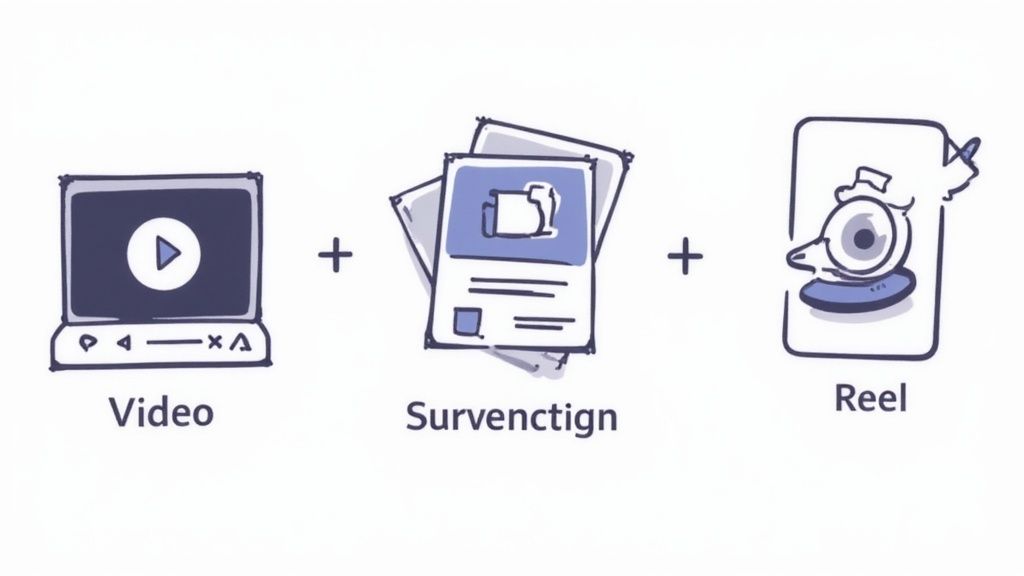
- Video Ads: In a crowded feed, nothing stops the scroll like motion. Videos are brilliant for telling a story, showing a product in action, or sharing a quick customer testimonial. Just remember to keep them short and design them for silent viewing—most people are scrolling without sound.
- Carousel Ads: These are perfect for showing off multiple products or features in a single, interactive ad. If you’re an e-commerce brand with a new collection or a service-based business highlighting different benefits, carousels are a fantastic tool.
- Reels and Stories Ads: These vertical, full-screen formats feel much more organic and less like a disruptive ad. They're ideal for behind-the-scenes glimpses, quick tutorials, or user-generated content that builds real authenticity and trust.
To help you decide, here’s a quick rundown of which formats tend to work best for specific goals.
Facebook Ad Format Performance Comparison
Choosing the right format can make a massive difference in hitting your campaign goals. Some are built for grabbing attention, while others excel at driving sales. This table breaks down the strengths of each.
| Ad Format | Best For Objective | Key Creative Tip |
|---|---|---|
| Video | Brand Awareness, Engagement | Grab attention in the first 3 seconds. Use captions! |
| Carousel | Traffic, Conversions (e-commerce) | Use each card to tell a part of a story or showcase a product benefit. |
| Image | Traffic, Lead Generation | A single, high-impact image with minimal text works best. |
| Stories/Reels | Engagement, Brand Awareness | Use native-feeling vertical video with polls or stickers for interaction. |
| Collection | Conversions (mobile e-commerce) | Creates an instant, full-screen storefront experience. |
Ultimately, the best approach is to test different formats. See what your specific audience responds to and double down on what works.
Crafting Copy That Connects
Your ad copy is just as critical as your visuals. A common pitfall in the German market is using clunky, literal translations that instantly make your brand feel like an outsider. Aim for a tone that's direct and professional but not stiff or overly formal.
Focus on the benefits, not just the features. Don't just say your product has “5mm thick padding.” Instead, explain that it provides “all-day comfort for your busy commute.” That small change helps the customer immediately see the value you’re offering.
Pro Tip: Your primary text needs to be punchy. The first one or two sentences are all you get before the "See More" link. Hook them immediately with a sharp question, a surprising stat, or a clear promise of value.
And please, always include a clear Call to Action (CTA). Tell people exactly what you want them to do next. "Shop Now," "Learn More," and "Sign Up" leave no room for confusion. Vague CTAs are just missed opportunities.
Optimising For Every Placement
Remember, your ad doesn't just show up in the main Facebook Feed. It appears across a network of placements like Stories, Marketplace, and Messenger. A huge oversight I see is brands using one creative for all of them.
That square image that looks perfect in the Feed? It’s going to get cropped awkwardly in a vertical Story. Always take the extra five minutes to use the Asset Customisation feature in Ads Manager. Uploading different versions for key placements ensures your ad looks polished and professional everywhere, which absolutely boosts performance.
This same attention to detail applies to timing. Nailing your creative is half the battle; the other half is making sure it's seen at the right moment. For more on this, check out our guide on finding the https://repostly.app/blog/best-time-of-day-to-post-on-facebook-68bd452e650d8992d6cf717f, which can give you a solid starting point for both your organic and paid strategies.
Putting Your Ad Campaigns into Action
Alright, you’ve got your strategy nailed down. You know who you’re targeting and what you want to say. Now it’s time for the fun part: bringing it all to life in Facebook Ads Manager and, crucially, managing your campaigns for the best possible results.
Let’s be clear: a "set it and forget it" approach just won’t cut it. The real magic happens in the day-to-day optimisations. That’s what separates a campaign that just runs from one that truly delivers.
When you first open Ads Manager, it can feel a bit much. But it’s actually organised quite logically into three levels: Campaigns (your main goal, like generating leads), Ad Sets (where you define your audience, placements, and budget), and Ads (the actual creative your audience sees). Getting your head around this hierarchy is the key to building clean, organised campaigns you can easily test and scale later.
Think of it as a continuous cycle. You set things up, you test, you analyse, and you adjust. This visual really breaks down the workflow you'll be following.
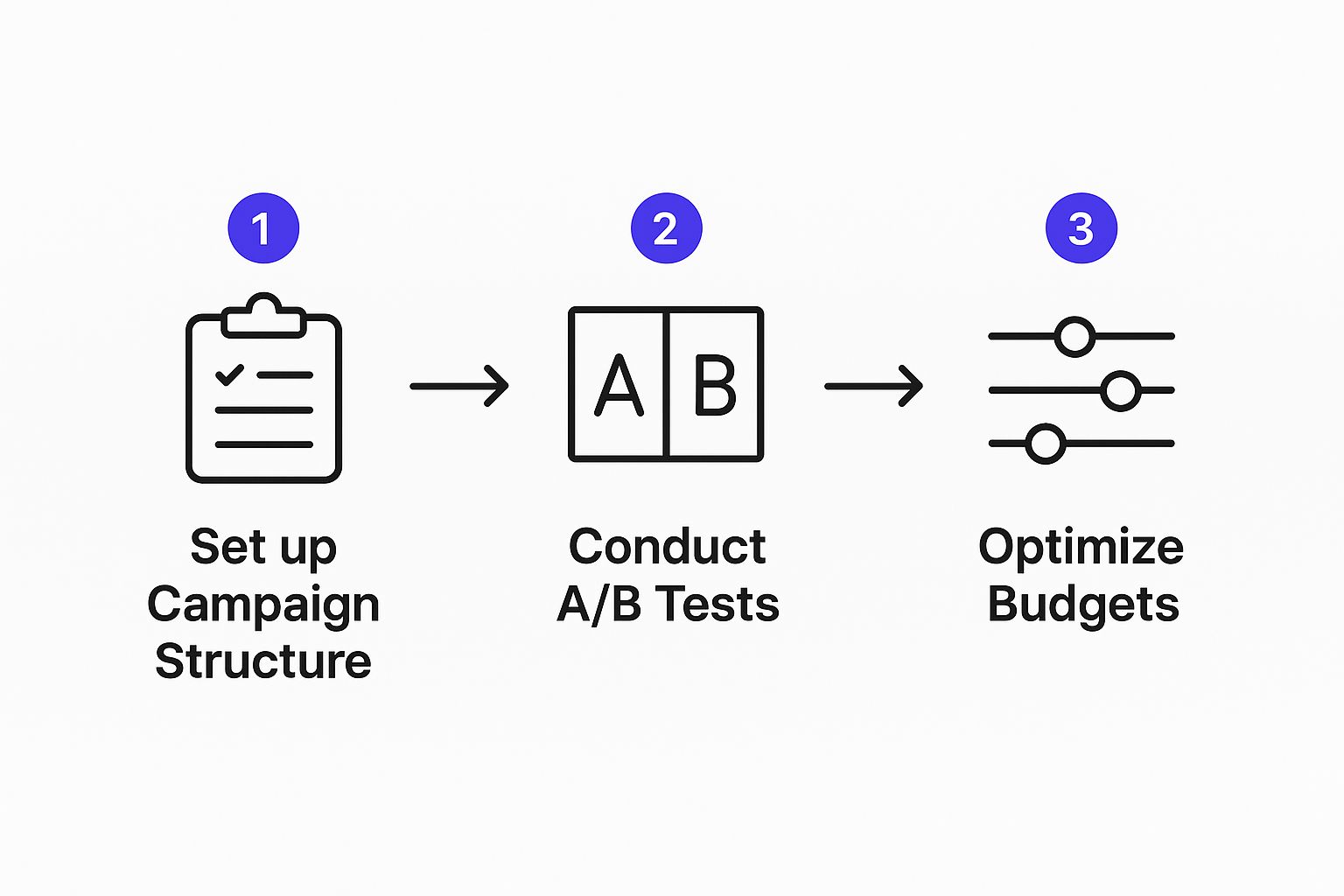
As you can see, this isn't a one-and-done setup. It’s an ongoing process of structuring your campaigns, testing what works, and moving your budget to the winners based on real-time data.
Structuring Your Campaigns for Success
One of the first big decisions you'll make is where to set your budget. You can do it at the campaign level with Campaign Budget Optimization (CBO) or at the ad set level. CBO lets you give Facebook a total budget for the entire campaign, and its algorithm automatically pushes more of that money towards your best-performing ad sets.
For most campaigns, I'd suggest starting with CBO. It lets the algorithm do the heavy lifting, hunting down the most efficient ways to spend your budget. It's a lifesaver when you're testing several different audiences at once, as Facebook’s AI will figure out which group is responding best and shift funds accordingly without you having to constantly babysit it.
Real-World Scenario: Let's say an online coffee retailer is testing two audiences. Ad Set A targets people interested in "specialty coffee," while Ad Set B targets a Lookalike Audience built from their best customers. With CBO, if Ad Set B starts bringing in sales at a lower cost, Facebook will automatically funnel more of the daily budget there. You maximise your return on ad spend without having to lift a finger.
Trusting Facebook’s AI to Do its Job
Facebook's AI has become incredibly powerful over the last few years, and you should absolutely be using it. Advantage+ campaigns, for example, remove a lot of the manual guesswork. You feed the system your creative assets and some basic audience signals, and it gets to work finding the best opportunities across the entire platform.
Sure, you give up some manual control, but Advantage+ is brilliant for discovering pockets of customers you might have otherwise missed. For broad e-commerce campaigns, it can often deliver a lower cost per acquisition than a campaign you've painstakingly targeted yourself. The trick is to trust the process and give it enough time (and budget) to learn.
The platform is still a powerhouse for a reason. Globally, Facebook pulled in around $144.3 billion in ad revenue in 2024, with Europe making up 27% of that figure. Here in Germany, social media ad spend is expected to hit $5.58 billion by 2025. This is all driven by solid performance—we’re talking an average ad conversion rate of 9.2% and the fact that nearly half of all advertisers now use Advantage+ campaigns to get better results. You can dig into more of these numbers and find other insights on Facebook's advertising impact at sqmagazine.co.uk.
The Never-Ending Quest of A/B Testing
Never assume you know what will work best. Always be testing. This is where A/B testing (or split testing) comes in. It’s simply the practice of running two slightly different versions of an ad against each other to see which one performs better.
You can test almost anything, but the golden rule is to change only one thing at a time. That way, you know exactly what caused the shift in performance.
Here are a few of the most impactful elements I always recommend testing:
- Creative: Pit a video ad against a sharp static image.
- Headline: Try a question ("Tired of weak coffee?") versus a clear benefit ("Your perfect morning brew awaits.").
- Primary Text: Test long, story-driven copy against something short and punchy.
- Call to Action: Does "Shop Now" get more clicks than "Learn More"?
Even tiny tweaks can lead to big wins in your click-through rate and cost per result. Just make sure you let your tests run for at least 3-4 days to gather enough meaningful data before you call a winner.
Once you find a winning ad, that becomes your new baseline. From there, you start testing new variations against it. This cycle of continuous improvement is how you steadily chip away at your costs and scale your campaigns. It’s not about finding one perfect ad; it’s about constantly finding a better ad.
Analysing Performance to Drive Growth
https://www.youtube.com/embed/Un9ndLTfjus
Launching your campaigns is a huge milestone, but it's really just the starting line. Real, sustainable growth from your marketing with Facebook efforts comes from digging into the results, understanding what they mean, and using that knowledge to make smarter decisions next time.
This isn’t about getting lost in a sea of numbers. It’s about focusing on the key performance indicators (KPIs) that tell you if you're actually making money or just making noise. This process turns your raw data into a clear roadmap for what to do next.
Focusing on the Metrics That Matter
When you open Facebook Ads Reporting for the first time, the sheer number of available metrics can feel overwhelming. The secret is to ignore the vanity metrics and zoom in on the ones that tie directly to your business goals.
For most businesses, these are the heavy hitters:
- Return On Ad Spend (ROAS): This is the ultimate bottom-line metric. It tells you how many euros you're generating for every euro you spend on ads. A ROAS of 3:1 means you made €3 for every €1 spent.
- Cost Per Result: This shows how much it costs to get the action you want, whether that's a purchase, a lead, or an app install. Keeping this number low is key to profitability.
- Click-Through Rate (CTR): This measures the percentage of people who saw your ad and actually clicked it. A low CTR is often the first sign that your creative or audience targeting is off the mark.
Understanding the true impact of your campaigns is vital. To really get a handle on it, you need to measure the ROI of your social media efforts properly. This is how you justify your budget and prove the value of your work.
Interpreting Your Campaign Data
Knowing what ROAS is and knowing what to do when it's low are two different things. The real skill lies in interpreting the numbers within the context of your specific campaign. A "good" Cost Per Result for a high-ticket item will be vastly different from one for a low-cost product.
Key Insight: Don't just look at metrics in isolation. A high CTR is great, but if it's not leading to conversions, you might be attracting the wrong audience. Always look at how your KPIs work together to tell the full story of your campaign's performance.
This is particularly relevant in the competitive German market. Digital marketing on Facebook is growing fast, with over 67.8 million active social media users in Germany. Since Facebook ads can reach 28.7% of the population—and 95.1% of users are on mobile—your performance data can tell you if your mobile-first creatives are hitting the mark.
Building Reports for Actionable Insights
The standard reports in Ads Manager are a decent start, but the real power comes from building your own custom reports. This lets you see the exact data you need, organised in a way that makes sense for you.
For example, you could build a report that compares the performance of different ad creatives side-by-side. You might find that your video ads have a much higher ROAS than your static images, or that one particular headline is driving a significantly lower Cost Per Result.
These aren't just interesting facts; they are direct instructions on how to improve. This data-driven feedback loop is the engine of continuous improvement. You'll learn what resonates with your audience, allowing you to refine your creatives, tighten your targeting, and get better results with every campaign you launch. For a deeper dive, our guide on creating effective social media analytics reports offers a more structured approach.
Your Top Facebook Marketing Questions Answered (Germany Edition)
Jumping into Facebook marketing in Germany can feel a bit different. You've got this massive, engaged audience on one hand, and some of the world's strictest data privacy laws (like the DSGVO) on the other. It’s a unique mix that naturally brings up some common questions.
These aren't just abstract concerns; they're the real-world roadblocks that can stop a campaign in its tracks. Let's clear the air on some of the most frequent queries I hear so you can build your strategy with confidence.
How Much Should I Actually Spend on Facebook Ads?
Ah, the million-euro question. The honest answer is: there's no single magic number. Your ideal budget really boils down to your industry, what you're trying to achieve, and how fast you need to get there.
For a local shop or a small service business just getting its feet wet, starting with around €10-€20 per day is a sensible approach. It’s enough to start gathering some initial performance data and test the waters with different ad creatives and audiences without breaking the bank. But if you’re an e-commerce brand launching a new product line, you’ll likely need to invest more heavily from the get-go to feed Facebook's algorithm enough data to find your ideal customers.
My Advice: Don't pull a number out of thin air. Work backwards. Figure out your target Cost Per Acquisition (CPA) first. If you're selling a product for €100 and your profit margin is €40, you know you can't afford to spend more than €40 to get that sale. Start with your profit margins, and let that guide you to a realistic ad budget.
With GDPR and DSGVO, Is Effective Targeting Still Possible?
Yes, absolutely. The Wild West days of grabbing any and all data are long gone, but don't mistake that for targeting being dead. Facebook's tools are still incredibly powerful; you just have to be smarter and more respectful in how you use them. The focus has simply shifted to privacy-first methods and your own data.
Here’s how you can still zero in on the right people:
- Interest and Behaviour Targeting: This is your bread and butter. It’s based on what people do inside Facebook and Instagram, so it’s less impacted by external tracking issues. Targeting users interested in "Wandern" (hiking) or "Bioprodukte" (organic products) is as effective as ever.
- First-Party Custom Audiences: The data you've collected yourself (with permission!) is gold. Uploading your customer email list lets you create incredibly powerful Custom Audiences to re-engage past buyers or build Lookalike Audiences to find new people just like them.
- Engagement Audiences: This is a fully compliant powerhouse. You can easily build audiences of people who have watched your videos, liked your posts, or visited your Facebook Page. These are warm leads who already know you.
Think of the regulations not as a barrier, but as a framework for building genuine trust with your customers. It forces you to be more deliberate, and that's a good thing.
Why Did My Ad Get Rejected?
It’s frustrating, I know, but ad rejections are usually caused by a few common slip-ups. Facebook has a very long list of ad policies, and its automated review system can sometimes be a bit overzealous. Always give your ad a final check against their official guidelines before you hit that publish button.
In Germany, I often see ads get flagged for these reasons:
- Unsupported Claims: This is a big one, especially for health or finance. Making specific promises like, "This cream cures eczema," or flashing "get rich quick" vibes will get your ad shut down fast.
- Referencing Personal Attributes: Your ads can't call out or imply you know something personal about the user. An ad that says, "Struggling with debt?" is a no-go. But one promoting "Financial planning services" is perfectly fine. It's a subtle but crucial difference.
- Before-and-After Images: These are almost always rejected in the health, wellness, and beauty categories. They're seen as making unrealistic or misleading promises about results.
If your ad gets rejected, take a breath. Read the reason they gave you, make the change, and resubmit. If you're certain you haven't broken any rules, you can always request a manual review from a real person.
Ready to take control of your social media and save hours every week? Repostly lets you schedule and automate your content across all major platforms, including Facebook. Stop posting manually and start focusing on what really matters—creating great content. Find out how much time you can save.
Keep reading

10 Fresh Instagram Story Idea Tactics for 2025
Stuck for content? Discover our top Instagram story idea list, with actionable tips to boost engagement and grow your audience in 2025.

A Practical Social Media Planner for German Markets
Build a results-driven social media planner for Germany. This guide offers actionable strategies for content, scheduling, and analysis in the German market.
Crafting Your Social Media Content Plan
Stop guessing and start strategizing. This guide provides an actionable social media content plan to audit, plan, and execute content that gets results.
Post once. Show up everywhere.
Start your 7-day free trial and publish your next video to every platform in minutes.Pick a plan and publish your next video to every platform in minutes.
Start your free trialSee plansCancel anytime