10 Social Media Growth Strategies to Dominate in 2025
Discover 10 powerful social media growth strategies to boost your online presence. Learn actionable tips and see real examples to increase your reach.

In a crowded digital marketplace, simply being present on social media is not enough. Achieving meaningful audience expansion requires a deliberate and sophisticated approach. The challenge lies in moving beyond posting updates and into building a strategic framework that consistently attracts, engages, and converts followers into a loyal community. This is where effective social media growth strategies become critical, serving as the blueprint for sustainable and authentic expansion.
This guide is designed to cut through the clutter of generic advice. We will dive deep into 10 proven strategies that deliver tangible results. Forget vague tips; instead, you'll find a comprehensive playbook filled with actionable steps, practical implementation details, and real-world examples to guide your efforts. We'll explore everything from mastering video content and leveraging user-generated campaigns to optimising your approach with data-driven analytics. Each section is structured to provide clear, concise insights you can immediately apply to your own accounts.
Before we explore these advanced tactics, it's crucial to have a strong foundation. To establish a solid groundwork for your entire approach, a clear understanding of the social media marketing fundamentals for growth is indispensable. A firm grasp of these core principles ensures that the sophisticated strategies detailed below are built upon a stable and well-organised plan. Whether you are a seasoned social media manager, an entrepreneur, or a content creator, this article will equip you with the tools needed to not just participate in online conversations, but to lead them and drive measurable growth.
1. Content Marketing & Storytelling
At its core, content marketing is a strategic approach focused on creating and distributing valuable, relevant, and consistent content to attract and retain a clearly defined audience. Rather than directly pitching your products or services, you provide genuinely useful content that solves your audience's problems, entertains them, or inspires them. This builds trust, authority, and a loyal community that eventually drives profitable customer action.

Storytelling is the engine of effective content marketing. It transforms dry facts into memorable narratives, creating an emotional connection that hard-sells simply cannot achieve. This is one of the most powerful social media growth strategies because it shifts the dynamic from a business-to-consumer broadcast to a human-to-human conversation.
When and Why to Use This Strategy
This strategy is ideal for brands aiming to build long-term relationships and establish themselves as industry leaders. It excels in competitive markets where differentiation is key, allowing you to build an audience that values your expertise and perspective, not just your price point. If your goal is sustainable, organic growth rather than short-term, paid acquisition, this is a foundational approach.
How to Implement This Strategy
- Define Your Content Pillars: Identify three to five core topics that align with your brand's expertise and your audience's interests. For a fitness brand, pillars might be nutrition, workout routines, and mental wellness.
- Establish a Brand Voice: Decide on a consistent personality. Are you an expert guide, a witty friend, or a motivating coach? This voice should permeate every post, video, and comment.
- Embrace Storytelling Frameworks: Use classic structures like the "Hero's Journey" to frame case studies, customer testimonials, or even your brand's origin story. Position your customer as the hero, and your brand as the guide helping them succeed.
- Provide Tangible Value: Every piece of content should have a clear purpose. Offer educational carousels, behind-the-scenes videos, or user-generated content features that make your followers feel seen and valued.
A prime example is Red Bull, which rarely posts about its energy drink. Instead, its social media is a masterclass in storytelling, centring on extreme sports and human achievement. This content strategy has built a massive, engaged community that associates the brand with energy, adventure, and pushing limits, proving that selling a lifestyle is far more powerful than selling a product.
2. Influencer Marketing & Partnerships
At its core, influencer marketing is a collaboration strategy where brands partner with individuals who have established credibility and an engaged audience within a specific niche. Instead of advertising directly to a large group, you leverage the trust and relationship an influencer has built with their followers. This allows your brand message to be delivered authentically by a voice the audience already respects, making it one of the most effective social media growth strategies for driving both awareness and conversions.
This bar chart highlights key data points in the influencer marketing landscape, showing common tiers, top-performing niches, and average return on investment.
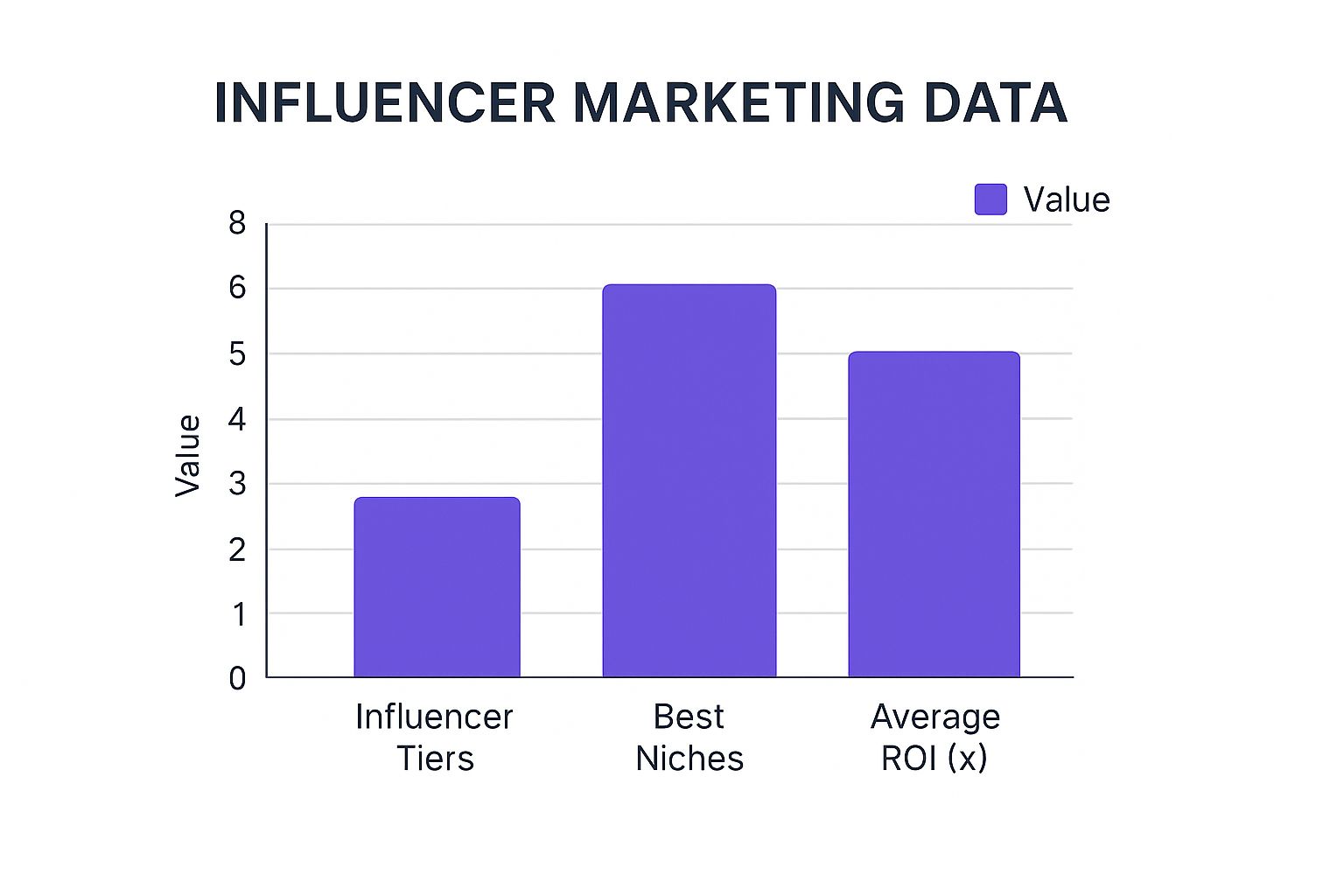
The data illustrates the significant ROI potential, with brands earning an average of £6.50 for every £1 spent, a testament to the power of authentic, niche-focused collaborations.
When and Why to Use This Strategy
This strategy is exceptionally powerful for brands needing to build trust and credibility quickly. It's ideal for reaching highly specific, niche audiences that are often difficult to target with traditional advertising. If your goal is to generate high-quality leads, drive direct sales, and create authentic social proof, influencer partnerships offer a direct line to an engaged and receptive consumer base. It is particularly effective for product launches and market entry.
How to Implement This Strategy
- Focus on Micro-Influencers: These creators (typically 10k-100k followers) often have higher engagement rates and a more dedicated community than mega-influencers. Their endorsement can feel more like a genuine recommendation from a trusted friend.
- Ensure Value Alignment: The influencer's content, values, and audience demographic must align perfectly with your brand. A mismatch can damage both your brand's and the influencer's credibility.
- Establish Clear Guidelines: Create a detailed brief outlining campaign goals, key messages, deliverables, and usage rights, but allow for creative freedom. Authenticity is key, so avoid overly restrictive scripts.
- Track Performance Accurately: Use unique discount codes, affiliate links, or dedicated landing pages for each influencer. This allows you to measure the direct ROI and identify your most effective partners for long-term relationships.
A classic example is Daniel Wellington, which pioneered the use of micro-influencers on Instagram. By gifting its watches to thousands of smaller fashion and lifestyle creators, the company built massive social proof and a sense of ubiquitous desirability, turning a small startup into a global brand with over $200 million in revenue.
3. User-Generated Content (UGC) Campaigns
User-generated content (UGC) is a powerful strategy that revolves around encouraging and showcasing content created by your customers and community rather than by the brand itself. By leveraging authentic customer experiences, you tap into a source of creativity that builds immense trust, boosts engagement, and organically expands your reach. This is one of the most effective social media growth strategies because it turns your audience from passive consumers into active brand advocates.

This approach leverages the principle of social proof, where people are more likely to trust recommendations from peers than from the brand itself. When potential customers see real people enjoying your products or services, it acts as a genuine, high-impact testimonial. It transforms your social media feed from a corporate monologue into a vibrant community dialogue, fostering a deeper sense of belonging and loyalty.
When and Why to Use This Strategy
This strategy is perfect for brands with a visually appealing product or a strong community ethos. It is especially effective for consumer goods, travel, and lifestyle brands looking to build a large-scale conversation and source a high volume of authentic marketing material without a massive budget. If your goal is to enhance brand credibility and create a self-sustaining cycle of engagement, a UGC campaign is an unparalleled choice.
How to Implement This Strategy
- Create a Memorable Branded Hashtag: Develop a simple, unique, and easy-to-remember hashtag for your campaign. This organises submissions and makes it easy for others to discover the content.
- Offer Clear Incentives: Motivate participation by offering prizes, discounts, or the chance to be featured on your official channels. The incentive should be valuable enough to encourage high-quality submissions.
- Provide Clear Guidelines: Set clear rules for what you're looking for in terms of content style, quality, and theme. This ensures the UGC aligns with your brand's aesthetic and campaign goals.
- Engage and Amplify: Actively like, comment on, and share submissions. Featuring the best content on your profile not only rewards creators but also encourages others to participate. To amplify your brand's message authentically, consider implementing UGC gifted collaborations, where products are sent to creators in exchange for valuable content.
A classic example is Starbucks' annual #RedCupContest, which encourages customers to share creative photos of their holiday-themed cups. This simple campaign generates millions of pieces of organic content each year, turning customers into marketers and cementing the red cup as an iconic symbol of the festive season.
4. Community Building & Engagement
This long-term strategy centres on creating and nurturing a loyal community of followers who actively engage with your brand and each other. Instead of chasing vanity metrics like follower count, this approach prioritises relationship building, meaningful interactions, and fostering a sense of belonging around shared interests or brand values. It transforms your social media presence from a simple broadcast channel into a thriving digital hub.
Community building is one of the most sustainable social media growth strategies because it creates a powerful network effect. Engaged members become brand advocates, generating organic word-of-mouth marketing and defending your brand. It moves beyond passive consumption, encouraging active participation that deepens brand loyalty and provides invaluable customer feedback.
When and Why to Use This Strategy
This strategy is essential for brands that thrive on customer loyalty, repeat business, and advocacy. It's particularly effective for niche markets, subscription-based services, and lifestyle brands where a shared identity is a key purchase driver. If your objective is to build a resilient brand with high customer lifetime value and reduce reliance on paid advertising, cultivating a community is a non-negotiable approach.
How to Implement This Strategy
- Respond Promptly and Authentically: Make it a priority to reply to comments and direct messages. Go beyond generic responses; ask follow-up questions and show genuine interest in your followers' opinions.
- Create Exclusive Spaces & Perks: Use platform features like Facebook Groups, Instagram's "Close Friends" list, or a dedicated Discord server to offer exclusive content, early access, or special Q&As for your most active members.
- Host Regular Live Events: Schedule consistent live sessions, workshops, or Q&As to facilitate real-time interaction. This creates a predictable "appointment" for your community to gather and engage directly with you.
- Encourage Peer-to-Peer Interaction: Pose questions and create discussion prompts that invite your followers to talk to each other, not just to your brand. Feature user-generated content to make members feel seen and valued. For a deeper dive, learn more about how to boost social media engagement.
A stellar example is Peloton, which has cultivated a powerful community around its instructors and classes. Riders use hashtags to form subgroups, interact directly with instructors on social media, and share their progress. This has transformed a piece of fitness equipment into a shared cultural experience, proving that a strong community is a brand's most powerful asset.
5. Video Content & Live Streaming
Video has become the dominant language of social media, offering a dynamic and immersive way to connect with audiences. This strategy centres on creating everything from polished long-form videos to spontaneous, real-time live streams. It leverages motion, sound, and personality to capture attention far more effectively than static images or text, making it one of the most powerful social media growth strategies available today.
Live streaming adds a layer of authenticity and urgency. It creates a direct, unedited line of communication, allowing for real-time interaction, Q&As, and community-building events. This raw, interactive format fosters a deeper sense of connection and trust, as followers feel they are part of a shared, live experience.
When and Why to Use This Strategy
This strategy is essential for any brand looking to maximise engagement and build a human connection. It's particularly effective for tutorials, product demonstrations, behind-the-scenes glimpses, and expert interviews where showing is more powerful than telling. If your goal is to rapidly build community, increase watch time, and capitalise on platform algorithms that prioritise video, this approach is non-negotiable.
How to Implement This Strategy
- Prioritise Audio Quality: Viewers will forgive mediocre video quality, but poor audio is an instant turn-off. Invest in a decent external microphone before upgrading your camera.
- Establish a Consistent Schedule: Whether it's a weekly live Q&A or a bi-weekly tutorial video, a predictable schedule encourages your audience to tune in regularly and builds anticipation.
- Engage in Real-Time: During live streams, acknowledge viewers by name, answer their questions, and react to their comments. This interactive element is the primary advantage of going live.
- Repurpose and Cross-Promote: Edit down long-form videos or live stream recordings into short, impactful clips. Share these highlights on other platforms like Instagram Reels or TikTok to drive traffic to your primary video content.
A phenomenal example is MrBeast, whose high-concept YouTube videos have built an empire. He masters compelling titles and thumbnails to drive initial clicks, then delivers on high-stakes, engaging video content that keeps viewers watching. This video-first approach has resulted in one of the fastest-growing channels in history, demonstrating the immense power of a well-executed video strategy.
6. Cross-Platform Content Strategy
A cross-platform content strategy involves creating and distributing content across multiple social media networks, but it goes far beyond simply copy-pasting the same message. It is the art of adapting your core message, format, and delivery to suit the unique audience behaviours and technical specifications of each platform. This ensures your brand voice remains consistent while the content feels native and optimised for every environment, from a professional LinkedIn article to a fast-paced TikTok video.
This nuanced approach is one of the most effective social media growth strategies because it maximises your reach without sacrificing engagement. By tailoring content, you respect each platform’s culture and user expectations, which leads to better performance, deeper connections, and a more cohesive brand presence. It’s about being everywhere your audience is, but speaking their specific language in each place.
When and Why to Use This Strategy
This strategy is essential for any brand aiming to build a truly dominant and widespread online presence. If your target audience is fragmented across different platforms, this approach allows you to engage them in their preferred digital spaces. It's particularly powerful for brands looking to amplify a single campaign or piece of cornerstone content, ensuring it reaches the largest possible audience in the most effective formats. It moves beyond single-channel success to create a holistic and resilient digital footprint.
How to Implement This Strategy
- Create Pillar Content: Start with a significant piece of content, like a detailed blog post, a webinar, or a podcast. This will serve as the "pillar" from which you can derive smaller, platform-specific assets.
- Adapt, Don't Just Republish: Slice your pillar content into different formats. A single interview can become a long-form YouTube video, several short audio clips for Twitter, a quote-graphic carousel for Instagram, and a professional insights post for LinkedIn.
- Maintain a Consistent Core Message: While the format and tone will change, your brand's core message, values, and visual identity should remain consistent across all channels to build brand recognition.
- Utilise a Content Calendar: Plan and map out which adapted content pieces will be posted on which platform and when. This ensures a coordinated and strategic rollout rather than a chaotic one.
Netflix is a master of this approach. It promotes a new show with a glossy, high-production trailer on YouTube, shares behind-the-scenes photos on Instagram, engages in witty meme-based conversations on Twitter, and uses viral audio clips from the show on TikTok. Each piece of content is unique and platform-native, yet all work together to drive viewership for the same programme.
7. Hashtag Strategy & Trend Leveraging
A tactical hashtag strategy is about more than just adding popular tags to your posts; it's a method for categorising your content and making it discoverable to a relevant audience actively searching for your niche. By combining this with trend leveraging, you capitalise on timely, high-volume conversations, inserting your brand into the cultural zeitgeist to gain explosive visibility and attract new followers.
This dual approach turns your content into a magnet for engagement. A well-placed hashtag connects you with interested users, while skilfully participating in a trend demonstrates that your brand is relevant and in-the-know. This is one of the most dynamic social media growth strategies because it combines consistent discoverability with opportunities for viral reach.
When and Why to Use This Strategy
This strategy is essential for brands seeking rapid visibility and audience expansion on platforms like Instagram, TikTok, and Twitter/X. It's particularly effective for businesses in fast-moving industries such as fashion, entertainment, or technology, where trends emerge daily. Use it when you want to boost the reach of individual posts, launch a new campaign, or connect with a younger, culturally-aware demographic.
How to Implement This Strategy
- Develop a Hashtag Mix: Don't just use the most popular tags. Create a balanced mix of broad, high-volume hashtags (e.g., #DigitalMarketing), niche community tags (e.g., #SEOTipsForBeginners), and a unique branded hashtag for your campaigns (e.g., #YourBrandChallenge).
- Monitor Emerging Trends: Use platforms' native "trending" or "For You" sections, and tools like Google Trends, to spot rising conversations. Act quickly but thoughtfully, ensuring the trend aligns with your brand's voice and values.
- Create Value, Don't Just Hijack: When participating in a trend, add your unique perspective. Don't simply copy what others are doing. Your goal is to contribute to the conversation in a way that feels authentic to your brand.
- Analyse Performance: Regularly track which hashtags and trends drive the most engagement and reach for your account. Use these insights to refine your approach for future content.
A classic example is Oreo's "You can still dunk in the dark" tweet during the 2013 Super Bowl blackout. By leveraging a real-time, massive event with a simple, clever, and on-brand message, they generated immense organic reach and solidified their reputation for agile and creative marketing.
8. Social Media Advertising & Paid Promotion
Social media advertising is a paid strategy that leverages the powerful targeting capabilities of platforms like Meta, TikTok, and LinkedIn to accelerate growth. Instead of relying solely on organic reach, this approach uses paid promotion to deliver your content directly to highly specific audiences, driving traffic, generating leads, and boosting sales with precision and speed. It allows you to bypass algorithmic limitations and guarantee visibility among users most likely to be interested in your brand.
This method transforms social media from a mere engagement tool into a robust performance marketing channel. By investing in ads, you can amplify your best-performing organic content, run targeted conversion campaigns, and gather valuable data on audience behaviour. It is one of the most direct social media growth strategies for achieving measurable business objectives in a predictable, scalable manner.
When and Why to Use This Strategy
This strategy is essential when you need to achieve specific, time-sensitive goals, such as launching a new product, promoting an event, or driving immediate sales. It is also invaluable for reaching new audiences beyond your existing followers and for businesses in competitive niches where organic visibility is challenging. If your growth has plateaued or you need to generate leads with a clear return on investment, paid promotion is the most effective lever to pull.
How to Implement This Strategy
- Start with a Clear Objective: Define what you want to achieve. Is it website traffic, lead generation, or direct sales? Your objective will determine your campaign setup, ad format, and key performance indicators.
- Utilise Advanced Targeting: Go beyond basic demographics. Use lookalike audiences based on your best customers, or target users based on their online behaviours, interests, and recent purchase intent to maximise relevance and reduce costs.
- Create Compelling Ad Creative: Your ad must stop the scroll. Use high-quality visuals, a strong opening hook, and a clear, concise call-to-action (CTA). Test different formats like video, carousels, and user-generated content style ads.
- Test, Optimise, and Scale: Begin with a small budget to test different audiences, creatives, and placements. Monitor performance closely, reallocate your budget to the winning variations, and then confidently scale what works.
A classic example is Dollar Shave Club, whose initial low-budget, witty video ad went viral through paid promotion on YouTube and Facebook. This campaign not only built massive brand awareness but also directly drove subscriptions, demonstrating how a well-crafted ad, combined with a strategic paid push, can launch a business into the mainstream.
9. Social Commerce & Shoppable Content
Social commerce is an integrated strategy that transforms social media platforms into dynamic storefronts, allowing users to discover and purchase products directly within the app. It collapses the traditional sales funnel by removing friction between inspiration and transaction. Instead of clicking out to an external website, customers can complete their purchase journey seamlessly, from product discovery in a post to checkout, all within a familiar social environment.
This evolution from content consumption to direct commerce is one of the most powerful social media growth strategies for product-based businesses. It capitalises on impulse buying behaviour and leverages the high engagement of visual content, turning your social feed into a revenue-generating channel. The key is to blend product promotion with authentic, lifestyle-oriented content, making shopping feel like a natural extension of the browsing experience.
When and Why to Use This Strategy
This strategy is indispensable for e-commerce brands, particularly in visually-driven sectors like fashion, beauty, home decor, and consumer electronics. If your primary goal is to increase direct sales and shorten the customer journey, social commerce is non-negotiable. It is exceptionally effective for reaching younger audiences (like Gen Z and Millennials) who value convenience and expect native shopping experiences on their preferred platforms.
How to Implement This Strategy
- Set Up Platform-Specific Shops: Utilise built-in tools like Instagram Shopping, Facebook Shops, and Pinterest Product Pins. Connect your product catalogue and ensure all information, like pricing and stock levels, is accurate and synchronised.
- Tag Products Strategically: Don't just tag products in sterile studio shots. Integrate product tags within high-quality lifestyle images, user-generated content, and influencer posts to show them in a real-world context.
- Create Shoppable Video Content: Leverage formats like Instagram Reels and TikTok videos to demonstrate products in action. Use shopping stickers and product links to make these dynamic videos instantly shoppable, capturing viewer interest at its peak.
- Optimise the Mobile Experience: Ensure your entire checkout process is streamlined and mobile-first. A clunky or slow checkout is the fastest way to lose a sale, so test the user journey from start to finish.
A prime example is the fashion retailer ASOS. Their Instagram feed expertly blends influencer-style photos with direct product tags. Followers see a styled outfit they love, tap the image to see product details and pricing, and can move to purchase in just a few clicks. This seamless integration of inspiration and commerce has turned their social profile into a major sales driver.
10. Analytics-Driven Optimization
Analytics-driven optimisation is a data-focused strategy that treats social media growth as a science rather than a guessing game. It involves using social media analytics, audience insights, and performance metrics to continuously refine your content strategy, posting schedules, and targeting. Instead of relying on intuition, this method uses concrete data to test, measure, and iterate on every aspect of your social media presence.
This approach transforms your social channels from a simple content feed into a dynamic feedback loop. Every post becomes a small experiment, providing data on what resonates with your audience and what doesn't. This is one of the most powerful social media growth strategies for achieving consistent, predictable results because it replaces assumptions with evidence-based decisions.
When and Why to Use This Strategy
This strategy is essential for any brand that wants to move beyond vanity metrics and tie social media efforts to tangible business objectives. It is particularly effective for businesses with limited budgets, as it helps maximise the ROI of every post and campaign. If you feel your growth has plateaued or your engagement is inconsistent, using analytics to guide your decisions is the key to breaking through and scaling your results.
How to Implement This Strategy
- Focus on Business-Centric Metrics: Move beyond likes and followers. Track metrics that align with your business goals, such as click-through rates, conversion rates, and cost per acquisition. Understanding these digital marketing performance metrics is crucial for proving value.
- Establish a Reporting Cadence: Set up weekly or monthly reviews of your social media data. Look for trends, identify top-performing content formats, and note the best times to post for your specific audience.
- A/B Test Your Hypotheses: Don't just make changes; test them. Run controlled A/B tests on different headlines, visuals, calls-to-action, or post formats to see what genuinely drives better performance.
- Turn Data into Actionable Insights: The goal isn't just to collect data but to interpret it. For example, if video posts receive 50% more shares, the actionable insight is to prioritise video content in your next content calendar.
BuzzFeed is a master of this approach. The company famously uses data from its massive audience to understand what types of content, headlines, and formats are most likely to go viral. By continuously analysing what people share and engage with, they have built a content engine that consistently produces highly shareable articles and videos, driving immense organic growth.
Top 10 Social Media Growth Strategies Comparison
| Strategy | Implementation Complexity 🔄 | Resource Requirements ⚡ | Expected Outcomes 📊 | Ideal Use Cases 💡 | Key Advantages ⭐ |
|---|---|---|---|---|---|
| Content Marketing & Storytelling | Medium - requires consistent time and effort | Moderate - content creation and planning | Long-term brand loyalty and organic reach | Building brand authority, audience education | Builds authentic connections, cost-effective |
| Influencer Marketing & Partnerships | Medium to High - managing partnerships and campaigns | High - influencer fees and management | Faster audience reach, higher conversions | Product launches, niche-targeted campaigns | Access to engaged audiences, authentic endorsements |
| User-Generated Content Campaigns | Low to Medium - community engagement and moderation | Low to Moderate - user interaction and moderation | Higher engagement, strong social proof | Community-driven marketing, brand trust building | Authentic content, cost-effective |
| Community Building & Engagement | High - requires ongoing active management | High - dedicated community managers and resources | Loyal brand advocates, organic word-of-mouth growth | Long-term loyalty and engagement | Sustainable growth, valuable customer feedback |
| Video Content & Live Streaming | Medium to High - technical skills and production | Moderate to High - equipment and editing | Higher engagement and conversion potential | Real-time interaction, entertainment, education | Real-time connection, favored by algorithms |
| Cross-Platform Content Strategy | High - complex scheduling and adaptation | High - high content creation and management | Maximized reach and brand consistency | Brands targeting diverse audiences across platforms | Increases visibility, reduces platform dependency |
| Hashtag Strategy & Trend Leveraging | Low to Medium - requires trend research and monitoring | Low - mainly research and content tagging | Increased discoverability, viral potential | Quick wins via trending topics | Cost-effective, boosts organic reach |
| Social Media Advertising & Paid Promotion | Medium to High - campaign setup and optimization | High - ongoing ad spend and expertise | Immediate, measurable ROI and scalable results | Direct sales, lead generation, retargeting | Precise targeting, fast results |
| Social Commerce & Shoppable Content | Medium - setup of e-commerce integrations | Moderate - ecommerce and content coordination | Increased conversions through seamless purchases | Retail, fashion, beauty e-commerce | Streamlines purchase, direct revenue attribution |
| Analytics-Driven Optimization | Medium to High - requires expertise in data analysis | Moderate - analytics tools and time | Continuous improvement and data-driven decisions | All strategies needing performance enhancement | Reduces guesswork, measurable ROI |
From Strategy to Execution: Your Next Steps to Growth
You have now explored a comprehensive blueprint of ten powerful social media growth strategies, each a vital piece in the complex puzzle of building a thriving online presence. From the authentic narratives of content storytelling to the precision of analytics-driven optimisation, the path forward is clear: growth is not a matter of chance, but a result of deliberate, strategic action. We have dismantled the idea that a single magic bullet exists, revealing instead a mosaic of interconnected tactics that, when combined, create a powerful and sustainable growth engine.
The core lesson is one of synergy. Your influencer partnerships will resonate more deeply when supported by authentic user-generated content. Your investment in paid advertising will yield a far greater return when it directs users to a vibrant, engaged community. Similarly, a dynamic video content strategy becomes exponentially more powerful when amplified through a sophisticated cross-platform approach. No single strategy operates in a vacuum; their true potential is unlocked when they work in concert.
Synthesising Your Social Media Growth Strategies
The journey from knowledge to implementation can seem daunting. To simplify this transition, focus on three foundational pillars that underpin all the strategies we have discussed:
- Audience-Centricity: Every successful strategy, from crafting compelling content to building a community, begins and ends with a profound understanding of your audience. Who are they? What do they value? Where do they spend their time? Answering these questions is the first step towards creating content and experiences that genuinely connect.
- Data-Informed Decisions: Your social media analytics are not just numbers; they are the voice of your audience. Consistently tracking metrics, understanding performance, and being agile enough to pivot based on data will separate you from those who rely on guesswork. This is the essence of moving from simply posting content to strategically engineering growth.
- Consistent, High-Value Execution: Growth is a marathon, not a sprint. Whether it is consistently showing up with live streams, regularly engaging with your community, or maintaining a steady flow of high-quality content, consistency builds trust and momentum. It signals to both your audience and the platform algorithms that you are a reliable source of value.
Your Action Plan for Immediate Progress
Rather than attempting to implement all ten strategies at once, which can lead to burnout and diluted efforts, a more measured approach is advisable. Start by selecting two or three strategies that most directly align with your current business goals, available resources, and brand identity.
For example, a visually-driven e-commerce brand might prioritise social commerce and UGC campaigns to drive direct sales and build social proof. In contrast, a service-based business might focus on community building and video content to establish thought leadership and foster client relationships. Once you have chosen your focus areas, commit to executing them with excellence for a defined period, perhaps one quarter. Meticulously track your progress, learn from the results, and then gradually layer in additional social media growth strategies as you gain confidence and capacity.
Ultimately, mastering these approaches is about more than just gaining followers. It is about building a powerful brand asset: a loyal, engaged community that trusts your voice, champions your products, and contributes to your long-term success. The strategies outlined in this article are your tools. Now, it is time to start building.
Ready to streamline your execution and save hours every week? Implementing a powerful cross-platform strategy is critical, and Repostly makes it effortless. Automate your content distribution across TikTok, Instagram, YouTube, and more, so you can focus on creating amazing content while your growth runs on autopilot. Visit Repostly to see how you can amplify your reach with just a few clicks.
Keep reading

10 Fresh Instagram Story Idea Tactics for 2025
Stuck for content? Discover our top Instagram story idea list, with actionable tips to boost engagement and grow your audience in 2025.

A Practical Social Media Planner for German Markets
Build a results-driven social media planner for Germany. This guide offers actionable strategies for content, scheduling, and analysis in the German market.

Crafting Your Social Media Content Plan
Stop guessing and start strategizing. This guide provides an actionable social media content plan to audit, plan, and execute content that gets results.
Post once. Show up everywhere.
Start your 7-day free trial and publish your next video to every platform in minutes.Pick a plan and publish your next video to every platform in minutes.
Start your free trialSee plansCancel anytime