Your Social Media Marketing Plan Template
Build a winning strategy with our social media marketing plan template. Get actionable steps and real-world examples to guide your growth.

A solid social media marketing plan template isn't about boxing yourself in with rigid rules. Think of it more as a reusable blueprint for everything you want to accomplish online. It guides your day-to-day actions, keeps your brand message consistent, and, most importantly, tells you what’s working and what’s not.
Why a Documented Strategy Beats Guesswork

Let's be real for a second. "Just posting" is a chore, not a strategy. When you're winging it, your social media feels disconnected and reactive. You end up scrambling for content ideas at the last minute and have no real clue if any of it is actually making a difference.
A documented plan, on the other hand, turns social media from a time-suck into a genuine business asset.
When you have a well-thought-out template, everyone on your team is on the same page. Your marketing and sales departments are aligned because the objectives, target customer, and core messages are crystal clear. This simple act of writing it all down prevents mixed signals and makes sure every single post builds toward a single, unified brand story.
From Chaos to Cohesion
Let's say you're launching a new product. Without a plan, the team might start posting on a whim. The visuals are all over the place, the captions have different tones, and the calls to action are inconsistent. It’s chaotic.
Now, imagine that same launch with a template in place. Suddenly, you have a defined workflow:
- Objective: Drive 100 pre-orders through Instagram.
- Key Message: "Simplify your life with our new smart gadget."
- Content Pillar: Focus on tech convenience and time-saving hacks.
- Visual Style: Use clean, minimalist photos and short, snappy video demos.
See the difference? This clarity makes everything so much more efficient. You know exactly what visuals, copy, and other assets you need and when you need them. No more last-minute panic. It’s the difference between throwing spaghetti at the wall and executing a coordinated campaign built to win.
To give you a clearer picture, a good template is built from several key pieces. Here’s a quick breakdown of what should be in your plan.
Core Components of an Effective Plan Template
| Component | Purpose and Key Details |
|---|---|
| Objectives & KPIs | What are you trying to achieve? Define specific, measurable goals (e.g., increase web traffic by 15%, generate 50 leads). |
| Audience Personas | Who are you talking to? Detail their demographics, pain points, and online habits. |
| Platform Strategy | Where will you post? Choose platforms where your audience is active and define the purpose of each (e.g., Instagram for visuals, LinkedIn for industry leadership). |
| Content Pillars | What topics will you own? Identify 3-5 core themes that align with your brand and audience's interests. |
| Content Calendar | When will you post? Map out your content schedule, including dates, times, post types, and captions. |
| Voice & Tone | How will you sound? Define your brand's personality—is it witty, professional, or inspirational? |
| Analytics & Reporting | How will you measure success? Set a schedule for tracking your KPIs and outline how you'll report on performance. |
With these elements defined, you have a comprehensive guide that anyone on your team can pick up and use to create effective, on-brand content.
A documented plan turns abstract goals into actionable steps. It’s the blueprint that ensures every piece of content, every campaign, and every dollar spent has a clear purpose tied directly to business growth.
Having a documented social strategy is becoming standard practice for any business serious about growth. Marketing insights from mid-2025 show a huge emphasis on using different templates tailored for either broad business goals or specific social networks.
For a wider view on how this fits into the bigger picture, checking out some top digital marketing strategy examples can spark some great ideas. At the end of the day, your template is what empowers you to do creative, impactful work and turns random acts of marketing into a predictable engine for your business.
Set Social Media Goals That Drive Business Results

Before you even think about filling in your social media marketing plan template, we need to talk about the "why." What are you actually trying to accomplish here? It's easy to get caught up in vanity metrics—a high follower count looks great on paper, but it doesn't pay the bills. The most effective social media strategies are always tied to real, tangible business outcomes.
So, let's move past fuzzy goals like "increase engagement." Instead, think about how your social media activity can directly impact your company's bottom line. We're talking about generating leads, driving sales, or building die-hard customer loyalty. Every single post and campaign should have a clear purpose.
The best way I’ve found to do this is by using the SMART framework. It’s a classic for a reason. This simple acronym helps you turn vague ideas into concrete targets by making sure every goal is Specific, Measurable, Achievable, Relevant, and Time-bound.
From Vague Ideas to Specific Actions
Let’s see how this works in practice. Say you run a B2B software company. A common but weak goal is "get more leads from LinkedIn." It's a starting point, but it's not specific, and you have no way to measure it.
A much stronger, SMART goal would be: "Generate 50 new marketing qualified leads (MQLs) through our LinkedIn content by the end of Q3." See the difference? It's specific (MQLs from LinkedIn), measurable (50), achievable (assuming that’s a realistic number for you), relevant (leads drive sales), and time-bound (end of Q3).
Here’s another one for a direct-to-consumer (D2C) brand:
- Weak Goal: "Get more user-generated content."
- SMART Goal: "Increase user-generated content submissions featuring our new product line by 20% over the next 60 days by running an Instagram photo contest."
This approach gives your entire strategy a clear North Star and makes it incredibly easy to prove its value later on.
When your goals are clear and measurable, your social media plan stops being a list of tasks and becomes a powerful tool for business growth. You know exactly what success looks like and how to get there.
Choosing KPIs That Matter
Once you've set your SMART goals, the next logical step is picking the right Key Performance Indicators (KPIs) to monitor your progress. KPIs are just the specific numbers that tell you whether or not you're on the right track.
The KPIs you choose will depend entirely on your goal. They have to match up.
If your goal is to increase brand awareness, you'll want to track KPIs like Post Reach, Impressions, Audience Growth Rate, and Social Share of Voice.
If you're trying to generate leads, your focus should be on KPIs like Clicks on lead magnet links, Form submissions from your social posts, and your Cost Per Lead (CPL).
And if you're aiming to improve customer loyalty, keep an eye on KPIs like Engagement Rate on community posts, Customer Mentions & Sentiment, and the Repeat customer rate from your social campaigns.
In your social media marketing plan template, make sure you have a section where you list each business goal, its corresponding SMART objective, and the 2-3 primary KPIs you'll use to measure it. This alignment is critical—it forces you to stay focused on the metrics that actually define success and demonstrate a clear return on your investment.
Audit Your Presence and Define Your Audience

Before you can map out your future, you have to get real about your present. It's tempting to jump straight into creating new content for your social media marketing plan template, but that's like trying to navigate a new city without checking a map first. You need a starting point.
That's where a social media audit comes in. Think of it as a frank, honest look in the mirror. You'll get a clear picture of what’s actually working, what’s falling flat, and where you might be missing out on some golden opportunities. It’s the only way to build a plan on solid data instead of just guesswork.
To do this right, you need a process. Using a good social media audit checklist is a lifesaver here. It walks you through everything, from tidying up your profiles and sniffing out imposter accounts to pinpointing which posts have performed the best. This tells you exactly what kind of content your audience already loves.
Moving Beyond Demographics
Alright, once you know your current standing, it’s time to shift focus to who you're actually talking to. This is, without a doubt, the most important piece of the puzzle. But I'm not just talking about basic demographics like age and gender. That's just scratching the surface. The real magic is in the psychographics.
Psychographics get to the why. They're all about your audience's attitudes, values, and beliefs.
- What keeps them up at night? What are their biggest frustrations?
- What are their goals and aspirations?
- What type of content genuinely stops their scroll?
Understanding these deeper motivations is how you create content that connects. For instance, a coffee brand might discover their audience isn't just buying coffee beans; they're buying a moment of quiet ritual before a chaotic day begins. That single insight can completely reshape your marketing message.
Great marketing isn’t about pushing a product. It’s about solving a real problem or speaking to a deep desire. When you understand your audience's inner world, you can communicate in a way that truly resonates.
Creating Detailed Audience Personas
Now, let's bring all that research to life by creating audience personas. A persona is essentially a fictional character who represents your ideal customer. It sounds a bit silly, but giving this "person" a name, a job, and some personality traits makes it infinitely easier to create content for them.
When you build out your personas, be sure to include details like:
- Goals & Motivations: What are they trying to achieve in life or work?
- Challenges & Pain Points: What’s getting in their way?
- Online Hangouts: Where do they spend their time online? Are they Instagram scrollers, LinkedIn readers, or TikTok watchers?
- Content Preferences: Do they binge-watch short videos, read long articles, or engage with interactive quizzes?
This level of detail is a game-changer. If you know your key persona, "Eco-conscious Eric," is passionate about sustainability and gets his news from Twitter, you know exactly where to find him and what to talk about. This is the foundation for driving real, meaningful results. And if you're looking to dive deeper, our guide on how to increase social media engagement is a great next step.
Craft Your Content Strategy and Calendar
Alright, you've got your goals and you know who you're talking to. Now for the fun part: deciding what you’re actually going to say. This is where your high-level strategy gets translated into the daily posts, videos, and stories that will build a real connection with your audience.
The best way to start is by defining your content pillars. Think of these as three to five core topics your brand will own. These pillars should live at the intersection of what your brand is all about and what your audience is genuinely interested in.
For example, a local coffee shop's pillars might be "Behind the Beans," "Community Spotlights," and "Barista Tips." A B2B software company might focus on "Productivity Hacks," "Customer Success Stories," and "Future of Work Insights." Having these pillars keeps your content focused, makes brainstorming a breeze, and stops you from posting random, off-brand content just for the sake of it.
Choosing Your Content Formats
With your pillars in place, think about how you'll package those ideas. You can't just post the same thing everywhere. Different platforms and people prefer different types of content, so a healthy mix is key to keeping your feed from feeling stale.
Here are a few formats to consider mixing into your plan:
- Video: Let's be honest, short-form video (Reels, TikToks, Shorts) is where the attention is. It’s perfect for showing off your brand’s personality with behind-the-scenes clips or quick, helpful tutorials.
- Carousels: These are fantastic for teaching. You can break down a complex topic into simple, swipeable graphics. Think mini-guides, step-by-step instructions, or telling a visual story.
- Static Images: Don't sleep on a beautiful photo or a sharp, well-designed graphic. They’re still powerful for announcements, sharing impactful quotes, or just showing off your product.
- Stories: This is your space for raw, in-the-moment content. Use polls, Q&A stickers, and daily updates to build community and create a sense of urgency.
You don't need to master all of these on day one. Pick two or three that you can create well and build from there.
The process of turning an idea into a published post doesn't have to be chaotic. It's a clear, repeatable workflow.
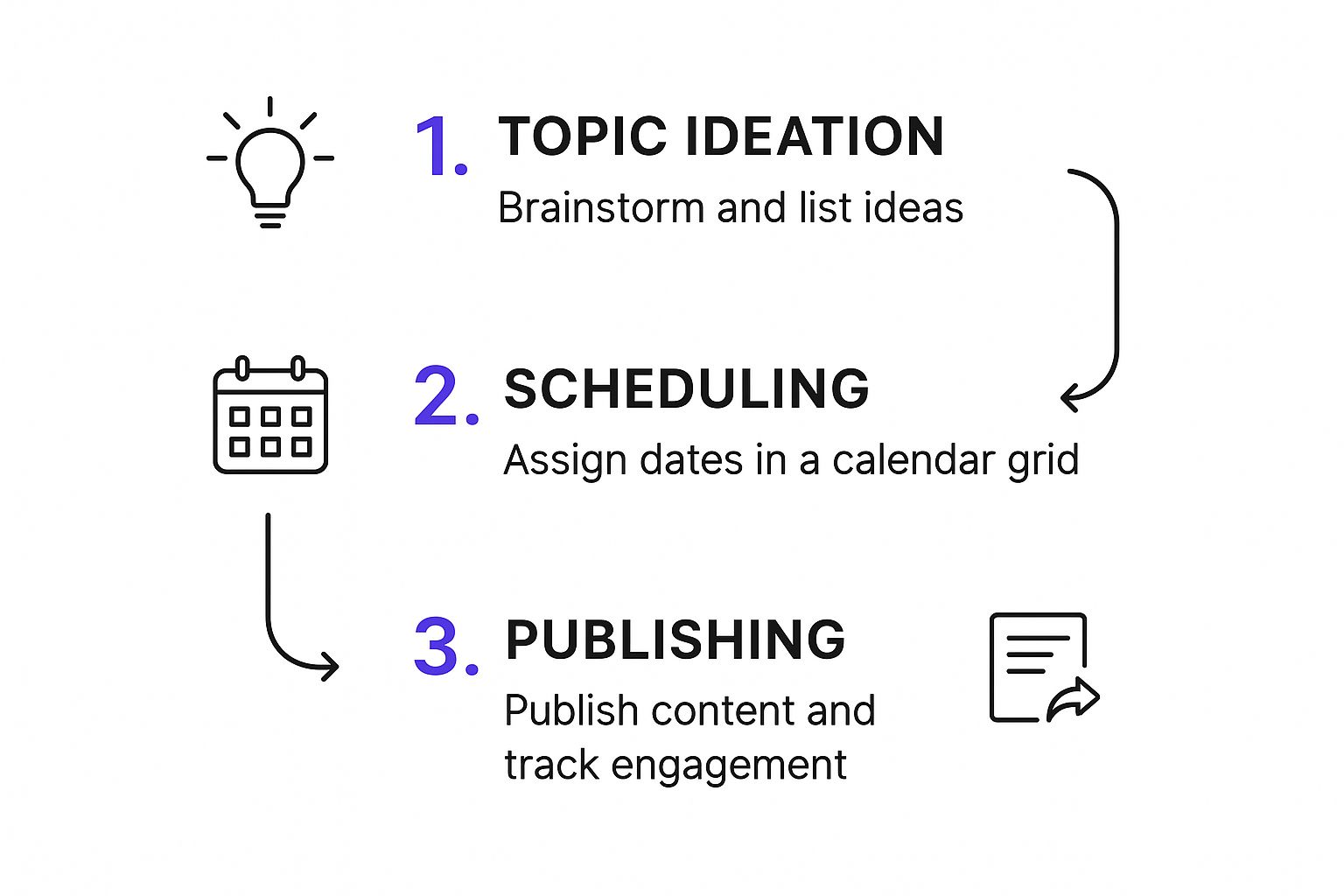
As you can see, a little structure goes a long way.
Building Your Content Calendar
This is the tool that turns your strategy into action. Your content calendar is your single source of truth for planning, organizing, and scheduling everything. It's what saves you from that daily "Oh no, what do I post today?" panic.
And it doesn't need to be fancy. A simple spreadsheet is often all you need to get started.
| Date | Platform | Content Pillar | Format | Copy/Caption | Visuals | Link |
|---|---|---|---|---|---|---|
| Oct 14 | Healthy Recipes | Carousel | "5 easy fall salads..." | Carousel images | [Link to recipe] |
|
| Oct 15 | Customer Success | Static Image | "See how Company X..." | Quote graphic | [Link to case study] |
|
| Oct 16 | TikTok | Workout Tutorials | Video | "Try this 10-min core..." | Vertical video file | [Link in bio] |
I've found that the most successful social media plans are the ones that also attach a budget to the calendar—factoring in costs for content creation or ad spend. It keeps the financial planning tied directly to the campaign's goals.
A content calendar isn’t a creative straightjacket—it’s the key to creative freedom. When you plan ahead, you free up your mental energy to focus on making great content, not just filling a slot.
Once your calendar is mapped out, the final piece of the puzzle is scheduling. Using a tool like Repostly lets you prepare your content in batches and schedule it to post automatically at the best times. This is a game-changer for staying consistent and efficient. To learn more about getting this right, check out our guide on how to schedule social media posts for maximum impact.
Measure What Matters and Refine Your Plan
https://www.youtube.com/embed/OOAk8xjgB2s
A great social media marketing plan template isn't a "set it and forget it" document. It’s a living, breathing guide that should change as you get real-world performance data. The final—and arguably most important—part of your strategy is closing the loop: tracking what’s happening, figuring out why, and then tweaking your plan for even better results next time.
This is where you graduate from looking at vanity metrics. For example, a post might get a ton of reach but almost zero engagement. What does that actually tell you? It could be that your visual stopped the scroll, but the message didn't resonate enough for a like or comment. Or maybe you reached a big audience, but it was the wrong one. These are the kinds of insights that lead to smarter decisions.
From Data Points to Actionable Insights
Your first move should be to tie your performance directly back to the KPIs you set in the beginning. Don't just collect numbers for the sake of it; you need to ask what they mean for your business goals. I’ve found that setting up a regular review—whether weekly or bi-weekly—is the only way to consistently turn that raw data into a story about what’s working and what isn’t.
I like to frame my analysis around a few key questions:
- Which content pillars are getting the most love? If your "Behind the Scenes" content gets twice the comments as your "Product Features," that’s a pretty clear sign from your audience about what they want to see more of.
- Which platforms are sending you the best traffic? Let's say LinkedIn sends visitors who convert at a 5% rate, while traffic from another platform bounces instantly. You know exactly where your time and budget are better spent.
- When are the best times to post? Dig into the native analytics on platforms like Instagram or use your scheduling tool to see when your specific followers are actually online and active. It's often not when you think.
This process is all about trimming the fat from your strategy. If a certain content format consistently tanks, no matter how much you polish it, it’s okay to let it go. Reinvest that time and energy into what's already a proven winner. For a deeper dive, our guide to metrics and reporting can help you get even more granular.
Making Your Reporting Process Painless
Pulling together a performance report shouldn't be a soul-crushing task. The whole point is to create a simple, clear snapshot that shows progress and justifies the ROI without getting everyone lost in spreadsheet hell. To make tracking your performance easier, using a good social media analytics report template can be a real game-changer.
A report’s job isn't just to show what happened; it's to guide what should happen next. Use your data to form a hypothesis, then test it in the coming weeks.
Automating this reporting is where the real magic happens. The best templates and tools will pull data automatically, updating in real-time so you aren't stuck doing manual entry. This frees you up to spend less time copying and pasting and more time finding those golden nuggets of insight that will help you optimize your campaigns.
By building a cycle of measuring, analyzing, and refining, you make sure your social media plan never gets stale. It shifts from being a static document to a dynamic roadmap that keeps you on a path of constant improvement and real, measurable success.
Got Questions About Your Social Media Plan? Let's Clear Things Up.
Even with the best template in hand, you're bound to have a few questions as you start putting your social media plan into action. That's completely normal. Let’s walk through some of the most common hurdles I see marketers and business owners face.
Getting these answers straight will give you the confidence to build a plan that's not just a document, but a real, working blueprint for growth.
How Often Should I Actually Update This Thing?
Your social media plan isn't meant to be carved in stone. Think of it more like a living, breathing guide that should evolve with your business and what the data is telling you.
As a general rule, I always recommend a solid quarterly review. This is your dedicated time to step back, look at what’s working (and what’s not), and compare it against the goals you set. It’s not about starting from scratch; it's about making smart, informed adjustments.
For example, maybe you notice your Instagram Reels are absolutely crushing it, bringing in way more engagement than static posts. Your quarterly review is the perfect moment to say, "Okay, let's double down on video for next quarter" and adjust your content calendar and budget accordingly.
A complete, top-to-bottom overhaul? That’s more of an annual event, or something you’d do when a major shift happens in your business—like launching a new product or expanding into a different country.
Strategy vs. Plan: Aren't They the Same Thing?
This one trips people up all the time, but the difference is crucial. It’s easy to use the words interchangeably, but they have very distinct jobs.
- Strategy is your why. It’s your big-picture vision. It answers foundational questions like, "Why are we even on social media in the first place?" and "What do we ultimately want to accomplish here?"
- Plan is your how. This is the tactical, on-the-ground roadmap that makes your strategy a reality. It’s where you get into the nitty-gritty: content calendars, platform choices, specific KPIs, and posting schedules.
Your strategy is the destination you've plugged into your GPS. Your plan is the turn-by-turn directions that get you there. You can't reach your destination without both.
Can't I Just Post the Same Content on All My Channels?
I get this question a lot, and while it's tempting, the short answer is a firm no. A copy-and-paste approach across platforms is one of the fastest ways to kill your engagement. Each social network has its own unique culture, audience expectations, and content formats that work best.
You can absolutely repurpose a core idea, but you have to adapt it for the environment.
Let's say you have a fantastic, in-depth case study that did wonders on LinkedIn. Simply dropping that link on Instagram won't work. Instead, you could transform that one piece of content into:
- A visually compelling carousel on Instagram breaking down the key results into bite-sized slides.
- A short, high-energy video reel featuring a snippet of a customer testimonial from the study.
- A concise, data-packed thread on X (formerly Twitter) that highlights the most surprising statistics.
When you tailor content like this, you're showing your audience you understand the platform and respect their time. The results will speak for themselves.
Ready to stop guessing and start executing? Repostly is the tool that helps you schedule your content, track what’s working, and manage your entire social media plan from one central hub. Start your free trial of Repostly today and see how much time you can get back.
Keep reading

10 Fresh Instagram Story Idea Tactics for 2025
Stuck for content? Discover our top Instagram story idea list, with actionable tips to boost engagement and grow your audience in 2025.
A Practical Social Media Planner for German Markets
Build a results-driven social media planner for Germany. This guide offers actionable strategies for content, scheduling, and analysis in the German market.
Crafting Your Social Media Content Plan
Stop guessing and start strategizing. This guide provides an actionable social media content plan to audit, plan, and execute content that gets results.
Post once. Show up everywhere.
Start your 7-day free trial and publish your next video to every platform in minutes.Pick a plan and publish your next video to every platform in minutes.
Start your free trialSee plansCancel anytime