Effective Social Media Time Management Strategies
Stop letting social media control your day. Learn proven social media time management strategies to boost productivity, reduce stress, and get real results.

Let's be honest, we've all been there. You open Instagram for a quick peek, and suddenly an hour has vanished. You close the app feeling a bit dazed, wondering where the time went and what you even accomplished. That’s the classic sign of social media running your schedule, not the other way around.
This guide is about flipping that script. It’s not about logging off for good, but about transforming these platforms from digital black holes into powerful tools that actually serve your goals.
Stop Scrolling and Start Winning at Social Media
The real problem isn't social media itself; it's using it on autopilot. When you're just passively scrolling, you let the algorithm dictate what you see and how you spend your time. We're going to move past the usual "just turn off notifications" advice and get into practical strategies that put you back in control.
Whether you're building a business, cultivating a personal brand, or just trying to stay connected with people you care about, every click and post should have a purpose. It's about making your time online count.
Redefining Your Relationship with Social Media
The first move is a mental one: stop seeing social media as a mere distraction. Think of it as a resource. The secret is shifting from a reactive state (endless scrolling) to a proactive one where you're calling the shots. This starts with knowing exactly what you want to achieve and making sure your online actions line up with that vision. Of course, this requires a solid foundation in how to stop wasting time in general, not just on social media.
This guide will give you a clear roadmap to get there. We’ll walk through how to:
- Audit your current habits: You can't fix a problem you don't understand. We’ll get real about where your time is actually going.
- Set clear, meaningful goals: "Growing my account" is too vague. We'll help you define what success truly looks like for you.
- Use powerful efficiency techniques: I'll show you how simple methods like content batching can literally save you hours every single week.
The whole point is to turn social media from a source of distraction into a high-value asset. With a bit of structure, you can reclaim your focus, cut down on stress, and see real results without feeling chained to your phone.
Ultimately, mastering your time on social media means you're in the driver's seat. You decide when to log on, what to post, and how each platform helps you hit your bigger goals. This simple shift in mindset is what separates passive users from strategic creators. It's time to turn that mindless scrolling into mindful action and win back your most valuable resource: your time.
Why German Social Media Habits Matter

To really get a handle on your own social media time, it’s helpful to look beyond your own feed. Seeing how other cultures use these platforms can give you a fresh perspective, and Germany offers a fascinating example of deliberate, intentional digital life.
Despite being one of Europe’s most connected countries, a huge chunk of the German population uses social media sparingly, if at all. This isn't because they dislike technology or lack access. It actually points to a much more purpose-driven way of being online.
This cultural insight is gold. It flips the script from feeling swamped by notifications to actively choosing when and why you log on. By looking at this mindset, you can start to reframe your own habits and see social media not as a constant demand, but as a tool that you control.
The Deliberate Digital Divide
There's a really interesting pattern in Germany that goes against the common assumption that more internet access automatically means more social media. Recent studies have brought this to light, showing that while 93% of German adults are online, only about 51% are using platforms like Facebook, Instagram, or TikTok.
That 42 percentage point gap is the biggest in any Western European country surveyed. It tells us that nearly half of all connected Germans are consciously choosing to limit or completely avoid social media. This is a stark contrast to neighbours like France and Italy, where roughly two-thirds of adults are active users. You can dig into the complete analysis of German digital habits on pewresearch.org.
What's really telling is that this limited use doesn't come from a negative view of social media. In fact, 57% of Germans feel these platforms have been a positive thing for democracy in their country. This suggests their lighter engagement isn’t about fear or disapproval, but a deliberate choice—a cultural tendency towards being more intentional with their digital lives.
What Can We Learn From This Approach
The German model of "light-touch" engagement offers some fantastic lessons for anyone trying to manage their social media time better. It’s not about deleting your accounts; it's about being more mindful.
This way of thinking encourages you to:
- Question the Default: Don't just jump on every new platform. Ask yourself if it genuinely helps you reach your personal or professional goals.
- Prioritise Quality over Quantity: Shift your focus to meaningful interactions instead of getting lost in a constant stream of content creation and consumption.
- Separate Connection from Constant Availability: It’s a game-changer when you realise you can stay connected with people without being perpetually logged in.
Adopting this perspective helps you move from being a passive scroller at the mercy of algorithms to becoming the active director of your own digital world.
This approach is about treating your time and attention as valuable resources. It’s a powerful reminder that effective social media use is defined by the value it adds to your life, not the hours it subtracts from your day.
Applying Intentionality to Your Strategy
So, how do you put these ideas into practice? It all starts by redefining what "success" on social media actually means to you. Is it about hitting a certain follower count, or is it about building real relationships with a smaller, more engaged community?
Here are a few actionable steps inspired by this deliberate approach:
- Define Your Purpose: Why are you on Instagram? What’s your goal on LinkedIn? If you can’t answer that clearly, it might be time for a rethink.
- Schedule Your Social Media Time: Block out specific, limited chunks of time for social media in your calendar, just like a meeting. This simple trick stops it from bleeding into the rest of your day.
- Conduct a "Feed Audit": Go through and unfollow any accounts that don't add value, inspire you, or align with your goals. Curate your digital environment to be intentional, not just a source of distraction.
Ultimately, understanding the German approach gives us a blueprint for a healthier, more productive relationship with social media. It proves you can be digitally connected while staying firmly in control of your time and focus—and that’s the very core of smart time management.
How to Conduct a Social Media Time Audit
You can't manage what you don't measure. It’s an old saying, but it’s the absolute truth when it comes to getting a handle on your social media habits. Before you can build a smarter strategy, you need an honest, data-backed picture of where your time is actually going.
An audit isn't about shaming yourself for wasted minutes. It’s about gathering the intelligence needed to make deliberate, impactful changes. The idea is to stop guessing and start knowing.
Think about the difference between feeling like "I spend way too much time on Instagram" and knowing for a fact that "I spend 45 minutes scrolling Reels between 9 PM and 10 PM every night." That level of detail is where you find the power to take back control.
Start With the Tools You Already Have
The easiest place to start your audit is right in your pocket. Your smartphone’s built-in screen time features are perfect for getting an unbiased look at your digital habits without downloading a single new app.
On an iPhone: Just head to Settings > Screen Time. You’ll find a detailed breakdown of your daily and weekly app usage, showing you exactly where your time goes. You can even tap into specific apps to see your most active hours.
On an Android: You’ll find this under Settings > Digital Wellbeing & parental controls. This dashboard gives you similar insights, including how many times you unlock your phone and which apps you open most.
Let these tools run in the background for one full week. The key here is not to change your behaviour yet—you want to capture what a typical week looks like. After seven days, you’ll have a clear baseline.
Find Your Time Sinks and Triggers
With a week of data in hand, it’s time to move from observation to analysis. Look at the numbers and start connecting them to what you were actually doing and feeling. It’s not just about the "what," but digging into the "why."
Ask yourself a few honest questions:
- Which platforms are eating up the most time? Is it the endless scroll on TikTok, or are you getting lost in professional debates on LinkedIn? The answer might surprise you.
- When are you most active? Pinpoint your peak hours. Are you a morning scroller, a mid-day procrastinator, or a late-night browser?
- What prompts you to open these apps? Try to remember what you were doing or feeling right before you started scrolling. Was it boredom? A tough task you wanted to avoid? Or a genuine need to check in on something?
Understanding your triggers is a game-changer. For example, if you realise you open Facebook every time you hit a mental block at work, you're not just dealing with a social media problem—you've identified a procrastination habit that uses social media as its escape route.
An honest time audit pulls back the curtain on the patterns that drive your behaviour. It's the moment you stop guessing and start understanding the specific habits that are holding you back.
Sort Your Activities: High-Value vs. Low-Value
The final piece of the puzzle is to look at your time qualitatively. Not all time on social media is created equal, right? Spending five minutes replying to a great comment from a potential client on LinkedIn is a far better use of time than thirty minutes of mindlessly watching random videos.
Now, create a simple list or table and start categorising your main activities on each platform.
| Activity Type | Description | Examples |
|---|---|---|
| High-Value Tasks | Actions that directly help you reach your goals. | Engaging with your community, networking with industry peers, replying to customer DMs, posting scheduled content. |
| Low-Value Tasks | Passive consumption with no clear purpose. | Mindless scrolling, watching irrelevant content, getting into pointless arguments in the comments section. |
This simple framework turns raw data into a strategic map. It shows you exactly which activities are a worthy investment and which are just draining your energy and time.
Once you have this clarity, you can start consciously shifting your focus towards the high-value column. Tracking these activities also gives you solid performance data, which you can take even further by exploring some of the best social media analytics tools to really measure your return on investment. With this audit complete, you're finally equipped with the insights you need to build a smarter, more efficient social media workflow.
Build an Efficient Workflow with Batching and Scheduling
The secret to taming the social media beast isn’t about working harder; it’s about working smarter. The game-changer for me was embracing content batching—turning what felt like a million tiny, scattered tasks into focused, productive work sessions.
Instead of scrambling to create a post every day, imagine dedicating a single 90-minute block to designing all your visuals for the entire month. It’s a completely different energy. You stay in that creative zone, the ideas flow, and you avoid the constant mental whiplash of switching between tasks.
Here’s how to get started:
- Time-block your process: Set aside specific times for brainstorming, writing captions, and creating graphics.
- Create in bulk: Think batches of visuals, drafts of copy, and ready-to-go hashtag sets.
- Schedule a final check: Always reserve a little time to review and tweak everything before it goes live.
Craft a Monthly Batch Structure
Once you start thinking in batches, you need a calendar to hold it all together. This is what stops the last-minute panic. I find it helpful to group tasks by content type, so one day might be all about static images, while another is dedicated to Reels or Stories.
Visualising your week can make a massive difference. Here's a sample schedule to give you an idea of how this could look in practice.
Sample Weekly Content Batching Schedule
This table shows how you can break down your social media workload into manageable, themed blocks throughout the week. By dedicating specific time slots to specific tasks, you create a rhythm that boosts efficiency and keeps you ahead of schedule.
| Day | Time Block (90 Minutes) | Task Focus | Goal |
|---|---|---|---|
| Monday | Morning | Graphics Batch | 15 Visuals Ready |
| Tuesday | Afternoon | Caption Writing | 30 Captions Drafted |
| Wednesday | Morning | Hashtag Research | Sets of 10 |
| Thursday | Afternoon | Scheduling Setup | Content Queued |
| Friday | Morning | Performance Review | Insights Logged |
Organising your workflow this way isn’t just about feeling more in control; it’s about setting yourself up for success.
The real magic happens when you pair this batching system with automated scheduling. You get to reclaim your evenings and weekends instead of being chained to your phone, waiting for the perfect time to post. A tool like Repostly, with its calendar view, lets you see your entire content plan at a glance, all neatly queued up and ready to go.
This consistency is exactly what the algorithms love.
“Batching and scheduling cut my content time in half.” – Lena Müller, freelance marketer.
A huge part of making this work is learning how to automate repetitive tasks, freeing you up for the creative stuff. Scheduling tools let you load up your content weeks in advance, slotting everything into the best posting windows without you having to lift a finger. This is the core of effective social media time management.
Think about it: in Germany, over 67.8 million people—that's more than 80% of the population—are juggling an average of 5.4 social media accounts. With 95.1% of that access happening on mobile, the demand for quick, on-the-go content is massive. Smart scheduling helps you meet that demand without burning out.
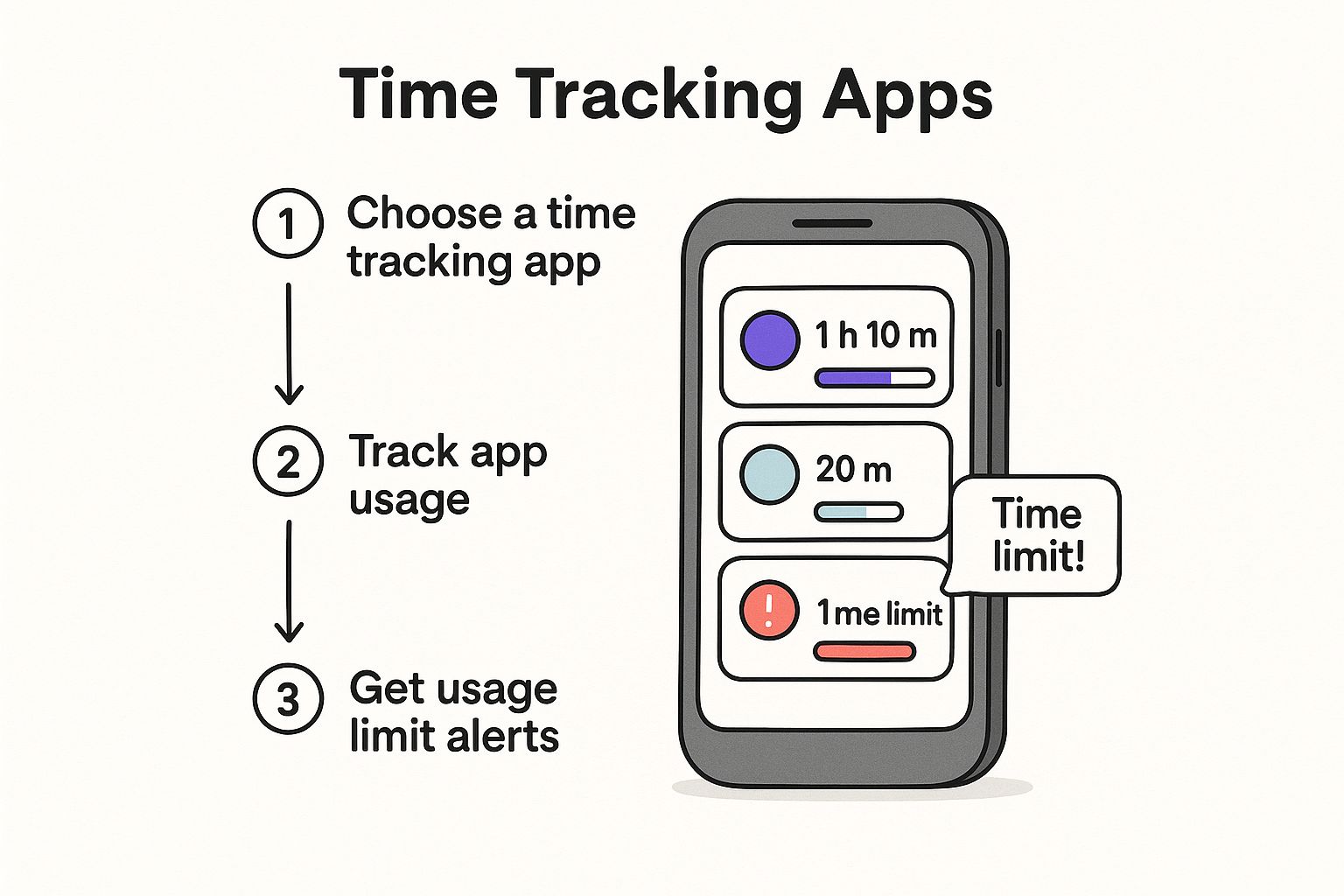
As this graphic shows, even simple app limits and usage notifications can be a powerful way to stop mindless scrolling and take back your time.
Schedule With Repostly
Using a dedicated platform like Repostly is a non-negotiable for me. It drastically reduces the chance of manual errors—no more copy-paste fails or posting to the wrong account! You can set custom posting times and intervals with a few clicks.
Once your content is queued, it publishes automatically across your connected accounts like Instagram and Facebook. It just works. If you're exploring your options, our guide on the https://repostly.app/blog/best-social-media-scheduling-tools-68a586e344be737efa9f3c3f is a great place to compare the top platforms.
Analyse Performance And Adapt
Your job isn't done once the content is scheduled. The final piece of the puzzle is looking at the data. Use your tool's analytics to see which posts are actually connecting with your audience.
Look for patterns. Are Tuesdays really your best day? Do carousels outperform single images? This is where you find the gold.
- Engagement Rate: Shows if your content is truly resonating.
- Posting Frequency: How often you post can directly impact follower growth.
- Interaction Patterns: Pinpoint the peak times your audience is online and active.
This process is a cycle. You batch, you schedule, you analyse, and then you adapt. Small tweaks here and there compound over time, leading to huge time savings and much better results.
Test Different Time Blocks
Remember, the 90-minute block is just a suggestion. It might not be your magic number. Experiment with 60 or even 120-minute sessions to see what feels right.
Personally, I find my creativity is at its peak in the morning, so that’s when I tackle design work. Afternoons are better for more analytical tasks like repurposing content or digging into analytics. Document what works for you to find your own sustainable rhythm.
Combine Tools For Maximum Efficiency
Don’t be afraid to mix and match your tools. Pair Repostly with a simple Pomodoro timer to keep your batching sessions hyper-focused. Syncing your calendar alerts across all your devices also ensures you never miss a beat. And if you’re working with a team, a shared board on a platform like Trello or Asana is essential for keeping everyone on the same page.
Evaluate And Rebatch
Set aside time each month to review your workflow. Are there bottlenecks? Is designing graphics taking way longer than you planned? Are you constantly running out of captions?
If I notice I'm falling behind on visuals, I'll re-evaluate and dedicate an extra batching session just to graphics. This is also the perfect time to look at what’s not performing and swap it out for something new. Don’t be afraid to experiment!
A Real-World Example
Take Maria, a small business owner I worked with. She used to spend at least two hours every single day on social media. Now, she handles everything in one focused session on Monday morning.
She maps out her ideas on Thursday evening, designs the visuals on Friday, and schedules it all with Repostly before the week even starts. The result? Her stress levels are way down, her weekends are her own again, and her online presence has never been more consistent.
Prioritise batching, automate with scheduling tools, and measure results to reclaim your time.
This isn't just about being more organised; it's about transforming social media from a daily chore into a strategic, manageable asset for your business. Try this system for one month. Track the hours you save. You’ll be amazed at the difference.
Set Clear Goals and Digital Boundaries

It’s one thing to be ‘busy’ on social media; it’s another to be effective. We’ve all been there—lost in an endless scroll, only to look up and realise an hour has vanished. Every minute you spend online should be a deliberate investment towards a specific outcome, not just a reaction to what’s in your feed.
This is exactly why defining your ‘why’ is the absolute cornerstone of smart social media time management. Without a clear destination, you’re just wandering. Your goals act as a compass, guiding every decision you make, from the content you create to the communities you engage with. They turn social media from a notorious time-drain into a purpose-driven tool.
Getting specific is non-negotiable. Vague objectives like "get more followers" are impossible to measure and almost always lead to unfocused, ineffective effort. A well-defined goal, on the other hand, gives you a clear target to aim for and a solid benchmark to measure your success against.
Define Your Purpose with SMART Goals
To bring real clarity to your efforts, the SMART framework is an invaluable tool. I’ve seen it time and again: it’s what separates the social media pros from the amateurs. It forces you to move beyond fuzzy ideas and create objectives that are concrete and actionable, making it far easier to track your progress and justify the time you invest.
Let’s walk through a real-world example for a small business owner:
- Specific: Instead of "I want more leads," you get precise: "I want to generate qualified leads for my coaching business through LinkedIn."
- Measurable: How do you know you've succeeded? "I will generate 10 qualified leads per month."
- Achievable: Is this realistic? "Based on my current engagement rates, generating 10 leads is a challenging but reachable target."
- Relevant: How does this fit into the bigger picture? "These leads are crucial for hitting my quarterly sales targets."
- Time-bound: What’s the deadline? "I will achieve this goal by the end of the second quarter."
Setting goals this way is the first step in building a plan that actually works. If you want to dive deeper, we cover this in our comprehensive guide on how to create a social media strategy.
The power of a SMART goal is that it turns a wish into a plan. It provides the focus needed to prioritise tasks and ignore the countless distractions vying for your attention online.
Establish Firm Digital Boundaries
Once your goals are locked in, the next critical step is to fiercely protect your time and focus. Think of digital boundaries as the rules of engagement you set for yourself. They ensure your online environment serves your objectives, not the platforms’ algorithms.
Without these boundaries, you're at the mercy of every notification, DM, and the siren call of the infinite scroll. They will constantly pull you off track. Creating an intentional separation between focused work and casual browsing is essential for both your productivity and your mental well-being.
This is particularly relevant in Germany, where a huge portion of the population is active online. Take Facebook, which has 43.4 million users—that's 53.1% of the population. The largest user group, adults aged 25 to 34, numbers 12.3 million. This is a demographic often juggling intense professional demands with their digital lives, highlighting just how widespread the need for effective time management is. You can find more insights on German social media users at napoleoncat.com.
Practical Ways to Take Back Control
Creating digital boundaries isn't complicated, but it does demand consistency. It’s all about making small, deliberate changes that add up to significant time savings and a lot less mental clutter.
Here are a few practical methods I recommend putting into practice immediately:
- Schedule Notification-Free Work Blocks: Carve out dedicated time in your calendar for deep work. During these blocks, all social media notifications are turned off. Use your phone's "Do Not Disturb" or "Focus Mode" to eliminate interruptions. Seriously, try it.
- Declutter Your Feeds: Be ruthless. Mute or unfollow accounts that are distracting, irrelevant to your goals, or just make you feel drained. Curating your feed is an act of self-care that has a direct impact on your focus.
- Use Separate Devices or Browsers: This is a game-changer. If possible, use one device or browser profile strictly for work-related social media and another for personal use. The physical separation creates a powerful mental distinction.
- Set App Timers: Your phone has built-in screen time features—use them. Set daily limits for your most-used social media apps. When you hit your limit, it’s a firm but friendly reminder to log off and shift your attention.
By combining clear, measurable goals with firm digital boundaries, you fundamentally change your relationship with social media. It stops being a source of endless distraction and becomes a powerful, efficient tool that works for you. This way, you can be sure every minute you spend online is a minute well spent.
Got Questions? We’ve Got Answers
Even with a solid plan, managing your time on social media can throw you a curveball. Real success comes from learning how to adapt when things get messy, not from having a perfect schedule from day one. It's all about fine-tuning your system and not getting discouraged.
Think of this as your go-to guide for those common sticking points that can easily derail your progress. We'll walk through the most frequent questions I hear and give you clear, practical answers to keep you on track.
"How Can I Stay Consistent When I Get Busy?"
We've all been there. Your schedule gets jam-packed, and consistency is the first thing to go. The secret isn't finding more time—it's about being smarter with the time you have. This is precisely why that batching and scheduling workflow we talked about is your best friend.
When you see a hectic period on the horizon, like a big product launch or the holiday rush, block out one solid session to get ahead. Schedule your content far in advance. Just getting two weeks of posts in the queue creates an incredible buffer, keeping your profiles active even when you're pulled in a million other directions.
Your system needs to work for you on your busiest days, not just your quietest. An automated schedule is what keeps the momentum going when you can't be there to post manually.
"How Do I Deal With FOMO (Fear of Missing Out)?"
Ah, FOMO. It's a real, powerful feeling that social platforms are practically built to trigger. That nagging sense that you have to be online or you'll miss a critical trend or conversation is a massive time-drain. The best way to fight it is to shift from mindlessly consuming to proactively engaging.
Instead of scrolling endlessly just to "see what's happening," set aside specific, short blocks of time for discovery. Give yourself 15 minutes to intentionally browse a few relevant hashtags, check in on what industry leaders are saying, or see what your community is chatting about. By putting a hard limit on it, you satisfy that need to stay in the loop without letting the algorithm hijack your entire day. You’re back in control.
"Should I Really Be on Every Social Media Platform?"
Let me make this easy for you: absolutely not. Spreading yourself too thin is a classic rookie mistake that leads straight to burnout and delivers mediocre results everywhere. You want to focus your energy where it will actually make a difference.
To figure that out, you need to go back to your audience and your goals:
- Where are your people? If you’re targeting B2B professionals, your time is much better spent on LinkedIn than on TikTok.
- What’s your content style? If you create stunning visuals, Instagram should be your priority. If long-form video is your thing, YouTube is the place to be.
- What can you realistically handle? It's so much better to be a master of one or two platforms than to be a flaky, inconsistent presence on five.
Start with one primary and one secondary platform. Get a solid, manageable system going for those. Only then should you even consider expanding, and only if it makes strategic sense.
"Are Paid Social Media Tools Actually Worth the Money?"
Look, you can absolutely get by with free tools, especially when you're starting out. But for serious creators and businesses, investing in a paid platform is often the turning point. A powerful tool isn't just a scheduler—it's the command centre for your entire social media strategy.
Think about the return on your investment. If a tool saves you five hours a week, what's that time worth? You could be creating better content, talking to your customers, or working on other parts of your business. Paid tools give you better analytics, smoother workflows, and powerful automation that frees up your most valuable resource: your time. They're an investment in efficiency, helping you get bigger results with less grunt work.
Ready to stop wasting time and start winning at social media? Repostly streamlines your entire workflow, letting you schedule content across all your platforms in minutes. Join thousands of creators who save over 5 hours a week and see an average 300% increase in reach. Start managing your social media smarter today at https://repostly.app.
Keep reading

10 Fresh Instagram Story Idea Tactics for 2025
Stuck for content? Discover our top Instagram story idea list, with actionable tips to boost engagement and grow your audience in 2025.

A Practical Social Media Planner for German Markets
Build a results-driven social media planner for Germany. This guide offers actionable strategies for content, scheduling, and analysis in the German market.

Crafting Your Social Media Content Plan
Stop guessing and start strategizing. This guide provides an actionable social media content plan to audit, plan, and execute content that gets results.
Post once. Show up everywhere.
Start your 7-day free trial and publish your next video to every platform in minutes.Pick a plan and publish your next video to every platform in minutes.
Start your free trialSee plansCancel anytime