8 Key Workflow Automation Benefits for Your Business in 2025
Discover the top workflow automation benefits that can boost efficiency, cut costs, and improve customer satisfaction. Unlock your business potential today.

In today's competitive landscape, manual tasks are a significant drain on your most valuable resources: time, money, and creativity. From managing social media content to processing customer data, repetitive processes can stifle growth and lead to costly errors. This is precisely where workflow automation transforms operations. By implementing automated systems, businesses can reclaim hours of productive time, reduce operational costs, and deliver a consistently high-quality experience.
For content creators and social media managers, tools like Repostly exemplify this shift, automating content distribution across platforms like TikTok, Instagram, and YouTube. This crucial step frees up creators to focus on what they do best: creating compelling content. This article moves beyond theory to explore the eight most impactful workflow automation benefits you can realise today.
We will provide actionable insights and practical examples to show you how to leverage this technology for maximum growth and efficiency in 2025. You will learn how to boost productivity, enhance accuracy, improve scalability, and ultimately drive better business outcomes. Let's delve into the specific advantages that make automation a cornerstone of modern success.
1. Increased Efficiency and Productivity
One of the most significant workflow automation benefits is the dramatic boost in operational efficiency and team productivity. By automating repetitive, rule-based tasks, businesses can standardise processes, ensuring they are executed with consistent speed and accuracy every time. This systematic approach eliminates the risk of human error and frees your team from tedious manual work.

This shift allows employees to redirect their focus towards high-value activities that require creativity, critical thinking, and strategic planning, areas where human intelligence excels. Organisations often report productivity gains of 10-30% within the first year of adopting automation. When looking to achieve higher efficiency and productivity, it's beneficial to examine strategies for optimising your content creation workflow.
How to Implement This for Maximum Impact
To effectively leverage automation for productivity, start small and scale intelligently. Identify processes that are high-volume yet low in complexity, as these offer the quickest returns.
- Map Existing Workflows: Before automating anything, create a detailed map of your current process. This helps identify bottlenecks and clarifies exactly which steps can be automated.
- Set Clear Metrics: Define what success looks like. Will you measure success by time saved, error reduction, or output volume? Clear key performance indicators (KPIs) are crucial for evaluating your return on investment.
- Train Your Team: Ensure employees understand how to use and monitor the new automated systems. Their role shifts from doing the task to overseeing the system that does it.
For instance, a social media manager can use tools like Repostly to automate content scheduling across multiple platforms, saving hours each week. This allows them to spend more time on community engagement and campaign strategy. The goal is not to replace humans but to empower them by handling the routine operations. Explore a variety of powerful social media automation tools on Repostly.app to see what fits your needs.
2. Significant Cost Reduction
Another of the core workflow automation benefits is the substantial reduction in operational costs. By automating labour-intensive processes, businesses minimise the need for manual intervention, which directly translates to lower wage-related expenses. Furthermore, automation reduces the frequency of costly human errors that often require significant time and resources to rectify, optimising resource allocation across the board.
The bar chart below illustrates the typical financial gains organisations experience, with studies consistently showing cost reductions between 20-60% in automated processes.
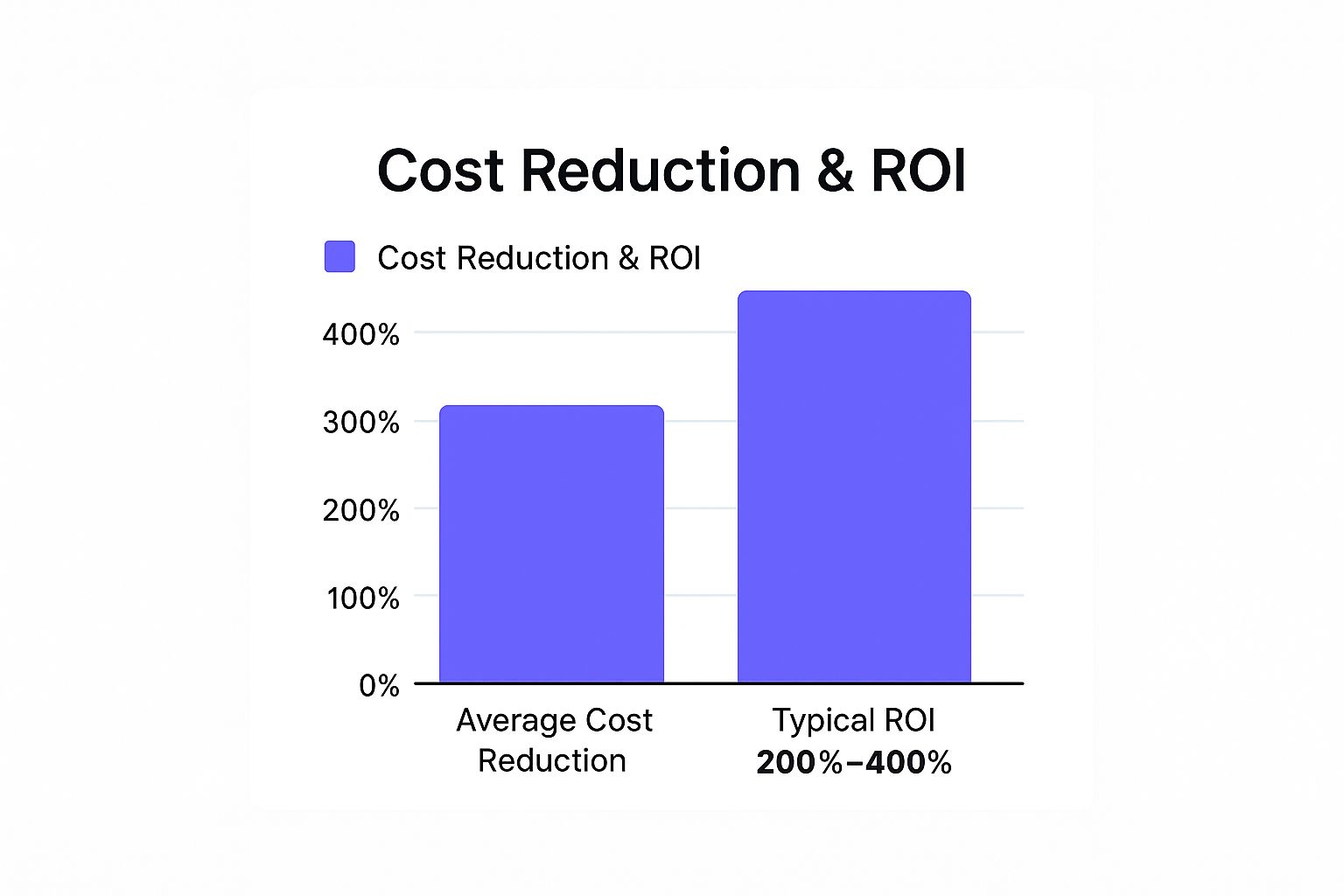
This data highlights that the initial investment often yields a powerful return, enabling businesses to reinvest savings into growth-focused areas like product development or marketing. For instance, Netflix saves millions annually through its automated content delivery systems, and Coca-Cola cut supply chain costs by 15% using automated inventory management.
How to Implement This for Maximum Impact
To achieve significant cost savings, focus your automation efforts on processes with clear, measurable financial outputs. A strategic approach ensures you target areas with the highest potential return.
- Calculate ROI Beforehand: Before implementing any new tool, calculate the potential return on investment (ROI). Factor in software costs, implementation time, and training against projected savings in labour hours and error reduction.
- Opt for Cloud-Based Solutions: Consider Software-as-a-Service (SaaS) automation platforms to minimise upfront infrastructure and maintenance costs. These tools offer predictable subscription-based pricing, making budgeting simpler.
- Factor in Change Management: Allocate a portion of your budget to training and supporting your team through the transition. Proper change management is crucial for smooth adoption and maximises the long-term financial benefits.
For a marketing team, automating the process of generating weekly performance reports can save an analyst several hours each week. This not only cuts direct labour costs but also ensures reports are consistent and delivered on time, leading to faster, more informed decision-making. The key is to view automation not as an expense but as a strategic investment in financial efficiency.
3. Enhanced Accuracy and Quality
Another of the core workflow automation benefits is a significant improvement in the accuracy and quality of your outputs. Manual processes are inherently susceptible to human error, especially in repetitive tasks where concentration can wane. Automation eradicates this risk by executing workflows based on predefined rules, ensuring every task is completed with absolute consistency.
This systematic execution leads to higher-quality work, a drastic reduction in the need for rework, and better adherence to both internal standards and external regulations. For instance, in manufacturing and claims processing, businesses report that error rates can plummet by as much as 80-90% after implementing automated systems. Anthem, for example, successfully reduced claim processing errors by 85% through automation.
This enhancement in precision allows teams to operate with greater confidence, knowing that foundational tasks are being handled flawlessly. This frees them up to focus on the strategic elements of their roles, such as refining quality control protocols or innovating new processes, rather than constantly correcting minor mistakes.
How to Implement This for Maximum Impact
To achieve the highest levels of accuracy, your automation strategy must be built on a foundation of precision and foresight. It's not just about automating a task but ensuring it performs correctly under all conditions.
- Implement Validation Checkpoints: Build multiple checks and balances directly into the automated workflow. For example, a system could automatically verify that all required fields in a form are filled before processing it.
- Design for Exception Handling: No process is perfect. Plan for edge cases and anomalies by creating clear protocols for how the system should respond when it encounters an unexpected issue, often by flagging it for human review.
- Maintain Human Oversight: For critical decisions or high-stakes processes, automation should assist, not replace, human judgement. Use automation for data gathering and processing, but leave the final approval to a team member.
4. Improved Customer Experience
Another of the core workflow automation benefits is the significant enhancement of the customer experience. By automating key touchpoints, businesses can deliver faster, more consistent, and personalised service around the clock. Automated systems can handle initial queries, provide instant order updates, and guide users to the right resources, ensuring customers feel supported at every stage. This operational excellence directly translates into higher satisfaction and loyalty.

This level of responsiveness meets modern consumer expectations for immediate and seamless interactions. For instance, Amazon's highly automated order processing and tracking system has been shown to improve customer satisfaction significantly by providing real-time visibility. Similarly, Spotify’s automated playlist generation keeps users engaged by delivering highly personalised content. These systems work tirelessly to create a smooth, positive journey for every customer.
How to Implement This for Maximum Impact
To leverage automation for a superior customer experience, focus on creating a seamless blend of automated efficiency and human empathy. The goal is to make interactions smoother, not more robotic.
- Map the Customer Journey: Before you automate, comprehensively map every touchpoint a customer has with your brand. This reveals the best opportunities for automation, such as initial support queries or post-purchase follow-ups.
- Provide Escalation Paths: Ensure customers can easily reach a human agent when needed. An automated system that creates a frustrating loop will damage customer relationships. A clear "talk to a person" option is non-negotiable.
- Gather and Refine: Use customer feedback to continuously improve your automated processes. Analyse satisfaction scores and comments to identify friction points and refine workflows accordingly.
For example, a business can automate the initial response to social media direct messages, acknowledging the query and providing an estimated response time. This simple step manages expectations and shows the customer they have been heard, allowing the support team to prioritise complex issues. The key is to use automation to handle routine interactions, freeing up your team for moments that require a personal touch.
5. Better Scalability and Flexibility
Another of the core workflow automation benefits is the ability to scale operations up or down with remarkable agility. Automated systems can handle fluctuating workloads without a proportional increase in manual labour or resources. This flexibility empowers organisations to navigate peak periods, seasonal demands, and rapid growth phases without significant operational disruption or the immediate need for new hires.

This operational elasticity means your business is always prepared, whether you are a startup experiencing sudden viral success or an established company managing seasonal rushes. For instance, Airbnb’s automated booking and communication workflows seamlessly manage millions of transactions during peak travel seasons, a task that would be impossible with manual processes. This adaptability ensures a consistent user experience and prevents your team from becoming overwhelmed, maintaining service quality even as demand skyrockets.
How to Implement This for Maximum Impact
To build scalable systems, you must design your automated processes with future growth in mind from day one. This proactive approach prevents bottlenecks before they occur.
- Design for Growth: When mapping workflows, consider potential future volume. Choose tools and platforms known for their ability to handle increased loads without a drop in performance.
- Use Cloud-Based Platforms: Opt for cloud-based automation tools. Their inherent elasticity allows you to scale resources on demand, paying only for what you use, which is far more cost-effective than investing in fixed on-premise infrastructure.
- Monitor Performance Metrics: Keep a close eye on key performance indicators (KPIs) like processing times, error rates, and system load. This data will alert you to potential scaling issues, allowing you to address them proactively.
For example, a content creator using a tool like Repostly can easily scale their output from five posts a week to fifty across multiple new platforms without a linear increase in their workload. The automated scheduling and posting system handles the increased volume effortlessly, allowing the creator to focus on strategy and content quality rather than the logistics of publishing.
6. Enhanced Data Management and Analytics
A crucial, yet often overlooked, workflow automation benefit is the generation of comprehensive data trails and metrics. Automated systems meticulously log every action, creating a rich repository of information that provides invaluable insights into process performance, bottlenecks, and opportunities for improvement. This data-driven approach allows businesses to move beyond guesswork and make strategic decisions based on real-time operational intelligence.
This systematic data collection enables continuous optimisation. By analysing performance metrics, you can refine your workflows, reallocate resources effectively, and predict future trends with greater accuracy. For instance, Walmart’s automated supply chain analytics help predict demand patterns, ensuring optimal stock levels and minimising waste. Furthermore, the integration of AI marketing automation exemplifies how advanced technologies enhance data management and analytics for better decision-making.
How to Implement This for Maximum Impact
To transform raw data into a strategic asset, you must approach automation with a clear analytical framework from the start. This ensures you collect the right information and can act on it effectively.
- Define KPIs Before Automating: Before you implement any new system, clearly define the key performance indicators (KPIs) you want to track. These could include cycle time, error rates, or output volume.
- Ensure Data Quality: Implement validation rules within your automation to maintain the integrity and accuracy of the data being collected. High-quality data leads to reliable insights.
- Use Visualisation Tools: Raw data can be overwhelming. Employ dashboards and visualisation tools to translate complex numbers into actionable charts and graphs that are easy for your team to understand and act upon.
A social media manager, for example, can use the analytics from an automation tool to identify which content formats perform best at specific times. This allows them to optimise their content strategy for maximum engagement. To delve deeper into this, you can explore the principles of leveraging data analytics in social media.
7. Improved Compliance and Risk Management
Another of the key workflow automation benefits is the enhancement of compliance and risk management. By embedding regulatory requirements and internal policies directly into automated processes, businesses can ensure consistent adherence. This approach significantly reduces the risk of human error leading to compliance breaches and simplifies audit procedures.
Automated workflows create an unchangeable, time-stamped audit trail for every action taken. This provides transparent, easily accessible documentation that demonstrates regulatory adherence and supports risk mitigation efforts. For industries like finance and healthcare, where compliance is non-negotiable, this level of control and documentation is crucial for maintaining operational integrity and avoiding costly penalties.
How to Implement This for Maximum Impact
To effectively use automation for compliance, focus on embedding rules directly into your operational systems. This shifts compliance from a manual review process to an integrated, proactive function.
- Involve Compliance Experts: Collaborate with legal and compliance professionals during the workflow design phase. Their expertise is vital for accurately translating complex regulations into automated rules and validation checks.
- Implement Validation Checkpoints: Build multiple approval and validation steps into your workflows. For example, an automated system can prevent a marketing email from being sent until its content has been programmatically checked against advertising standards.
- Schedule Regular Updates: Regulations change. Set up a recurring process to review and update your automated workflows to reflect the latest legal requirements, ensuring your organisation remains compliant over time.
For instance, major financial institutions like HSBC have successfully implemented automated anti-money laundering (AML) processes. These systems flag suspicious transactions in real-time based on predefined rules, reducing both compliance costs and the risk of regulatory violations. This strategic use of automation transforms compliance from a burdensome obligation into a streamlined, integrated part of daily operations.
8. Employee Satisfaction and Engagement
One of the most impactful workflow automation benefits is its positive effect on employee satisfaction and engagement. By automating the monotonous, repetitive tasks that often lead to burnout, businesses empower their teams to focus on more meaningful and strategic work. This shift allows employees to apply their creativity and critical thinking skills, leading to greater job fulfilment.
This transition from tedious data entry or manual report generation to high-value strategic input boosts morale and makes employees feel more valued. Organisations like Deloitte have successfully used automation to reduce consultant overtime by 25% while maintaining service quality, demonstrating a direct link between automation and improved work-life balance. When employees are more engaged, their contributions become more impactful, which can be seen in improved campaign results. For more on this, discover new strategies for increasing social media engagement on Repostly.app.
How to Implement This for Maximum Impact
To ensure automation boosts morale rather than causing anxiety, a people-centric approach is essential. The goal is to augment human capabilities, not replace them.
- Involve Employees in Planning: Actively involve your team in identifying which processes to automate. They have firsthand knowledge of the most tedious tasks and can offer valuable insights, fostering a sense of ownership.
- Communicate Benefits Clearly: Frame automation as a tool to eliminate drudgery and create opportunities for professional growth. Address concerns about job security head-on by highlighting new roles and responsibilities.
- Provide Robust Training: Equip your team with the skills needed to manage and work alongside new automated systems. This investment shows you are committed to their development and creates pathways for career advancement in a modernised workplace.
Workflow Automation Benefits Comparison
| Aspect | Increased Efficiency and Productivity | Significant Cost Reduction | Enhanced Accuracy and Quality | Improved Customer Experience | Better Scalability and Flexibility | Enhanced Data Management and Analytics | Improved Compliance and Risk Management | Employee Satisfaction and Engagement |
|---|---|---|---|---|---|---|---|---|
| Implementation Complexity 🔄 | Medium – requires process redesign and initial setup | High – significant upfront investment and technical staff | Medium – needs thorough testing and validation | Medium – requires mapping customer journey and setup | Medium – needs cloud investment and workflow design | Medium – needs proper workflow design, analytics tools | High – needs deep regulatory knowledge and frequent updates | Medium – involves change management and retraining |
| Resource Requirements ⚡ | Moderate – time and training investment | High – investment in technology and maintenance | Moderate – technical resources for quality checks | Moderate – customer journey analysis and monitoring | Moderate to High – cloud infrastructure preferred | Moderate – analytics tools and data management staff | High – compliance experts and automated systems | Moderate – employee training and communication efforts |
| Expected Outcomes 📊 | 10-30% productivity gains, consistent and faster task completion | 20-60% cost reduction, ROI 200-400% over 2-3 years | 80-90% error reduction, improved compliance | Faster responses, 24/7 availability, higher satisfaction | Handles volume spikes, scales with demand smoothly | Real-time insights, better optimization, continuous improvement | Reduced violations, simplified audits, proactive risk mitigation | Higher job satisfaction (up to 15%+), reduced burnout |
| Ideal Use Cases 💡 | High-volume, repetitive tasks needing standardization | Processes with clear cost metrics and high manual labor | Processes requiring strict quality and compliance standards | Customer service, multi-channel support | Businesses with fluctuating demand and growth ambitions | Organizations needing data-driven decision making | Regulated industries (finance, healthcare, pharma) | Workplaces aiming to improve engagement and reduce stress |
| Key Advantages ⭐ | Immediate time savings, consistent execution | Significant long-term operational savings | Consistent quality, fewer errors, compliance assurance | Personalization at scale, faster issue resolution | Rapid adaptation, consistent performance, easy replication | Full visibility, predictive insights, compliance reporting | Ensures compliance, mitigates risk, audit readiness | Increased engagement, career growth, reduced turnover |
Start Your Automation Journey and Redefine Your Workflow
We have journeyed through the transformative landscape of automation, exploring a comprehensive list of workflow automation benefits that extend far beyond simple time-saving. From the dramatic boosts in efficiency and significant cost reductions to the critical enhancements in data accuracy and customer experience, the message is clear. Automation is not merely a tool for large corporations; it is an essential strategy for creators, marketers, and small business owners aiming to thrive in a competitive digital environment.
The core takeaway is that automation liberates your most valuable asset: human potential. By offloading monotonous, rule-based tasks to intelligent systems, you and your team can redirect focus towards innovation, strategic planning, and creative problem-solving. This shift is fundamental. It transforms your operations from reactive to proactive, allowing you to scale effectively, manage risks with greater precision, and foster a more engaged and satisfied workforce.
Synthesising the Benefits for a Competitive Edge
Ultimately, the individual benefits we’ve discussed-enhanced productivity, improved data analytics, better compliance, and superior scalability-do not exist in isolation. They interconnect to create a powerful, synergistic effect that fundamentally strengthens your entire business model.
- Increased efficiency leads directly to cost savings.
- Enhanced accuracy bolsters compliance and improves the customer experience.
- Better data management fuels smarter decisions, enabling greater scalability and flexibility.
Realising these interconnected advantages is the key to building a resilient and forward-thinking operation. The initial step might feel daunting, but the journey begins with identifying a single, high-impact area ripe for optimisation. For many, that starting point is social media management.
Your First Step Towards Intelligent Automation
For content creators and digital marketers, the relentless cycle of content scheduling, posting, and performance tracking is a prime candidate for automation. This is where the true power of dedicated tools becomes apparent. By implementing a solution to handle these repetitive tasks, you immediately reclaim hours in your week, ensure consistent brand presence across platforms, and gain access to unified analytics that would be incredibly time-consuming to compile manually.
Embracing the future of work means choosing to work smarter, not harder. The workflow automation benefits are tangible and within reach. Don't let manual processes dictate the limits of your growth. Take the first concrete step today by analysing your daily tasks and identifying that one process that consumes your time without requiring your creative input. Automate it, measure the impact, and build momentum from there. This proactive approach will not only streamline your current operations but will also lay a robust foundation for future success and innovation.
Ready to unlock the full potential of your social media strategy? See for yourself how Repostly can automate your content scheduling, unify your analytics, and save you hours every week. Start your journey with a tool designed to deliver the core workflow automation benefits you need to grow your brand. Visit Repostly to learn more and begin optimising your workflow today.
Keep reading

10 Fresh Instagram Story Idea Tactics for 2025
Stuck for content? Discover our top Instagram story idea list, with actionable tips to boost engagement and grow your audience in 2025.

A Practical Social Media Planner for German Markets
Build a results-driven social media planner for Germany. This guide offers actionable strategies for content, scheduling, and analysis in the German market.

Crafting Your Social Media Content Plan
Stop guessing and start strategizing. This guide provides an actionable social media content plan to audit, plan, and execute content that gets results.
Post once. Show up everywhere.
Start your 7-day free trial and publish your next video to every platform in minutes.Pick a plan and publish your next video to every platform in minutes.
Start your free trialSee plansCancel anytime