Master Content Creation for Social Media
Unlock your brand's potential with this guide to content creation for social media. Learn proven strategies to engage audiences and drive real growth.

Creating content for social media isn't just about posting pretty pictures. It's the whole process—planning what to say, producing the actual posts, and publishing them on platforms like Instagram, TikTok, and Facebook. The goal? To put out valuable, relevant, and consistent content that grabs the attention of your ideal audience and, ultimately, helps your business grow.
Building Your Social Media Content Foundation
Jumping straight into making posts without a plan is a recipe for disaster. It’s like trying to build a house without a blueprint. A solid foundation ensures every single piece of content you create has a clear purpose and pushes you closer to your main business goals. This is about more than just filling a calendar; it's about building a framework for sustainable success.
So, where do you start? First, you need to decide what you're actually trying to achieve. Are you looking to get your brand name out there, pull in some solid leads, or build a really engaged community? Your answer will shape every piece of content you produce from here on out.
This infographic gives a good overview of how most businesses rank these goals.
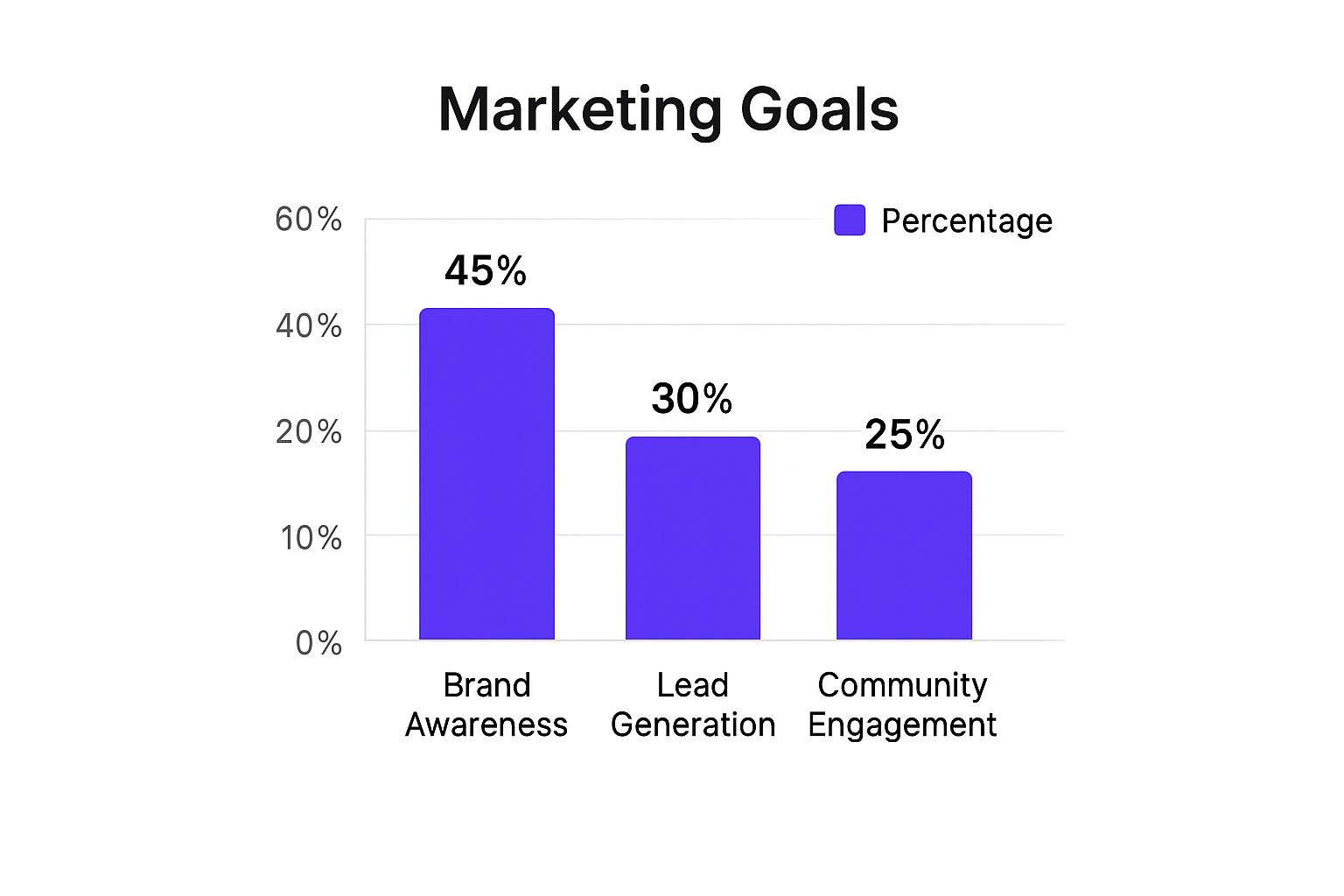
As you can see, brand awareness usually takes the top spot. It makes sense—you have to get in front of new people before you can turn them into customers.
Defining Your Audience in Germany
Knowing your audience inside and out is non-negotiable. If you're targeting Germany, you need to go beyond basic demographics. Dig into their interests, their online habits, and what problems they're trying to solve. As of January 2025, Germany had roughly 65.5 million social media user identities, which works out to about 77.6% of the population.
Here’s a crucial detail: a staggering 95.1% of these users are on social media via their mobile phones. This means your content absolutely must be designed for a vertical screen. Think short-form videos and text that's easy to scan on the go. You can find more data on Germany's digital habits over on datareportal.com.
Creating a detailed audience persona will be your guiding star. Let's say you run a sustainable fashion brand based in Munich. Your target might be "Eco-conscious Lena," a 28-year-old professional living in the city who cares about brand transparency and follows slow-fashion influencers. For Lena, you’d create content about your ethical sourcing, share styling tips for versatile outfits, and post behind-the-scenes videos from your workshop—all perfectly formatted for her phone.
One of the biggest mistakes I see brands make is trying to be everything to everyone. When you talk to everybody, you end up connecting with nobody. Get specific and your content will hit home.
Competitor Analysis and Brand Voice
Once you know who you’re talking to, it’s time to see what conversations are already happening. Take a close look at your competitors. What’s working well for them? And more importantly, what are they missing? If everyone else is just posting polished product photos, maybe there’s a huge opportunity for you to stand out with more authentic, user-generated content. Looking at some effective social media strategy examples can give you some great ideas for finding your own angle.
This research directly feeds into defining your unique brand voice. Your voice is your brand's personality, and it needs to be consistent everywhere you show up online. What does your brand sound like?
- Professional and authoritative? Like a B2B software firm.
- Playful and witty? Like a fun direct-to-consumer brand.
- Supportive and nurturing? Like a wellness coach.
Choosing the right platform is just as important as the content itself. For a German audience, different platforms serve different purposes.
Platform Content Alignment for German Audiences
Here’s a quick breakdown to help you match your content to the right platform for engaging users in Germany.
| Platform | Primary User Demographic (Germany) | Optimal Content Formats | Strategic Goal |
|---|---|---|---|
| 25-34 year olds, strong urban presence | Reels, high-quality images, Stories, Carousels | Brand building, visual storytelling, influencer marketing | |
| 35-54 year olds, broad demographic | Videos, community posts, event promotion, links | Community building, driving website traffic, local outreach | |
| TikTok | 16-24 year olds, Gen Z focus | Short-form vertical videos, trends, tutorials | Brand awareness, viral marketing, user-generated content |
| Professionals, B2B decision-makers | Articles, case studies, text posts, professional video | B2B lead generation, industry authority, networking | |
| Professionals (strong in DACH region) | Professional updates, articles, event networking | Professional networking specifically in Germany, Austria, Switzerland |
This table shows that you can't just copy and paste content across platforms. A professional article for XING won't work as a TikTok video, and a viral dance challenge has no place on LinkedIn. Tailoring your approach is key.
This initial strategic work is absolutely essential. To see how all these pieces fit together, check out our full guide on how to create a social media strategy. By setting clear goals, truly understanding your audience, and carving out a distinct voice, you’re creating the perfect launchpad for social media content that actually makes an impact.
Developing Your Content Ideation Engine

We’ve all been there. Staring at a blank content calendar, the pressure mounting to come up with something fresh and engaging. It’s a common source of stress for social media managers and creators alike, and it’s a fast track to burnout.
The secret isn’t to magically become a bottomless well of creativity. It’s about building a reliable system—an ideation engine—that does the heavy lifting for you.
An engine like this shifts your entire approach from reactive, last-minute posting to a proactive, strategic one. It’s about creating a sustainable process for content creation for social media that’s hardwired to your brand and what your audience actually wants. You stop waiting for inspiration to strike and start building a structured way to find it.
Let's dive into how to build this engine, getting past generic brainstorming and into real techniques that will keep your content pipeline full.
Establish Your Core Content Pillars
Before you can start generating ideas, you need a framework. This is where content pillars come in. Think of them as the 3-5 core themes or topics your brand will consistently own. These pillars should be a direct reflection of your expertise and the things your target audience genuinely cares about.
Let’s imagine a Berlin-based coffee roaster. Their content pillars might look something like this:
- Brewing Techniques: From tutorials and home barista tips to deep dives on brewing equipment.
- Bean Sourcing & Sustainability: Sharing stories about where their coffee comes from and their ethical practices.
- Local Café Culture: Highlighting other local businesses, covering community events, and telling neighbourhood stories.
- Behind the Scenes: Introducing the roasters, showing the process, and sharing the day-to-day realities of the business.
These pillars are your guardrails. They keep your content focused and ensure you’re always reinforcing who you are as a brand. Every single idea you come up with should slot neatly into one of these categories. This consistency is what builds trust and makes your brand recognisable over time.
Tapping Into Real Conversations
Your audience is handing you content ideas every single day. You just have to listen. Social listening is all about monitoring social channels for mentions of your brand, your competitors, and keywords related to your industry. It gives you an unfiltered look into what people are actually talking about, what they're struggling with, and what questions they have.
You can use tools to track keywords that tie back to your pillars. Our coffee roaster could set up monitors for terms like "kaffee in Berlin," "espresso zubereiten," or "nachhaltiger kaffee." In doing so, they might spot a recurring question about how to make the perfect cold brew at home. Boom—that’s a direct prompt for a how-to video or a step-by-step infographic.
Sometimes, the most powerful method is also the simplest: just ask.
Use interactive features like Instagram Story polls or Q&A stickers. You could even create a simple survey. Asking something as direct as, "What's your biggest challenge when brewing coffee at home?" can give you more solid content ideas in an hour than you'd get from a week of internal brainstorming.
Analysing Competitors and Identifying Gaps
Your competitors are a goldmine of information. Take a look at their best-performing content to see what’s hitting the mark with your shared audience. Are videos getting more traction than carousels? Do educational posts seem to land better than purely promotional ones? Look for the patterns.
But the goal here isn't to copy. It's to find the gaps.
If you notice every competitor is posting hyper-polished product shots, maybe there’s a massive opportunity for authentic, user-generated content (UGC). If their content is all highly technical, you could win by adopting a more beginner-friendly, approachable tone. This kind of analysis helps you carve out your own unique space and offer value that everyone else is overlooking.
By bringing these methods together—building your pillars, listening to your audience, and keeping an eye on the competition—you create a powerful, multifaceted ideation engine. This system ensures your content creation for social media is not just consistent but also deeply relevant, turning the daunting task of filling a calendar into a strategic and, dare I say, enjoyable process.
Crafting Content That Actually Connects

This is where the real work begins—and where the magic happens. Once you have a bank of solid ideas, it's time to turn them into actual posts that stop people from scrolling and start building genuine connections. Great content creation for social media is equal parts art and science; you need that creative spark, but you also need a strategic mind that understands what makes people click, comment, and care.
It's never enough to just throw content out there. To stand out, your posts need to feel real and offer something genuinely useful or entertaining. Let's walk through how to write copy that gets noticed, create visuals that tell a story, and pick the right tools to bring it all together without the headache.
Writing Copy That Captures Attention
Words are the heart of your message. Even the most incredible video will fall flat if the caption doesn't stick the landing. The aim is to be clear, concise, and compelling enough to guide your audience from that first glance to your final call-to-action (CTA).
You've got about three seconds to hook someone scrolling through their feed. That’s it. You need to lead with a punchy question, a surprising fact, or a relatable problem that makes them stop and think, "Hey, that's me."
Once you’ve got their attention, keep things simple. Use short sentences and paragraphs. Break up text with emojis or line breaks to make it easier on the eyes. Most importantly, write like you talk. Ditch the corporate jargon and get straight to the point in a tone that reflects your brand’s personality.
The best social media copy feels like a one-on-one conversation, not a public announcement. When you write as if you're talking to a single person about their specific interests, you build a much stronger, more personal connection.
And don't forget the "so what?" Every single post needs a purpose. What do you want someone to do after reading? Make your call-to-action impossible to miss. Whether it's "Drop your favourite tip below," "Shop the collection via the link in our bio," or "Save this for your next project," a clear instruction makes it easy for your audience to engage.
Mastering Visual Storytelling
On platforms like Instagram and TikTok, your visuals do most of the talking. High-quality images and videos are no longer optional—they're the price of entry. But beyond just looking good, they need to feel consistent with your brand and be formatted correctly for each platform.
Don't get stuck in a rut of posting the same type of content over and over. A dynamic feed is an interesting feed. Try mixing up your visual formats to keep things fresh:
- High-Quality Photos: Use professional, eye-catching photography to showcase your products, your team, or your process in a way that tells a story.
- Engaging Video Content: Short-form video reigns supreme. Get creative with Reels, TikToks, and Shorts that entertain, educate, or inspire your audience.
- Branded Graphics & Infographics: Jump into a tool like Canva to create shareable graphics that break down complex information, share tips, or highlight powerful quotes.
- User-Generated Content (UGC): Sharing posts from your happy customers is one of the most powerful forms of social proof. It builds community and shows your products in the real world.
For instance, a local bakery could post a gorgeous shot of a new cake, a quick Reel showing how they decorate it, a simple infographic on the benefits of sourdough, and then reshare a customer's Instagram Story of them enjoying a croissant. This mix keeps their followers engaged and coming back for more.
Choosing the Right Content Creation Tools
Long gone are the days when you needed a massive budget or a full-time design team to create professional-looking content. The right tools can make the entire process faster, simpler, and more accessible for everyone. This is a booming area; Germany’s digital content creation market is projected to grow at a compound annual growth rate (CAGR) of 10.7% between 2025 and 2035. In 2024 alone, content creation tools accounted for a staggering 72.57% of the market's revenue, proving just how essential they've become. If you want to dive deeper, you can explore more data on the German market for insights on digital content creation.
Here are a few must-have tools for your social media toolkit:
- For Graphic Design: Canva is the go-to for a reason. It's packed with thousands of templates that make it easy for anyone to design everything from Instagram Stories to detailed infographics.
- For Video Editing: Mobile apps like CapCut and InShot are incredibly powerful. You can edit high-quality short-form videos with professional features right from your phone.
- For Stock Media: When you need a specific photo or video clip, Pexels and Unsplash are fantastic resources for high-quality, royalty-free assets.
Having the right software doesn’t just improve the final product; it streamlines your entire workflow. This efficiency frees you up to focus on the creative strategy behind your content creation for social media, helping you stay consistent without ever compromising on quality.
Maximising Reach with Smart Distribution

Creating brilliant content is a huge achievement, but it's only half the job. The other, equally crucial half is making sure people actually see it. Hitting 'publish' and hoping for the best just doesn't cut it anymore.
To really get traction with your content creation for social media, you need a clever distribution plan that gets your hard work in front of the right audience. It’s about moving beyond just posting and crossing your fingers.
Tailor, Don't Just Post
One of the biggest mistakes I see brands make is copy-pasting the same content across every platform. It’s a fast track to being ignored. What grabs attention on TikTok will almost certainly fall flat on LinkedIn. Smart distribution is all about adapting your core message to fit the unique vibe of each channel.
Let's say you've just produced a fantastic, in-depth video tutorial. A lazy approach is to just share the link everywhere. A smart approach looks like this:
- YouTube: This is home base. Post the full, detailed video here. Spend time on an SEO-friendly title and description to catch people searching for your topic. To really boost its reach and accessibility, it's worth learning about effective YouTube video captioning.
- Instagram: Chop it up. Create a 60-second Reel showcasing the single most impactful tip from the video. Slap some trending audio on it and watch its reach expand.
- Facebook: Share a 2-3 minute clip that tells a quick story or solves a common problem. Your goal here is to spark conversation and get people commenting.
- LinkedIn: Forget the flashy video edit. Write a thoughtful text post summarising the key professional takeaways, and then embed the full video for those who want to dive deeper.
This strategy respects what users on each platform expect to see, which drastically increases your chances of getting likes, comments, and shares. For more great ideas on this, check out our guide on how to https://repostly.app/blog/how-to-repurpose-content-68c91d96650d8992d6cf721d.
Find Your Golden Hours for Posting
Everyone wants to know the "best time to post," and the honest answer is... it depends. Sure, you can find industry benchmarks, but the only data that truly matters is your own. Your audience has its own unique rhythm, and your job is to find it.
Dive deep into your platform analytics. Instagram Insights, Facebook Business Suite, and TikTok Analytics are treasure troves of information, showing you exactly when your followers are scrolling. Look for those consistent peaks in activity during the week. Those are your golden hours.
Your analytics aren't just a bunch of charts; they're your audience telling you exactly when they want to hear from you. If your data shows a huge spike on Sunday evenings, that's your cue. Listen to it.
And don't be afraid to experiment! Test out some unconventional times. You might just stumble upon an untapped engagement window that your competitors are completely missing.
Let Scheduling and Automation Do the Heavy Lifting
Trying to consistently post amazing content at the perfect times can feel like a recipe for burnout. This is where scheduling tools become your best friend, saving you hours of stress every single week.
Platforms like Repostly let you batch-create your content. You can set aside one afternoon to plan, write, and schedule everything for the upcoming week or even the entire month. This is a game-changer. It frees you from the daily "what do I post?!" panic and lets you focus on what really grows your brand: genuine engagement.
With your posts scheduled, you can spend your time actually talking to your community—replying to comments, answering DMs, and building real relationships. You let automation handle the posting, so you can handle the people.
Here’s a simple template for what a well-balanced week of content could look like.
Weekly Content Scheduling Template
This table offers a snapshot of how you can plan a week's worth of content, mixing different themes and formats to keep your audience engaged.
| Day | Time Slot 1 (e.g., 9 AM) | Time Slot 2 (e.g., 5 PM) | Content Theme |
|---|---|---|---|
| Monday | Educational Carousel | Behind-the-Scenes Video | Industry Insights |
| Tuesday | Quick Tip Graphic | Ask Me Anything (Story) | Audience Engagement |
| Wednesday | Product Feature Reel | Customer Testimonial | Promotion & Trust |
| Thursday | Industry News Post | Link to Blog Article | Authority Building |
| Friday | Fun Poll/Question | User-Generated Content | Community & Fun |
By weaving these elements together—tailoring your content, posting at the right times, and using smart tools—you turn your content creation for social media from a series of hopeful shots in the dark into a reliable engine for growth.
Measuring What Matters to Refine Your Strategy
https://www.youtube.com/embed/mPiWWnJsVGw
You've planned, created, and published your content. Great! But the job isn't done. The final—and arguably most crucial—part of the cycle is figuring out what actually worked. If you're not measuring your performance, you're essentially just guessing, with no real way to know which posts hit the mark and which ones disappeared into the void.
This is where you move from creating content to creating smarter content. It’s about digging into the data to understand the story your analytics are telling you about your audience, your messaging, and what truly resonates.
Think of measurement as the engine for improvement in your content creation for social media. It ensures your strategy evolves and gets sharper over time, rather than just staying stagnant. This data-driven approach isn't just a best practice; it has a massive economic impact. For perspective, in Germany during 2024, the digital advertising industry—which runs on performance data—generated gross salaries of €15.5 billion and contributed €22.9 billion in added economic value. You can discover more insights about the economic impact of digital marketing in Germany.
Demystifying Key Social Media Metrics
Diving into your platform's analytics can feel like staring at a wall of charts and numbers. It's easy to get overwhelmed. The trick is to ignore the noise and focus only on the metrics that tie directly back to the goals you set in the first place.
Let's cut through the clutter and look at what really matters:
- Reach & Impressions: Reach tells you how many unique people saw your post, while impressions are the total number of times it was viewed (one person could see it multiple times). If you want to get your brand in front of new eyes, high reach is a fantastic sign.
- Engagement Rate: This is the big one. It’s the percentage of people who saw your post and actually interacted with it—through likes, comments, shares, or saves. A high engagement rate is the clearest signal that your content is genuinely connecting with your audience.
- Click-Through Rate (CTR): For any post that includes a link, the CTR shows you what percentage of people who saw it actually clicked. This is vital if your goal is to drive traffic to your website, a blog post, or a specific product page.
- Conversion Rate: This takes CTR a step further. It tracks how many of those clickers went on to complete a desired action, like signing up for a newsletter or making a purchase. This is where your social media efforts translate directly into business results.
Don't get distracted by vanity metrics like follower count. While it looks impressive, it doesn't tell you much on its own. A smaller, highly engaged community is almost always more valuable than a massive, silent one. Focus on the numbers that show genuine connection and action.
Conducting Content Audits to Sharpen Your Focus
Once you have a good handle on your core metrics, it’s time to start doing regular content audits. This is simply a dedicated review of your past posts to spot patterns, identify your greatest hits, and pinpoint what’s not working.
Set aside some time every month or quarter to dig in. Start asking yourself some pointed questions:
- Which of my content pillars consistently gets the most engagement?
- Are my videos outperforming static images, or is it the other way around?
- Do posts published in the morning get more traction than my evening posts?
- What topics or questions spark the most comments and conversations?
Going through this process will give you crystal-clear insights into what your audience wants from you. It allows you to confidently double down on what works and stop wasting time on content that falls flat. Understanding these details is a huge part of figuring out how to measure your social media ROI and proving its value.
Using A/B Testing for Continuous Improvement
An audit is great for understanding what has worked in the past, but A/B testing is your tool for optimising the future. Sometimes called split testing, it's a simple method where you create two slightly different versions of a post to see which one performs better.
You can test almost anything. For instance:
- Headlines: "5 Ways to Boost Your Productivity" vs. "My Secret to a Productive Morning."
- Visuals: A slick product shot vs. a user-generated photo of someone using it.
- Calls-to-Action: A simple "Learn More" vs. a more urgent "Shop Now."
The key is to change only one thing at a time. That way, you know exactly which variable caused the difference in performance. This cycle of testing, learning, and refining is what separates a good social media strategy from a great one. It turns your content creation for social media into a living, breathing system that gets better with every post.
Got Social Media Content Questions? We’ve Got Answers.
Even with the best strategy in place, the daily grind of creating content for social media can throw you a curveball. It’s completely normal to hit a wall or wonder if you’re heading in the right direction. This is where we tackle the common hurdles that pop up when you're deep in the creative trenches.
Think of this as your go-to FAQ for the real-world problems that content creators and marketers face every day. Let's get these questions answered so you can keep your content flowing smoothly.
How Often Should I Post on Social Media?
This is the big one, isn't it? Everyone wants to know the magic number, but the truth is refreshingly simple: consistency is far more important than frequency.
It’s much better to publish three genuinely brilliant posts a week than to burn yourself out trying to post mediocre content twice a day. The goal is to become a reliable, valuable presence in your followers' feeds, not just another source of noise.
A good starting point for platforms like Instagram or Facebook is 3-5 times per week. See how that feels. Then, dive into your analytics. Are people engaging less now that you’re posting more? That could be a sign you’re overwhelming them.
Quality will always win the long game in building a loyal community. Let your own data be your guide to finding that sweet spot for your unique audience.
What Are the Best Content Creation Tools for Beginners?
You absolutely do not need a massive budget or a degree in graphic design to get started. The key is to find a few user-friendly tools that help you create professional-looking content without a painful learning curve. Honestly, the market is flooded with amazing, often free, options.
Here’s a simple starter kit I recommend to everyone:
- For Graphics: Canva is the undisputed champion, and for good reason. Its drag-and-drop interface is a dream, and the free version is packed with enough templates and assets to design anything from Instagram Stories to slick infographics.
- For Mobile Video Editing: You can create some seriously polished short-form videos right from your phone. Apps like CapCut and InShot are incredibly powerful, letting you add text, music, and effects with just a few taps.
- For Scheduling: Once you’re ready to plan ahead (and save your sanity), tools like Later and Buffer offer fantastic free plans. Scheduling your posts in advance is a game-changer for staying consistent.
This simple toolkit is the perfect foundation for high-quality content creation for social media. You can always explore more advanced software as your skills and needs grow.
How Do I Find Content Ideas When I Feel Stuck?
The creative well runs dry for everyone. Staring at a blank content calendar can be draining and is a fast track to creator burnout. When you feel stuck, the best thing to do is to stop looking inward for a spark and start looking outward—to your audience, your niche, and your industry.
Next time you’re drawing a blank, give these tactics a try:
- Just Ask Your Audience: Seriously, it's that simple. Use an Instagram Story poll, a Q&A sticker, or a straightforward post asking, "What do you want to learn about next?" Your followers will often tell you exactly what they need.
- Become a Niche Detective: What are people asking in your space? Dive into industry hashtags, browse forums like Reddit, or check out Quora. Every question you find is a content idea that solves a real problem.
- Analyse the Competition (Smartly): Don't copy, analyse. See what's working for others in your field. Which of their posts get the most comments? Those topics are clearly sparking conversation and are ripe for your own unique take.
- Repurpose Your Greatest Hits: Go back and look at your own best-performing content. Could that popular blog post be broken down into a quick-tip video? Can that insightful carousel be expanded into a more detailed infographic? This is the smartest way to get more value from your proven ideas.
When you have a system for finding ideas, you’ll never have to rely on random moments of inspiration again.
Ready to stop the daily posting panic and get hours back every week? Repostly lets you schedule all your content across TikTok, Instagram, and more in one go. See how our users increase their reach by 300% on average by visiting https://repostly.app and start managing your social media the smart way.
Keep reading

10 Fresh Instagram Story Idea Tactics for 2025
Stuck for content? Discover our top Instagram story idea list, with actionable tips to boost engagement and grow your audience in 2025.

A Practical Social Media Planner for German Markets
Build a results-driven social media planner for Germany. This guide offers actionable strategies for content, scheduling, and analysis in the German market.

Crafting Your Social Media Content Plan
Stop guessing and start strategizing. This guide provides an actionable social media content plan to audit, plan, and execute content that gets results.
Post once. Show up everywhere.
Start your 7-day free trial and publish your next video to every platform in minutes.Pick a plan and publish your next video to every platform in minutes.
Start your free trialSee plansCancel anytime