Effective Monitoring of Social Media for Business Growth
Boost your business with expert monitoring of social media. Discover strategies to track sentiment and gain valuable insights. Click to learn more!

Social media monitoring is all about keeping your ear to the ground, digitally speaking. It’s the process of tracking conversations, mentions, and trends happening around your brand on different platforms. Think of it as the first, most crucial step to actually understanding what people are saying, which lets you protect your reputation and jump into conversations as they happen.
Why You Can't Afford to Ignore Social Media Monitoring
The old "post and pray" approach is dead. Today’s social media world is a dynamic, two-way conversation, and believe me, people are talking about your brand whether you’re listening or not. By actively monitoring these discussions, you shift from being a passive broadcaster to an engaged participant in the dialogues that truly matter.
This proactive stance is a game-changer for a few key reasons. It gives you a real-time pulse on customer sentiment, helps you catch new industry trends before they hit the big time, and lets you get ahead of potential crises before they spiral out of control.
Get Real-Time Insights and Manage Your Reputation
Picture this: a major retail brand launches a new product, and suddenly, they see a huge spike in negative mentions. Without monitoring, that feedback could fester for weeks. With it, the team can immediately pinpoint the issue—maybe a confusing ad or a product defect—and adjust their strategy overnight. That's how you stop a small problem from becoming a full-blown PR disaster.
This is where monitoring really shines. It turns a firehose of raw, unfiltered social chatter into intelligence you can actually use. It gives you the power to:
- Protect Your Brand: Spot and respond to negative comments or false information right away.
- Elevate Your Customer Service: Address complaints and questions publicly, proving you’re listening and you care.
- Find Hidden Gems: Discover brand advocates, potential partners, and amazing user-generated content you can share.
- Keep an Eye on the Competition: See what’s working (and what’s not) for others in your industry.
The Sheer Scale of the Conversation in Germany
Trying to track all this manually is simply impossible. The volume is just too high. Take Germany, for instance, where social media monitoring has become an essential business tool. There are over 67.8 million active users—that’s more than 80% of the entire population.
On top of that, the average person has 5.4 different social media accounts. This creates an incredibly complex web of conversations that only specialised tools can hope to untangle. You can dive deeper into the latest German social media statistics on statcounter.com.
Effective social media monitoring isn't just about catching mentions of your brand name anymore. It's about understanding the context, the feeling, and the influence behind every post so you can make smarter, faster decisions for your business.
Defining What Success Looks Like for You
Before you even think about choosing a social media monitoring tool, you need to answer a fundamental question: what are you actually trying to accomplish? If you skip this step, you’ll end up with a mountain of data but no real insight. You'll be swimming in mentions and metrics without a clue what to do with them.
The trick is to move away from vague aspirations like "getting more brand awareness." You need to get specific. Connecting your monitoring efforts to tangible business objectives is what transforms this from a box-ticking exercise into a strategic powerhouse for your brand.
Moving Beyond Vague Goals
So, what does success look like for you? Your goals will be unique to your business. Are you trying to boost customer loyalty? Are you hunting for new leads? Or maybe you just want to know what your competitors are up to.
Here are a few concrete goals that I've seen work for brands time and time again:
- Improve Brand Health: This is all about tracking your share of voice (how often you’re mentioned compared to your competition) and your sentiment score (the balance of positive versus negative comments). You’re essentially taking the pulse of your brand online.
- Gain a Competitive Edge: Set up alerts for your competitors' brand names, key products, and even their marketing campaigns. This lets you listen in on what their customers are saying and spot weaknesses you can exploit.
- Enhance Customer Service: Real-time monitoring can be your secret weapon for customer support. By tracking keywords related to problems or complaints, you can jump in and solve issues before they escalate. It’s a game-changer.
- Prove Campaign ROI: How do you know if that big campaign you just launched is actually landing? Monitor the specific hashtags and keywords you’re using. This will show you its reach, engagement, and whether it's truly making an impact. For a deeper dive, our guide on how to measure social media ROI has some great frameworks.
This infographic gives a great visual breakdown of how different metrics feed into your broader social media goals, making it easier to see trends and patterns.
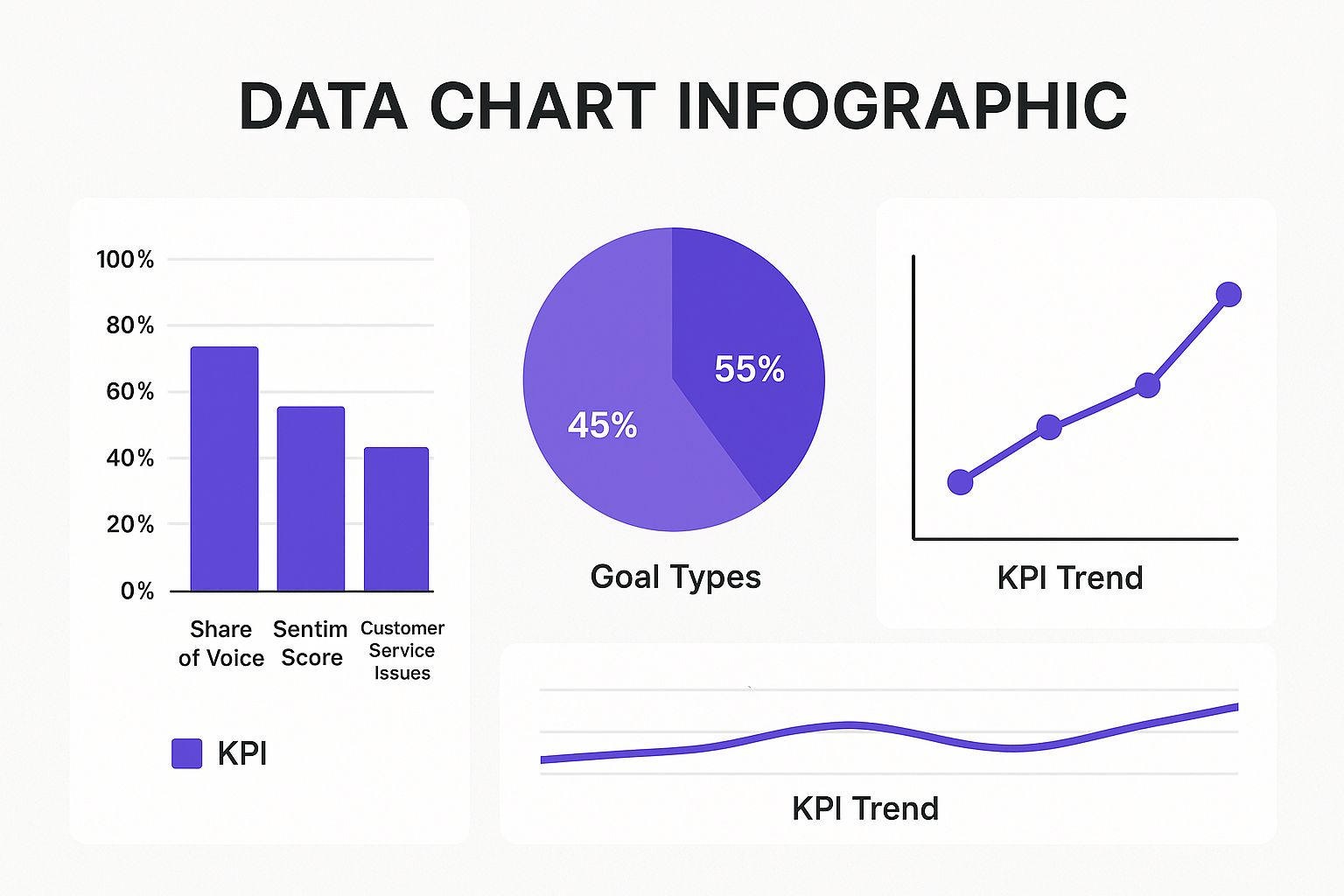
As you can tell, looking at a mix of metrics over time gives you a far more accurate and nuanced view of your performance than just obsessing over one number.
Setting Actionable KPIs
Once your goals are locked in, you need a way to measure your progress. That’s where Key Performance Indicators (KPIs) come in. These are the specific, measurable data points that tell you whether you’re heading in the right direction.
For example, if your goal is to improve brand health, a solid KPI might be to increase your positive sentiment score by 15% within the next three months. It’s specific, measurable, and time-bound.
Think of your KPIs as the bridge between your big-picture strategy and your daily tasks. They make sure everything you do is intentional and pushes you closer to your main objective.
It's absolutely vital to look past the vanity metrics. A great starting point is learning how to measure social media success beyond likes. Focusing on data that shows real business impact is what separates a truly effective monitoring strategy from one that just looks busy.
How to Choose the Right Monitoring Tools
https://www.youtube.com/embed/7EJZ2Wa030k
With what feels like a million social media monitoring tools out there, picking the right one can feel daunting. I've been there. The secret is to ignore the flashy bells and whistles and focus entirely on the business goals you’ve already set.
What really matters? Your company’s size, your budget, and what you actually need to know. A solo entrepreneur’s needs are a world away from a global corporation's, and the right tool reflects that. The aim is to find something that gives you actionable insights without a massive price tag or a user interface that requires a PhD to navigate.
Comprehensive Suites vs. Specialised Solutions
One of the first forks in the road is deciding between an all-in-one suite and a specialised tool. Comprehensive platforms like Hootsuite or Sprout Social bundle monitoring with publishing, analytics, and sometimes even CRM features. These are fantastic for teams that want a single command centre for all their social media activities.
On the other side of the coin, you have tools built to do one thing exceptionally well: listen. These specialised platforms often dig much deeper, giving you incredibly nuanced data on brand sentiment, share of voice, and sniffing out emerging trends before they hit the mainstream. If your main goal is hardcore market research or keeping a close eye on your competitors, a specialised tool is probably your best bet.
The best tool isn't the one with the most features; it's the one that fits your workflow and delivers the specific data you need to make smarter business decisions.
Core Criteria for Evaluating Tools
As you start comparing your options, there are a few things that should be on every checklist. First up: platform coverage. Does the tool actually monitor the networks where your audience lives? Don’t just think about the big names like Instagram and TikTok; consider if you need to track conversations on forums, blogs, or review sites, too.
Next, you have to look closely at the accuracy of sentiment analysis. This is a big one. For any business, but especially in regions with complex languages like Germany, basic algorithms can easily get tripped up by sarcasm or local idioms. Always ask for a demo and test it with real-world examples relevant to your brand.
Finally, a few other key things to think about:
- Reporting depth: Can you build custom reports that directly track your KPIs, or are you stuck with generic templates?
- Integration capabilities: Does it play nicely with the other software you rely on, like your CRM or a data visualisation tool?
- Scalability: Will the tool grow with you, or will you be forced to switch again in a year when your needs get more complex?
Picking the right tool is a big decision, but it’s an essential step in building a monitoring strategy that actually works. To give you a better sense of how different tools stack up, I've put together this quick comparison.
Comparison of Social Media Monitoring Tool Types
| Feature | Small Business Tool (e.g., Agorapulse) | Mid-Sized Agency Tool (e.g., Brandwatch) | Enterprise Solution (e.g., Sprinklr) |
|---|---|---|---|
| Primary Use Case | All-in-one management: scheduling, inbox, basic monitoring. | Deep listening, trend analysis, competitive intelligence. | Unified customer experience management across all channels. |
| Platform Coverage | Major social networks (e.g., FB, IG, X, LinkedIn). | Extensive: includes forums, blogs, news, and review sites. | Comprehensive: all digital touchpoints, including owned channels. |
| Sentiment Analysis | Generally good for basic positive/negative tracking. | Advanced, with nuanced understanding of context and emotion. | Highly sophisticated, often AI-driven with customisable models. |
| Reporting | Pre-built templates with some customisation options. | Highly customisable dashboards and in-depth reporting. | Fully customisable, integrated with business intelligence tools. |
| Price Point | $$ | $$$ | $$$$ |
| Ideal For | Small teams needing an affordable, easy-to-use solution. | Agencies and marketing teams focused on data-driven insights. | Large organisations managing complex customer interactions at scale. |
Ultimately, the tool you choose depends on your unique situation. A small business gets great value from a straightforward tool like Agorapulse, while a larger company might need the immense power of an enterprise solution from Sprinklr. An agency often finds its sweet spot with a dedicated listening platform like Brandwatch.
The market for these tools is expanding for a reason. In Europe alone, the social media monitoring tools market generated around $1.46 billion in revenue in just one year. This isn't just a marketing trend; it's a fundamental business tool, especially for industries like healthcare that depend on monitoring for compliance and managing their reputation. You can dig into the full research on the European market from cognitivemarketresearch.com to see just how significant this space has become.
For a deeper dive into specific options, be sure to check out our detailed guide on the best social media analytics tools available today.
Setting Up Your Keywords and Dashboards
This is where your strategy gets real. Getting your monitoring system set up correctly is the difference between drowning in noise and finding those golden nuggets of insight. It all starts with choosing keywords that go far beyond just your brand name.
Think of your keywords like a digital net. A wider, smarter net catches more valuable fish. Just tracking "YourBrandName" is a start, but you'll miss countless relevant conversations. The real power comes from the nuance.
Crafting Intelligent Keyword Queries
To really understand what's being said, you need to get inside your audience's head. What exact words would they use when talking about a problem your product solves? How do they talk about your competitors? These questions are your launchpad for a solid keyword list.
A brilliant way to expand your reach is by using Boolean operators. These simple commands—like AND, OR, and NOT—let you create incredibly specific search queries that weed out the irrelevant mentions.
Here are a few practical examples:
- To track competitors:
("Competitor A" OR "Competitor B") AND (review OR complaint) - To find pain points:
("struggling with" OR "problem with") AND ("social media scheduling") - To uncover sales leads:
("looking for a" OR "recommend") AND ("reposting tool")
Using combinations like these, you stop being a passive collector of mentions and become an active hunter of opportunities and intelligence.
A well-crafted keyword query is like a magnet for relevance. It pulls in the conversations that matter most to your business goals—whether that’s customer service, lead generation, or competitive analysis—and pushes away all the distracting chatter.
Building an Actionable Dashboard
Once your keywords start pulling in data, your next job is to organise it. Let's be honest, a cluttered dashboard is just as useless as no data at all. The aim is to create a clean, scannable view that shows you the critical stuff at a glance.
My advice? Don’t try to monitor everything in one massive view. It’s much more effective to create separate dashboards or widgets for each of your main objectives. Imagine a tech startup launching a new app. They could organise their dashboard into a few key areas.
Example Dashboard for a Product Launch:
- Brand Health Widget: This tracks mentions of the new app's name, keeping an eye out for spikes in volume and any shifts in sentiment. It’s your high-level overview.
- Competitor Buzz Widget: This one monitors keywords for their two main rivals, specifically looking for mentions alongside terms like "feature comparison" or "switching from."
- Bug & Issue Tracker Widget: Here, they'd use queries like
("app name" AND (crash OR bug OR "not working"))to instantly flag technical problems for the dev team. - Feature Request Widget: This searches for phrases like
("I wish it had" OR "add feature")to scoop up valuable feedback for the product roadmap.
This segmented approach makes the constant flow of information manageable. It also ensures the right data gets to the right people quickly. Building a great social media analytics dashboard is all about prioritisation; it should tell you what needs your attention now without overwhelming you. By separating your listening efforts by goal, you create a command centre that drives action, not analysis paralysis.
Turning Raw Data into Actionable Insights
Collecting a stream of data is just the first step. The real magic happens when you start making sense of it all. Raw metrics are just noise until you connect them to your business goals and start asking smart questions. The whole point is to shift from just seeing conversations to truly understanding the "why" behind them.
This is how you turn a simple list of mentions into a roadmap for making better decisions. It's how you answer the tough questions, like, "What on earth caused that sudden drop in our brand sentiment last Tuesday?" or "Which type of content genuinely resonated with our audience this quarter, and how do we do more of that?"
From Metrics to Meaning
The first thing to do is put your data into context. A sudden 10% spike in mentions sounds great on paper, but if they're all coming from one irrelevant blog, it’s not really a win. You have to dig into the details.
I always recommend starting with these key areas:
- Sentiment Analysis: Don't just settle for a simple positive/negative/neutral breakdown. Look for patterns. Is that wave of negative feedback consistently tied to a specific product feature? Or maybe it’s cropping up at a particular point in the customer journey? This is often the first smoke signal of a bigger fire.
- Emerging Topics: What are people really talking about when they mention you or your industry? A decent monitoring tool will flag recurring keywords and themes. Spotting these helps you create content people actually want to read and can even give your product team some brilliant ideas.
- Share of Voice (SoV): This is my go-to metric for seeing how we stack up against the competition. Your SoV (your brand's mentions versus your competitors') shows you how much of the online conversation you actually own. When you track this over time, you can see the real impact of your marketing campaigns.
Ultimately, this whole process is about transforming raw numbers into clear, actionable insights. It’s what provides a clear path for measuring marketing campaign effectiveness and pushing your business forward. This is where your strategy truly comes alive.
Creating Reports That Actually Get Read
An insight is completely useless if it just sits in a dashboard collecting digital dust. The final, and arguably most important, step is to package your findings into a report that’s clear, concise, and valuable to other teams. Your sales, product, and marketing departments can all benefit from what you’ve learned. I’ve found that a simple monthly report that tells a story with the data is most effective.
Don’t just throw charts at people. Explain what the data actually means for the business. A report that says "Negative sentiment increased by 5%" is just noise. But one that says "Negative sentiment rose by 5%, driven by complaints about our new checkout process" is an insight someone can act on.
This also means keeping legal and privacy standards top of mind. For instance, Germany is known for issuing some of the highest GDPR-related fines in Europe for the misuse of personal data in social media monitoring. This strict enforcement means companies operating there have to be incredibly careful, which in turn shapes the technology they use and how they analyse data. You can find some interesting statistics on social media activities and compliance in Germany from statista.com.
By framing your findings as strategic recommendations, you make sure your social media monitoring efforts do more than just generate reports—they lead to smarter, data-backed decisions across the entire organisation.
Common Questions About Social Media Monitoring

As you start diving into social media monitoring, you're bound to have some questions. That’s perfectly normal. Getting these sorted out early will make your whole strategy feel more solid and give you the confidence to really own it.
Let's clear up some of the most common questions I hear from teams who are just getting their feet wet. Think of this as a quick FAQ to keep your efforts focused and effective right from the start.
Monitoring vs. Listening: What's the Real Difference?
This is, without a doubt, the question I get asked most often. The distinction is actually quite simple when you break it down: monitoring is reactive, while listening is proactive. They’re two sides of the same coin, but they serve very different purposes.
Monitoring is the hands-on, day-to-day work of catching individual mentions of your brand. You're tracking conversations as they happen and responding directly. A customer complaining about a late delivery on X? That’s a monitoring task. Your job is to spot it and route it to the support team, fast.
Social listening, on the other hand, zooms out. It’s about taking all that data you've gathered from monitoring and analysing it for the bigger picture. Listening helps you understand the why behind the what. It uncovers broad trends in customer sentiment, reveals what people really think about your new product, and gives you the strategic insights needed to guide your entire business, not just your next social media post.
How Often Should I Check My Dashboard?
There’s no one-size-fits-all answer here. The right frequency depends entirely on what you’re trying to accomplish. Your goals should dictate your dashboard habits.
- For crisis management or customer support: You need real-time alerts. When a potential issue is brewing, every minute counts. Your setup should notify you instantly for keywords related to service outages, major complaints, or negative PR.
- For brand health and campaign tracking: A daily check-in is a great rhythm to get into. It’s enough to stay on top of general sentiment and performance without getting bogged down in every minor fluctuation.
- For deep strategic analysis: A weekly or bi-weekly deep dive usually does the trick. This gives you enough data to spot meaningful patterns and report on progress without overreacting to daily noise.
Can I Monitor Social Media Without Expensive Tools?
Technically, yes, but you'll be making a lot more work for yourself. You could try to cobble something together using free tools like Google Alerts for web mentions and the native search functions on platforms like X.
The problem is that this approach is incredibly fragmented and manual. You'll miss a ton, and you won’t get any of the powerful features that dedicated tools offer, like automated sentiment analysis, consolidated reporting, or competitive benchmarking.
For any business that's serious about growth, investing in a proper monitoring tool is non-negotiable. The time you’ll save and the depth of insight you’ll gain almost always outweigh the cost. It lets you shift your focus from simply collecting data to actually acting on it.
Ready to stop guessing and start knowing what your audience is saying? Repostly provides the unified analytics and monitoring tools you need to turn social conversations into business growth. Save time, increase your reach, and build a stronger brand by visiting https://repostly.app to see how it works.
Keep reading

10 Fresh Instagram Story Idea Tactics for 2025
Stuck for content? Discover our top Instagram story idea list, with actionable tips to boost engagement and grow your audience in 2025.

A Practical Social Media Planner for German Markets
Build a results-driven social media planner for Germany. This guide offers actionable strategies for content, scheduling, and analysis in the German market.

Crafting Your Social Media Content Plan
Stop guessing and start strategizing. This guide provides an actionable social media content plan to audit, plan, and execute content that gets results.
Post once. Show up everywhere.
Start your 7-day free trial and publish your next video to every platform in minutes.Pick a plan and publish your next video to every platform in minutes.
Start your free trialSee plansCancel anytime